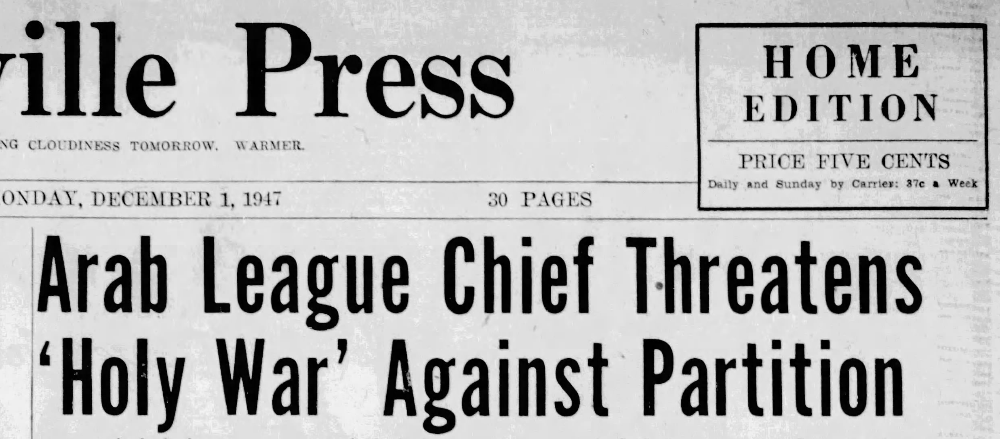
(Also Chronology A.) This is the foundation of all issues. Was Palestine an Arab-Muslim nation that was forced to surrender part of its domain? The evidence says, no.
Sections:
The name, History, How the Arabs viewed it,
Who was first?, Jewish conquest of Canaan,
What the Koran says, Summary.
The name
In 63 BCE, the Romans conquered the independent Jewish state of Judea. Over the next 200 years, millions of Jews died at their hands by war, mass slaughter or persecution. Many others were sold into slavery or exiled. At the end, nearly every village was razed, Jerusalem was destroyed and the Second Temple was burned. To complete their mission to erase Judaism, the Romans changed the name of Judea to Syria Palaestina, which evolved into “Palestine” (and “Filastin” in Arabic).

The Panarion of Epiphanius of Salamis Books II and III (Sects 47-80 De Fide),
page 133 – approx. 350 CE. Full page, Archive.org (needs login).

Book cover for The Land of Israel: A Journal of Travels in Palestine – 1865
by H.B. Tristram. Archive.org.
(The cover was edited to fit the lines into a small image.)

Britain’s Lord Robert Cecil – December 2, 1917.
Great Britain, Palestine and the Jews – 1918, p. 39. Archive.org.
The Romans based the name on the Philistines since they were an enemy of the Jews. An Aegean people (non-Arabs between Greece and Turkey), they invaded in the Late Bronze Age and settled in the coastal area south and north of Gaza, or from the Negev Desert to Tel Aviv. Greek and Latin writers called the area Philistia.
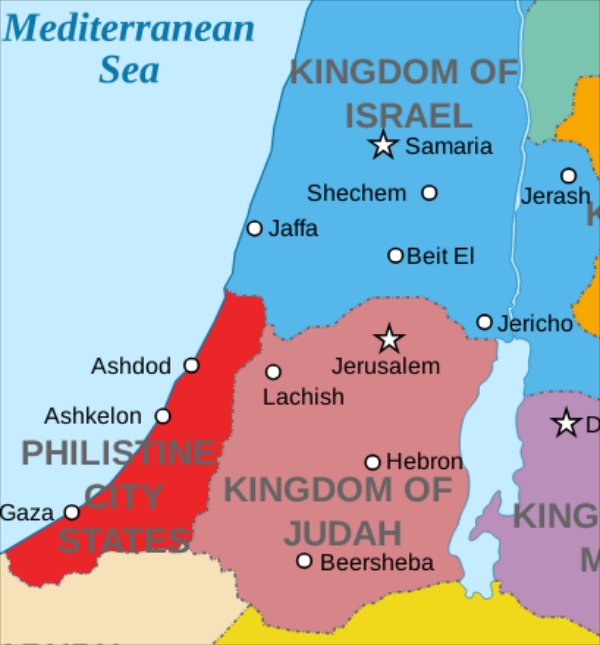
The Jewish Kingdoms and the Philistines circa 830 BCE. Full map and credits.
A name deriving from the Philistines was never applied to the whole region and the Philistines disappeared from the history books centuries before the Romans.
History
From 1258 BCE until after the Romans, all or most of the country was known as Eretz Yisrael (Hebrew), the Kingdom of Israel and Kingdom of Judah, Judea and Samaria, or Zion. The Jews didn’t control all the land in all this time, but they did maintain a sovereign presence (minus 70 years of the Babylonian exile). Before them, it was called Canaan.

Encyclopedia Americana 1922, Vol. 21, page 197 (221 from file). Loc.gov.
That some have said “Palestine” for eras before the Romans is either a mistake or bias. For the time before the Jews, saying Canaan or “ancient Israel” is much more accurate than “ancient Palestine”.
Jesus Christ was born, and lived, in Judea/Israel. He was a religious Jew.
The Jewish connection
For the longest time, the Jewish history of the land was primary and the Arabs acknowledged it on many occasions. Here is one from 1922-

Minutes from a meeting between Jewish and Arab leaders, quoted in
UN Special Committee on Palestine – 1947, A_364 Add-2, p. 196. UN.org.
Most prominent were the areas named Judea and Samaria (much of what some call the West Bank), despite Christians during the Crusades who also acted to sever the Jewish attachment to the land.

The UN Partition Plan / Resolution 181 (III)- 1947, p. 143 (13 of file). UN.org.
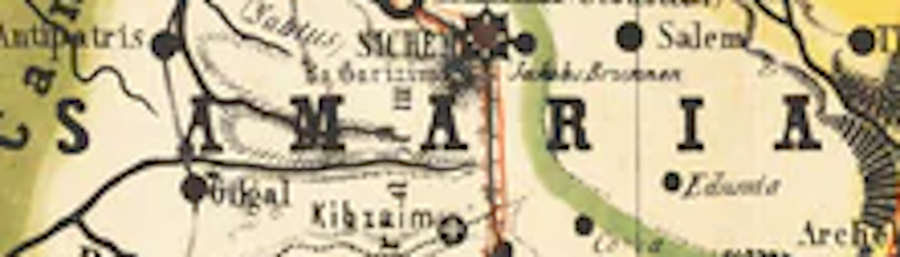
F. von Rappard’s map (from New World Cartographic) – 1869. Full map.
Similar:
Palestina Antiqua map – 1845. iStock.
S. Augustus Mitchell’s map (from Map and Arts) – 1867. Full map.

The Examiner (London) – Feb. 1, 1868. Full page.

The Guardian (UK) – Feb. 22, 1937. Full page.
Similar:
The Morning Post (London) – May 19, 1851. Clip, full page.
The Brooklyn Daily Eagle (USA) – Feb. 19, 1859. Clip, full page.
The Liverpool Mercury (UK) – Sep. 19, 1865. Clip, full page.
The Times (London) – April 7, 1870. Clip, full page.
Baltimore Sun (USA) – Nov. 3, 1891. Clip, full page.
Washington Evening Star – Oct. 28, 1925. Clip, full page.
Newsweek magazine (USA) – July 19, 1937. Clip, full page.
The Jordan River derives from the Torah that calls it Yarden. Lebanon is from Levanun. Arabs used to call Jerusalem and then the Temple Mount Bayt al-Maqdis, from the Hebrew Beit HaMikdash (House of Holiness); see it on the map below with Filastin. Villages everywhere had names with Jewish roots.

Biblical Researches in Palestine by Robinson and Smith- 1838, p. 16. Archive.
Concerning an area around Beit Nettif, 20km southwest of Jerusalem.
More: Page 34, 38…and many others.
In 1714, an esteemed scholar and cartographer named Adriaan Reland (also Hedriani Relandi) published Palaestina ex monumentis veteribus illustrata that was an expansive account of Palestine. He listed hundreds of settlements and places with names that had Hebrew origins. An English translation of the Latin book has not been found so read this article about it.

Mr. Reland knew Arabic and Hebrew (and Greek…). Archive.org.
Click for our response to the arguments about his book.
Foes try to dismiss Palaestina because Mr. Reland did not visit the region. True, but he held extensive communications with those who did, like agents, merchants and pilgrims.
On its website, Brill- the leading international academic publisher- quotes Jean Le Clerc, a major theologian, biblical scholar, and journalist at the time: “According to Le Clerc, ‘nobody before made such an effort in this subject matter as Mr. Reland’, who examined the whole body of ‘Hebrew, Arabic, Greek, Latin sources’, along with records from ancient and modern travellers’ in order to provide ‘numerous clarifications’ of locations and places of previously unclear provenance.”
We don’t argue that every point in the book is 100% accurate. Some origins of town names are debatable, but there’s no doubt that at least the vast majority were based on Judaism.
Concerning the population, Mr. Reland wrote that most were Jews, followed by Christians and a minimal Muslim presence, primarily Bedouins. Other people say Muslims were the majority at this time with 150,000. How to understand the discrepancy? Perhaps many lived in a broader definition of Palestine, as some included Trans-Jordan. Or perhaps there were more Bedouins that Reland did not learn of because it was dangerous for outsiders, even other Arabs, to travel south where most Bedouins camped.
This is a distraction. Even accepting the perspective that Muslims numbered 150,000 does not change the fact that Judaism and the land were intertwined and that the small number of Muslims- who were not even the rulers or a nation- did not mean they had a right to sovereignty over all the land. (More on Page #2.)
More:
Tour guide blog, JNS, IsraelToday.
For those who know German, there is an old book.
After the Roman conquest came the Byzantine Empire, the Crusades, Arab-Muslims from various caliphates outside Palestine, the Egyptian Mamluks (non-Arab, mostly Muslim, 1250-1517), the Ottoman Empire (non-Arab Muslim Turks, 1516-1918), and Britain after the Allied victory in World War I.

The League of Nations and Britain’s Mandate for Palestine and Trans-Jordan – 1922.
From the preamble. Full pdf.
Muslim conquest
Islam and the precursor of the modern Arabic language originated in the area that is today Western Saudi Arabia and entered Syria-Palestine with the conquest that ended in 640 CE. (It was colonialism- more on Page #2.)
Empires and caliphates covered much of the Middle East. They had major divisions and Palestine was never one of them. Muslims from the region of Palestine were never the rulers of an empire. (They naturally held positions in the local affairs of an empire’s administration.) No city, not even Jerusalem, was ever the capital of one. The small, unofficial borders shifted slightly over the centuries.
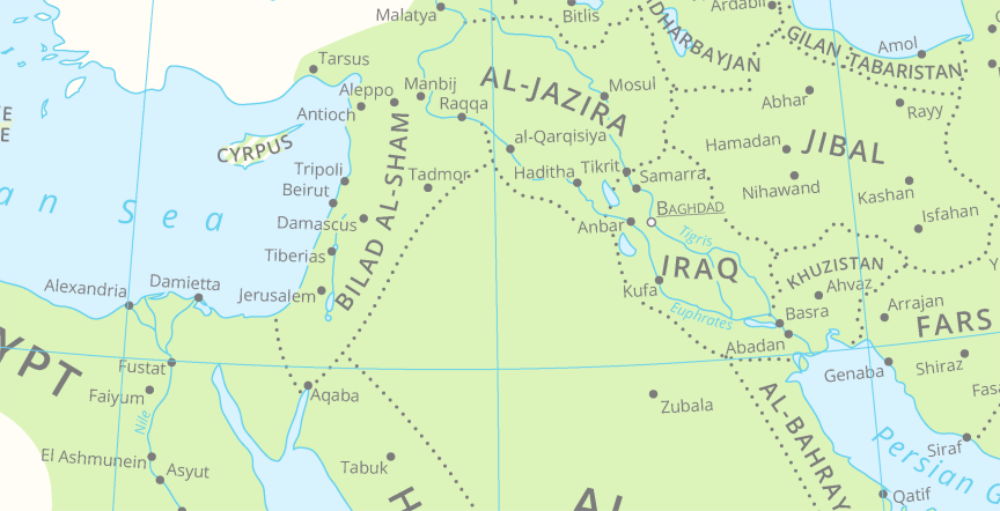
The major divisions of the 9th-century Abbassid Caliphate.
By Cattette. Full map and credits.
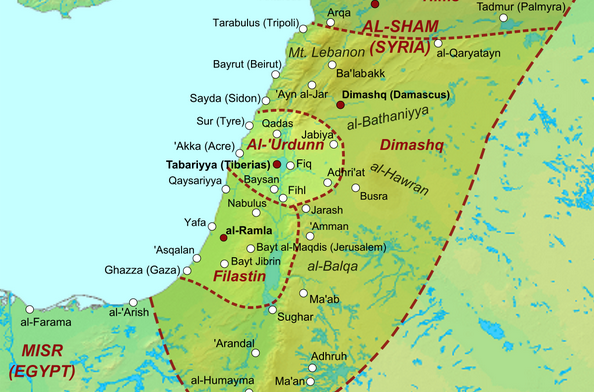
A closer look at the Abbassid Caliphate shows Palestine/Filastin as a province of Syria and encompassing about a third of its post-World War I shape.
By Constantine Plakidas. Full map and credits.
- From 1099-1291, Western Christians of the Crusades had much more than the local Muslims ever did- the Kingdom of Jerusalem, a polity that covered most of Palestine’s post-World War I incarnation.
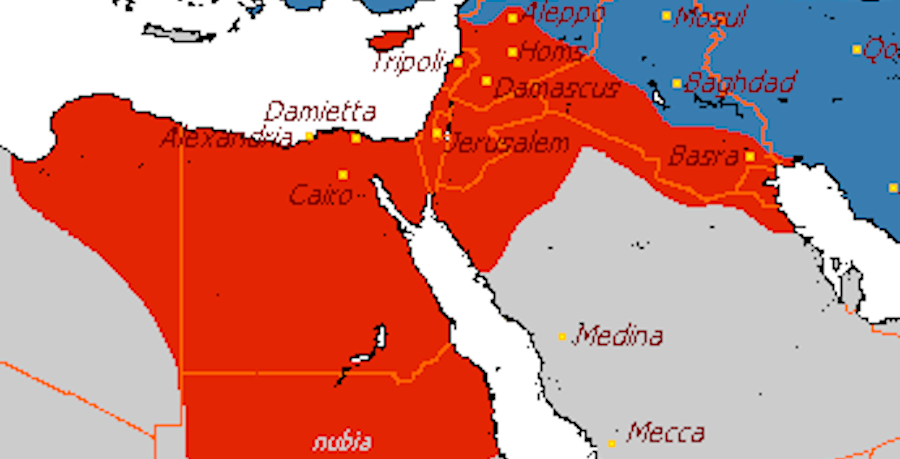
1250-1382 Bahri Dynasty (modern borders in yellow).
By Arab League at English Wikipedia. Full map and credits.
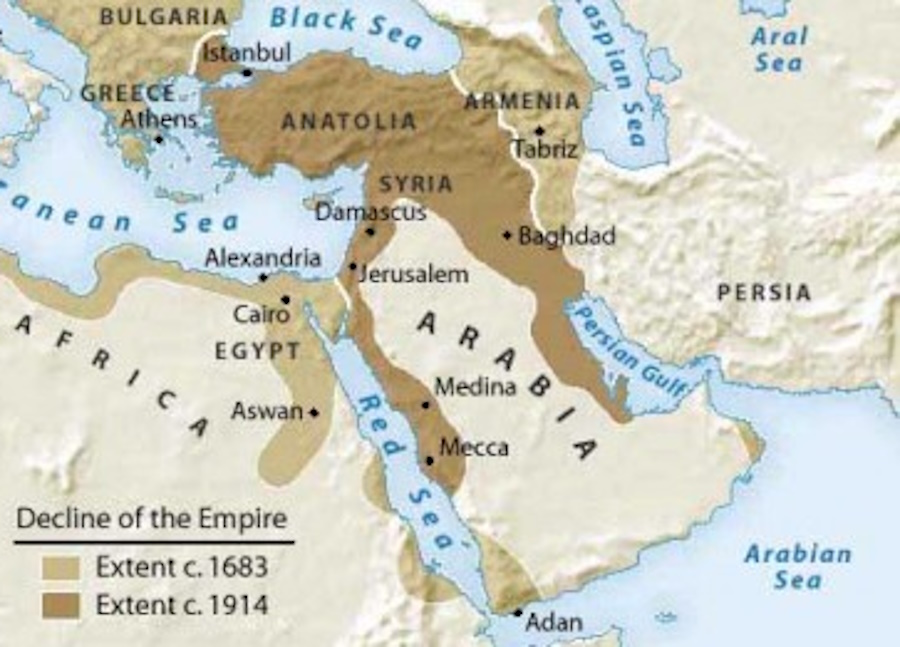
Ottoman Empire in 1683 and 1914.
Library, University of Illinois Urbana-Champaign. Full map.
The Ottomans had eyalets (provinces) that were divided into sanjaks (administrative zones) and Palestine was not a name of any one. They used the name in other cases and it referred to the Sanjak of Jerusalem.
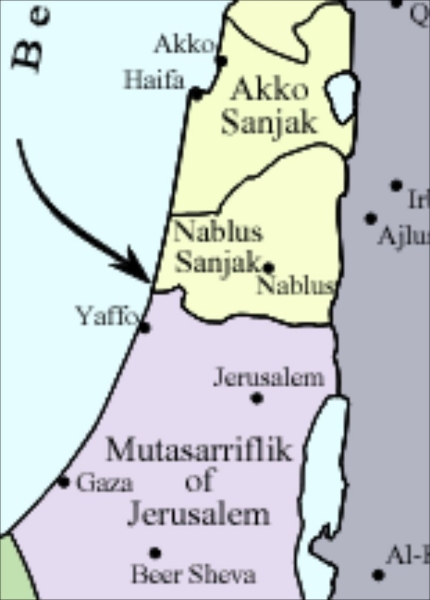
In 1867, the Jerusalem Sanjak was separated from the province of Syria and reported directly to Turkey. The move was not about autonomy for the locals, but security, politics due to a growing European presence, and other factors.
In the city of Jerusalem at this time, Jews were the plurality of the population. To the Arab-Muslims, the small shape of Palestine had barely changed since 640.
Only in 1915, after Britain declared war, did the Ottomans count the two sanjaks to the north as part of the Palestine region.

Syria and Palestine: Great Britain Foreign Office Historical Section – 1920, p. 2. Archive.
The Palestine that most people think of- “from the river to the sea”- was formed between 1915 and 1922, after the creations of Lebanon, Syria and Trans-Jordan.
While some Westerners of old used the term Palestine for a larger area, Arabs and Muslims who say this are engaging in historical revisionism.
How the Arabs viewed it
Syria, Lebanon and Eastern Palestine (aka Trans-Jordan) each had a new meaning after WWI. There were no official borders before the war and the people identified with their clan, tribe, village or major city like Damascus or Beirut. (Page #2.)
Shortly before and after the Allied victory in WWI, most people in this region wished for a Greater Syria to be in federation with the rest of the Arab world.
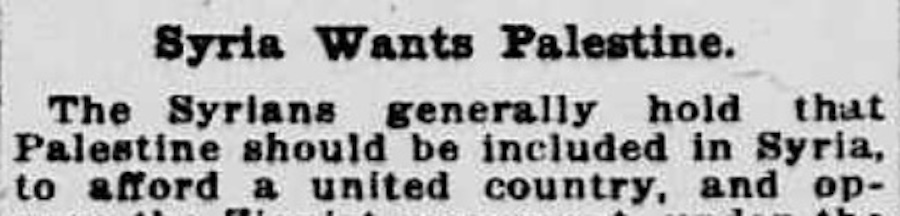
Associated Press (in Washington Evening Star) – August 30, 1919. Full page.

Archbishop Antonios Bashear in Toronto Star – November 6, 1939. Full page.

M. Chekri Gamen, Syrian Commission at the Paris Peace Conference of 1919.
In “My Diary at the Conference of Paris” by David Hunter Miller, 1924, p.414. Link.
Also see p. 405 for more on the Syria-Arabia divide.
Even years later…
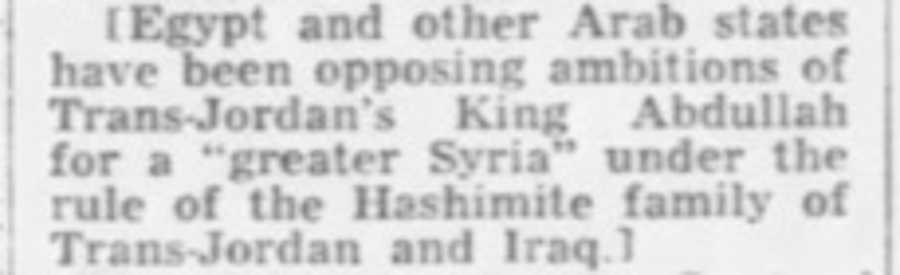
Associated Press (in Buffalo Evening News) – June 17, 1949. Full page.
Similar:
Associated Press (in The Toronto Star) – September 12, 1922. Clip, full page.
“Syria and Lebanon: A Political Essay” by A.H. Hourani, 1931, p. 2. Archive.org.
New York Times – June 1, 1956. Link.
More:
Article from a former US Proseuctor and UCLA Professor.
The other camp, headed by the recently created Kingdom of the Hejaz (Western Saudi Arabia), viewed the Arab Middle East one giant state, or pan-Arabia.
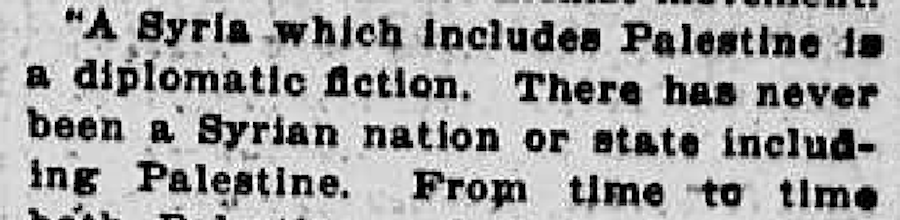
Washington Evening Star – August 17, 1919. Full page.

Washington Evening Star – July4, 1922. Full page.

Arab Covenant by the Arab Congress – December 13, 1931 in
Survey Of International Affairs 1934 by Arnold J. Toynbee, p. 107. Archive.
A smaller number of Arabs saw Palestine as being part of Trans-Jordan. Before WWI, a few petitioned Egypt to align with Syria as a way to break Ottoman rule. Nobody was talking about creating a new Arab entity called Palestine.
Both visions (aside from being unjust) are further proof that Palestine was not an independent or sovereign state or anything along the lines of Egypt. The territory had a unique history.

Britain’s Royal Commission Report (aka Peel) – 1937, page 40. Archive.org.
(Many had not lived there for centuries.)

Britain’s Lord Milner speaking in the House of Lords, 1923.
Ibid., p. 41. Full page, Archive.org.

Middle East Diary 1917-1956 by Colonel R. Meinertzhagen, p. 162. Full page, Archive.org (needs login). He was British and pro-Zionism.
Who was first, Arabs or Jews?
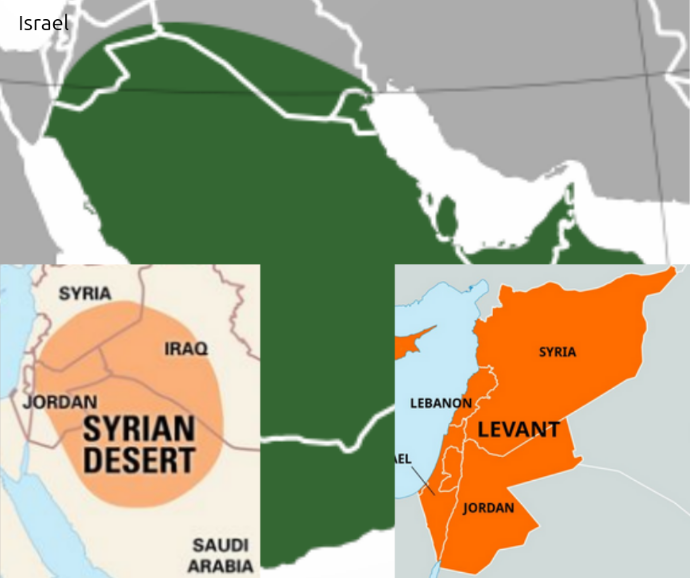
Map of the Arabian Peninsula, aka Arabia, by M.Bitton – Own work, CC BY-SA 3.0. (“Israel” added for clarity.) Full map.
Syrian Desert insert and Levant insert from Britannica.
The Jewish nation entered Canaan about 1,900 years before the birth of Islam. Between Arabs and Muslims, the latter is the key because, while some opposition to Zionism in the early years came from Arab Christians or was non-religious, the conflict was, and still is, mostly based on an extremist Islamic belief.
For those who wish to go further into this silly question…
The Jewish entry into Canaan was in 1273 BCE and the first record of an Arab tribe in the Levant (not necessarily the part that became Israel) is from the Assyrians in 853 BCE, or 420 years after the Jews. The Jews first had sovereignty at about this time.
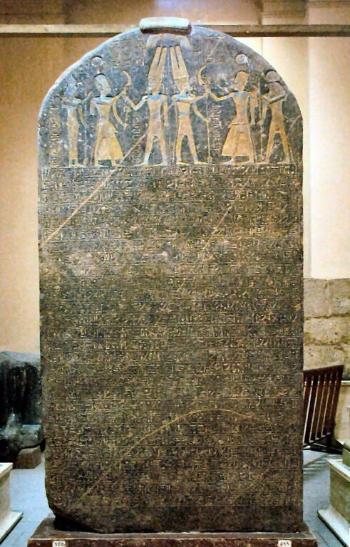
The Egyptian Merneptah Stele from 1205 BCE was the first extra-Biblical reference to the nation of Israel.
The only Arab tribe before then, the Bedouins, were from the Arabian Peninsula and Syrian Desert. The region with Lebanon, Syria, Israel/Palestine, much of Jordan and other areas is the Levant and only during the Ottoman Empire was it considered an extension of Arabia. Even if the Bedouins traveled into what became Israel, they were nomads so it would be foolish to argue that on this potential, miniscule, impermanent basis the modern Palestinians- many of whom don’t even descend from Bedouins- have a right to sovereignty over the land. (More about the population on the next page.)
The first Arabic group to have political power in part of Judea was the Nabataeans in the 4th century BCE. With a capital in Petra, their kingdom stretched over most of today’s Jordan, parts of Saudi Arabia and Syria, and at one point the southern half of Israel. They were vanquished by the Romans in 106 CE and, through that war and assimilation, their identity dissolved.
Later, the Ghassanid Arabs (or Jafnids) were a kingdom of tribes who originated in South Arabia and migrated to the Levant. They became a client state of the Byzantine Empire (aka Eastern Roman Empire) and converted to Christianity. Their territory encompassed a fraction of Northern Israel, along with all of Jordan, about a third of Syria and more. They lasted from the 3rd century until the Muslim conquest of 636 CE.
By the 4th century, many Arab tribes in the Levant were Christian.
The ancient peoples in the region- Canaanites, Phoenicians, Edomites, Amorites, Arameans, etc.- were not Arab. They were Semitic, which today refers to a linguistic family and more broadly to the nations who descended from the Biblical Noah’s son, Shem. Arabs and Jews are Semitic. The Sumerians, Hittites and Philistines were not Semitic. Jews descend from the patriarch Isaac, son of Abraham and Sarah, and Arabs descend from Ishmael, Abraham’s son with the Egyptian maidservant Hagar. (Islam rewrote Jewish history by switching the roles of the half-brothers.)
The Jewish conquest of Canaan
For the traditional Jewish perspective, here are two articles that explain it well: Aish (brief and practical) and Chabad (deeper).
The highlights: 1) The Canaanite nations were given chances to make peace with the Jews or to migrate, as God preferred to see them live. 2) They were shockingly immoral. 3) The Jews failed God’s directive because annihilation was not in their nature.
For those who dismiss any talk of God when it comes to the conflict, it’s important to note that Islam believes in the same God as Judaism and that the conflict is about the Muslim radicals violently opposing Jewish autonomy on even an inch of land.
What the Koran says about Israel
There are different opinions amongst respected scholars. For the Koran supporting the Jewish right to the Holy Land, there are two articles: Muhammad Al-Hussaini and Dr. Tim Orr. For the opposing view, there’s Robert Spencer, who also highlights the antisemitism in the Koran.
Either way, it’s worth noting that the Koran does not use the term “Palestine”- and it was written about 500 years after the Romans defeated the last Jewish rebellion and renamed the land.
Summary
If one believes the false narrative that Palestine was an Arab-Muslim nation and/or independent entity, then it’s easy to develop an anti-Zionist perspective. After World War I, Britain and the League of Nations had the true understanding of the territory and it’s a vital reason why they supported a renewal of the Jewish homeland.
Next: Page #2: The Arab-Muslims in Old Palestine: Settlers, immigrants, tribes, growth due to Zionism and not Palestinians. (It doubles as Chronology B.)
Or Home for the top issues.