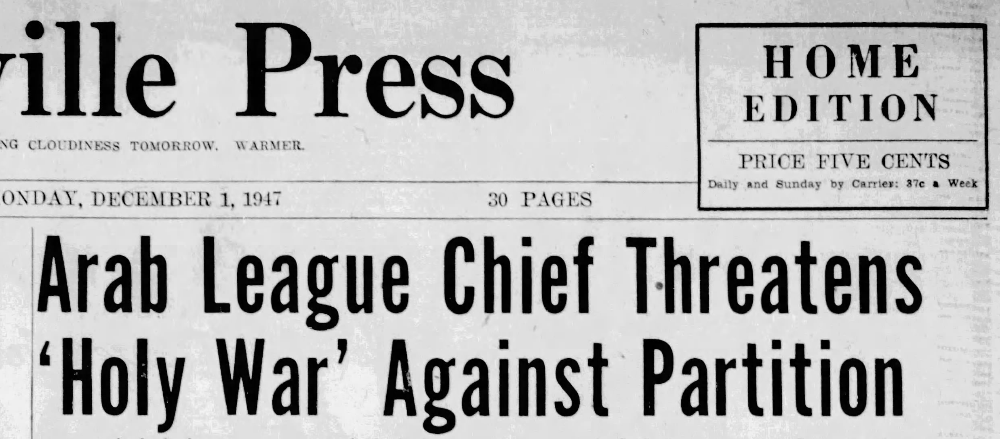
The heart of the conflict has been exactly the same since the developments in this handful of years.
Click for an overview of the previous pages.
After the Roman conquest, the Jewish state of Judea became known as Palestine; Palestine was never a state or independent to Muslims since their conquest in the 7th century; the small number of inhabitants were not a nation and most primarily identified with their clan, tribe or village; Jews always lived there and others returned over the centuries; the Zionist movement began after centuries of persecution and the Jews simply wanted to return home for security and freedom; for 400 years the territory was controlled by the Turks; there was plenty of room as it was largely barren and malaria-filled; European and Christian influences prevented the Jews from having a fair chance; there was minor violence; the few Jewish settlements attracted Arabs seeking better conditions and work opportunities.
Sections:
Jews played a large role in the Arabs’ liberation,
Sykes-Picot Agreement, The McMahon Pledge, Balfour Declaration,
Many Arabs supported Zionism, Detractors, Zionist hopes,
Problems start, Lies and fearmongering- A, Protocols of the Elders of Zion,
The carving and Mandates, Violence and religion,
What the Muslims actually claimed, Lies and fearmongering- B,
The bigger picture.
Jews played a large role in the Arabs’ liberation
In the Great War, Britain and Sharif Hussein of Mecca forged a deal where the Arabs would get independence- with the exception of Palestine and with the Lebanon set for Christians- in exchange for their help in defeating their despised Turkish rulers. Arabs from the Hejaz (today’s Western Saudi Arabia) were the first to throw off the Ottoman yoke.
While Jews in Germany naturally fought on that side and a few in Palestine had to fight for the Turks, about 900,000 risked their lives for the Allies, including many in Palestine and from around the world who wished to end Ottoman control of the Promised Land.

New York Times – May 19, 1919, page 32. Full page.

Washington Evening Star – July 12, 1919, p.8. Full page.
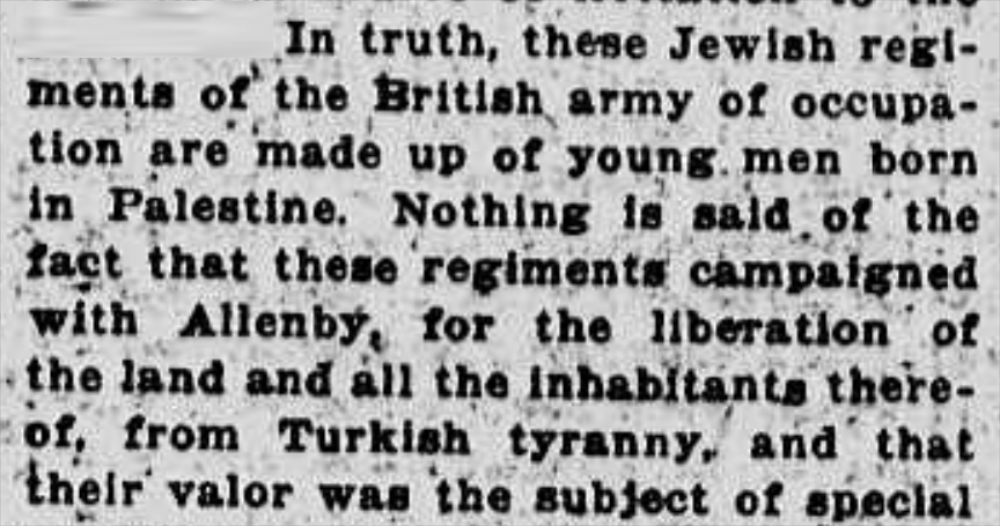
A Jewish response in Washington Evening Star – August 17, 1919. Full page.
More:
Jewish spies for the British were tortured by the Turks.
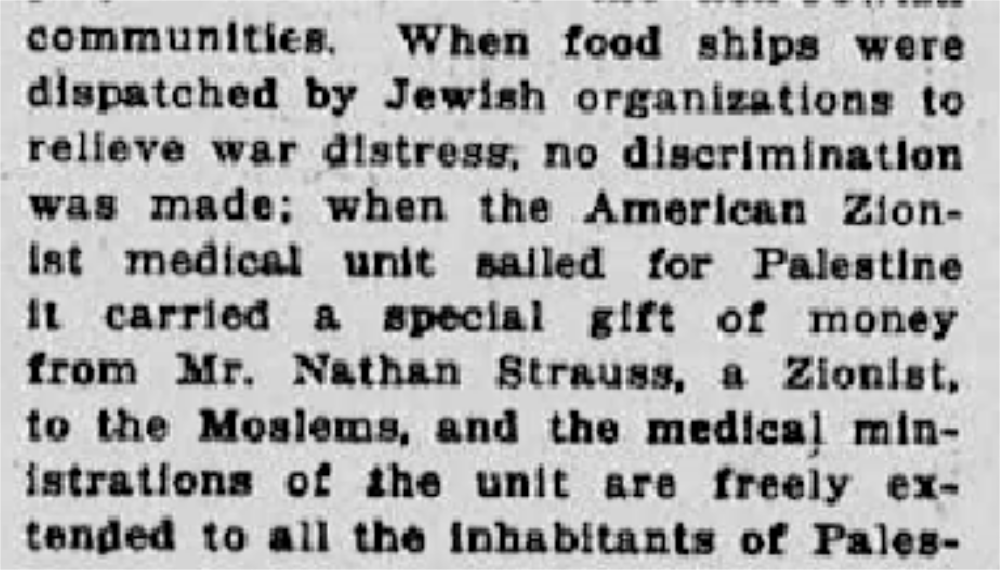
Ibid.
Bedouins in Palestine initially fought against the UK and then switched sides. Other Arabs there were sensitive about the Turks and did not actively serve.
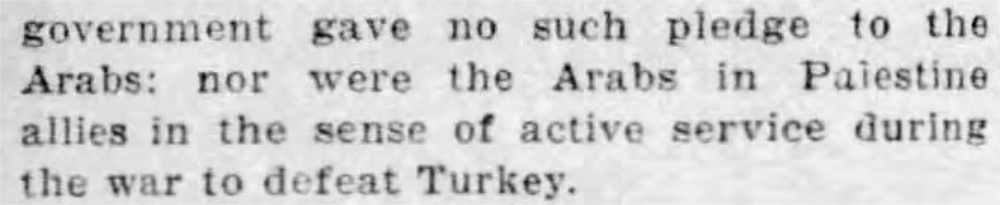
The Ottawa Citizen (Canada) – July 25, 1922. Full page.
World Jewry also contributed much financially and it was the bio-chemist Chaim Weizmann who invented a new method to produce acetone, a vital ingredient in explosives and munitions, that ensured Allied victory.

Article from The-Microbiologist.com.
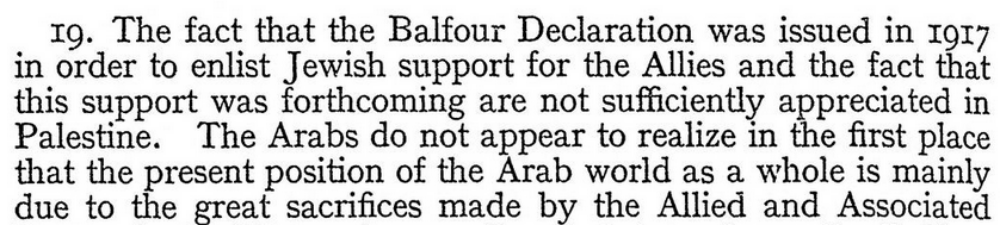
Britain’s Royal Commission Report (aka Peel) – 1937, p. 24. Archive.org.
This British POV was paraphrased in-
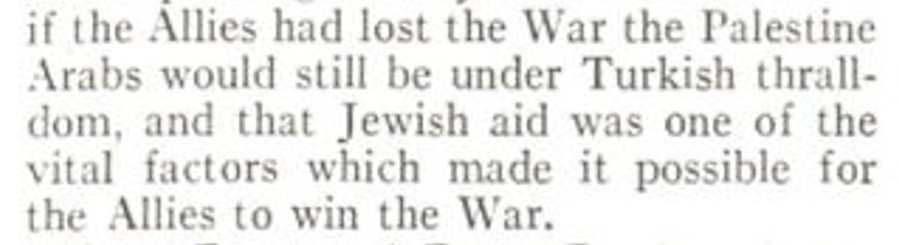
Time magazine – July 19, 1937. Full page.
Rebuttal: The Declaration had a few reasons behind it and the critics twist this one- without credible evidence- into a portrayal of Britain believing that American Jews controlled President Woodrow Wilson. The US entered WWI in April 1917- six months prior to Balfour.
Sykes-Picot Agreement
The Arabs had different visions for what their independence would look like. Most of the inhabitants of the Levant wanted a Greater Syria to be in federation with the rest of the Arab world, and others, namely the recently installed King Hussein of the Hejaz, wanted a pan-Arabia, or one giant state.
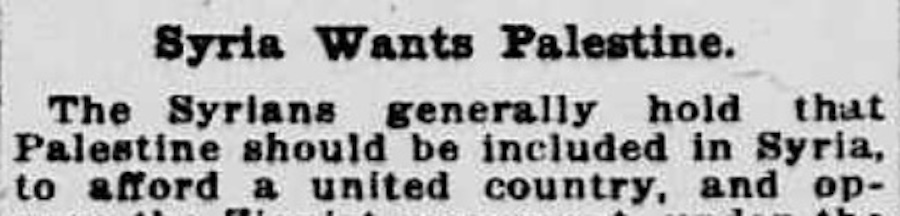
Associated Press (in Washington Evening Star) – August 30, 1919. Full page.
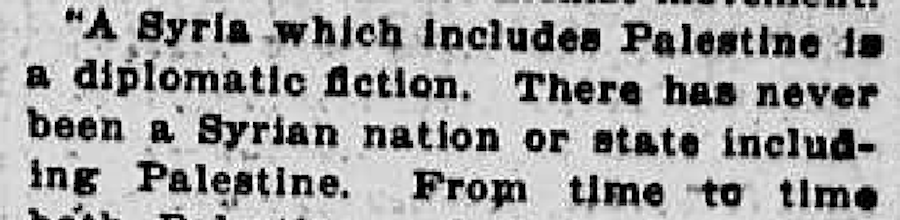
Prince Faisal in Washington Evening Star – August 17, 1919. Full page.
More on Page #1.
Neither came to fruition because of Britain and France, who don’t get enough blame for much of the mess in the Middle East that has nothing to do with Israel. In 1916, the two nations- with approval from Russia and Italy- held secret meetings and decided that, at the war’s end, the Middle Eastern lands of the Ottoman Empire would be divided into zones of influence in order to control strategic interests and resources. It was named after two diplomats and it was leaked in November 1917.
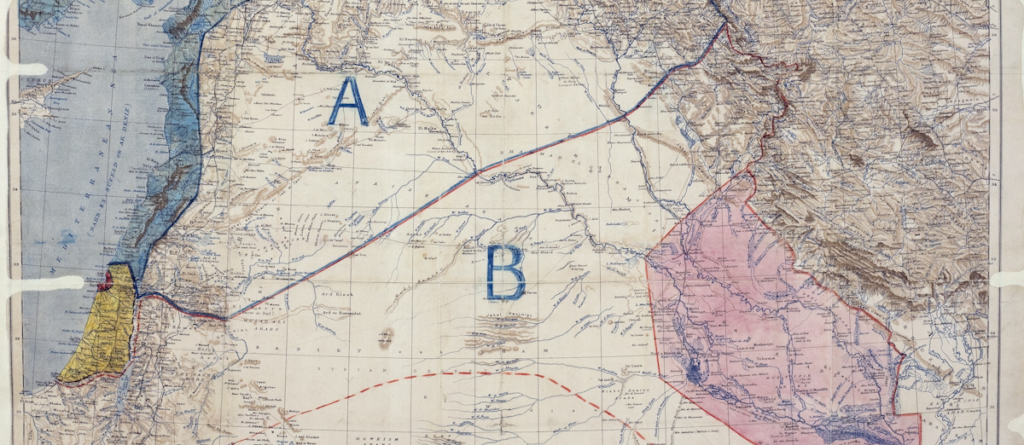
The Sykes–Picot Agreement map – 1916. Full.
What if?
The deeper issue that does not get enough attention is that the Arab visions were unjust as they excluded independence for historical nations who deserved it, like the Kurds, Yazidis, Assyrians and the Jews.
The ideal would have been to negotiate an agreement with all affected parties. The next-best scenario would have been for the world powers to create states for all these peoples and enforce their security against the Arabs who would’ve protested. (And drawn other borders along realistic lines.) At the very least, they could have created autonomous provinces for these groups and warned the Arabs that if harm befell them, they would be upgraded to states and armed beyond the Arabs’ abilities.
As for the Jews specifically…
It’s not certain what would have happened with them had the British and French adopted one of the unreasonable Arab views. Many leaders were open to the Jews having some form of autonomy in all or some of Palestine, yet there were also extremists who objected to even minimal proposals.
What is certain is that the vast majority of Middle East violence has been unrelated to the Jews/Israel. The different clans, sects and factions of Muslims, Arabs, Kurds and many others have been fighting each other or killing minorities since long before WWI and it worsened with liberation.

New York Times – March 14, 1919. Full page.
Palestine would have been no different. Before Zionism, there was a culture of vengeance and tribal warfare (Page #3). Later, the clash between the Husseinis and Nashashibis, and the matter of the Mufti wanting to lead a new caliphate (Chronology E.)
Beyond, there was the major divide between Syria and Arabia (P. #1). Islamic imperialism never ended (P. #2). The fundamentalist Wahhabism movement dates back to the late 1700s. The Muslim Brotherhood began in 1928 in Egypt. Notice how a revised Greater Syria (below) never materialized. Pretty much the most Arab unity in the Middle East has been in opposition to Israel. To imagine that Palestine and the Arab world would have been at peace if not for Israel is childish.
More: List of Middle Eastern conflicts on Wikipedia.
(They’re unreliable for Israel matters, but this page is fine.)
Similarly, if Israel were to fall…(click)
1) Hamas, Hezbollah and all the other jihadists around the world would be emboldened. Israel is only their first or juiciest target. Next are the West (just ask Canada, France and Belgium) and the rest of the globe.
2) Hamas and Hezbollah/Iran would be in conflict because Hamas is Sunni and Iran is Shia, and that fight is old and bloody. Iran only supports Hamas because of the shared objective to destroy Israel.
3) Any radical group like Hamas would purge the land of opponents.
4) As in the rest of the Middle East, and as in Bethlehem when the Palestinian Authority took it over from Israel, Christians would mostly disappear due to harassment or worse.
5) Like the above, other minorities, infidels, and LGBTQ would be exiled, persecuted or killed.
6) Archeological evidence of Judaism’s history in the land would be destroyed, as has already been happening in some areas.
7) The neighbouring states of Syria, Lebanon, Jordan and Egypt would not tolerate the country being ruled by a jihadist regime (which is exactly what Israel has been trying to avoid in the West Bank). Jordan would be especially vulnerable because the extremists have a long history of wanting to topple the Kingdom.
8) The larger powers of Iran, Turkey and Saudi Arabia would intervene to either become the rulers or support their preferred leaders.
9) America, Europe, Russia and China would compete for influence or containment of the chaos.
More: American Ambassador Gordon Sondland explains how US support of Israel is a bargain when considering the returns.
The McMahon Pledge
The deal between the UK and Hussein was called the McMahon Pledge, and Muslims to this day cite it even though the English couldn’t have been clearer in excluding Palestine.

British MP Winston Churchill – July 11, 1922. UK Parliament.
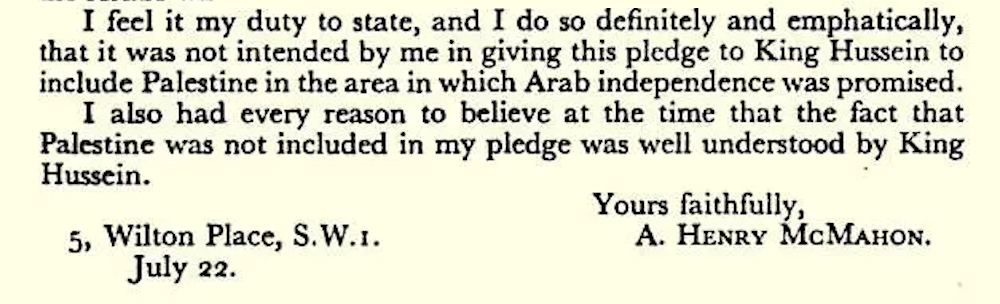
A. Henry McMahon refutes a promise for Palestine – July 22, 1937. Full letter.
Also: US Dep’t. of State – Office of the Historian. Find in page “himself”.
Similarly, in a letter from November 14, 1917 to the British War Cabinet Secretary, Sir Mark Sykes expressed no confusion between Arabian independence and Zionism.

Rise of Israel: The Zionism Commission 1918 – 1987, p. 106. Full, Archive.
(The book is a collection of original documents.)
He went on to illuminate why Zionism could push the Turks to peace. It’s not like the British were simply being kind to the Jews.
Refutation: The Pledge was also not a legal document like the Mandate.
Balfour Declaration
The victorious Allies spoke of a new era after World War I when small nations would have self-determination, though there was no precise meaning attached to the term.

Britain’s Lord Robert Cecil – December 2, 1917.
Great Britain, Palestine and the Jews – 1918, p. 39. Archive.org.

Colonel Roosevelt (the former American President’s son).
New York Times – September 7, 1918. Full page.
The Jews were a small nation, though not all in the world cared about that. The Arabs in Palestine primarily identified with their tribe, clan or village. Some saw themselves first as Syrian. After that, many felt they were a small part of a large nation. (Page #2.)
Chaim Weizmann was also a gifted statesman who befriended British officials and was part of the story behind Lord Balfour’s Declaration on November 2, 1917. It took until early 1918 for Arabs to hear of it or understand it- another mistake by the UK- which is why it’s presented after the Sykes-Picot leak.
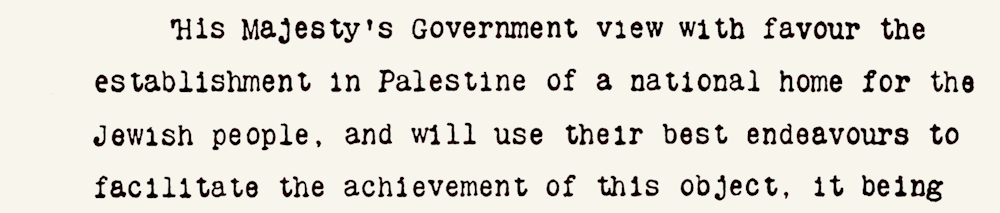
The Balfour Declaration – 1917. Full letter.
The wording “national home” was vague because the Zionists weren’t ready for independence. To say it excluded independence is false as that was the likely outcome. Britain’s Prime Minister at the time of the Declaration, Lloyd George, said so.
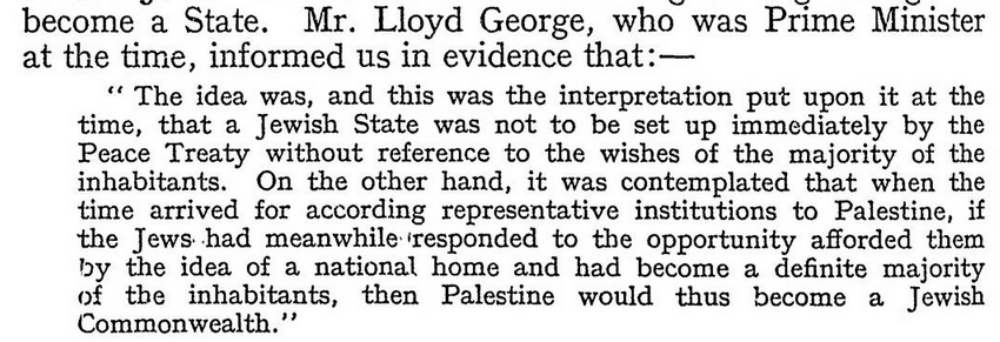
Peel, p. 24.
The Brits had other reasons for wanting to see a Jewish Palestine (details), such as protecting their interests in Egypt and some like Balfour believed in the Biblical Restoration. What stood out and what most of the League of Nations later supported was the special Jewish relationship with the land, and Hebrew laws and values being the foundation of civilization.
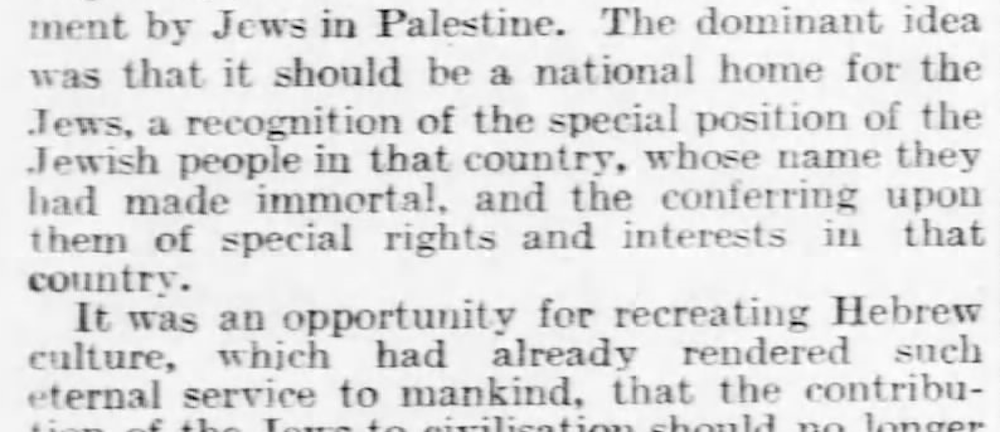
A British MP explains the Balfour Declaration and Mandate.
The Daily Telegraph (UK) – November 18, 1930. Full page.
More on Page #3.
Rebuttal: Weizmann and a few other Jews were involved in drafting the Declaration. Years later, critics painted that as a devious scheme. The reality is that the UK decided on the final text, obviously.
Many Arabs supported Zionism
The Jewish hand in their liberation was likely one of the reasons why many Arab leaders were open to Zionism, though some objected to sovereignty for them.
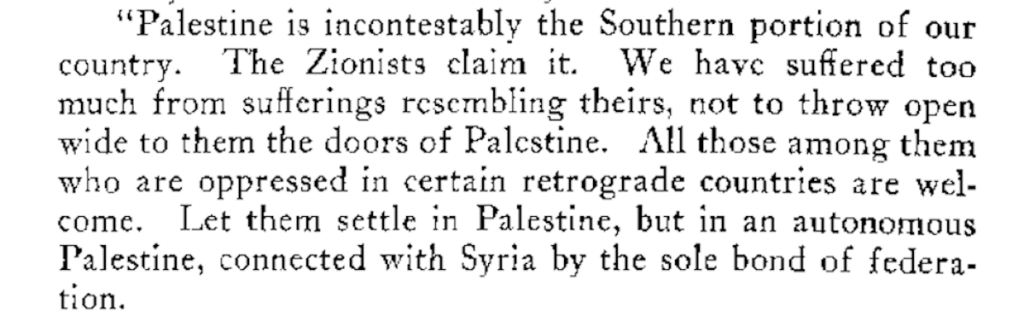
David Hunter Miller’s My diary at the Conference of Paris, 1924.
Page 414 (425 of file). Center for Research Libraries.

New York Times – March 5, 1919. Full page.

Prince Faisal: Pan-Arabia will assist Zionism.
Washington Evening Star – August 17, 1919. Full page.
We consider the Jews as a brotherly people sharing our joys and troubles and helping us in the construction of our common country. We are certain that without Jewish immigration and financial assistance there will be no future development of our country…
Hasan Bey Shukri, Mayor of Haifa, 1921.
Army of Shadows: Palestinian Collaboration with Zionism, 1917–1948
by Hillel Cohen in 2008. Page 15, Archive.org.
He set the stage for Haifa being a model of coexistence.

Haycraft Commission – 1921, page 54.
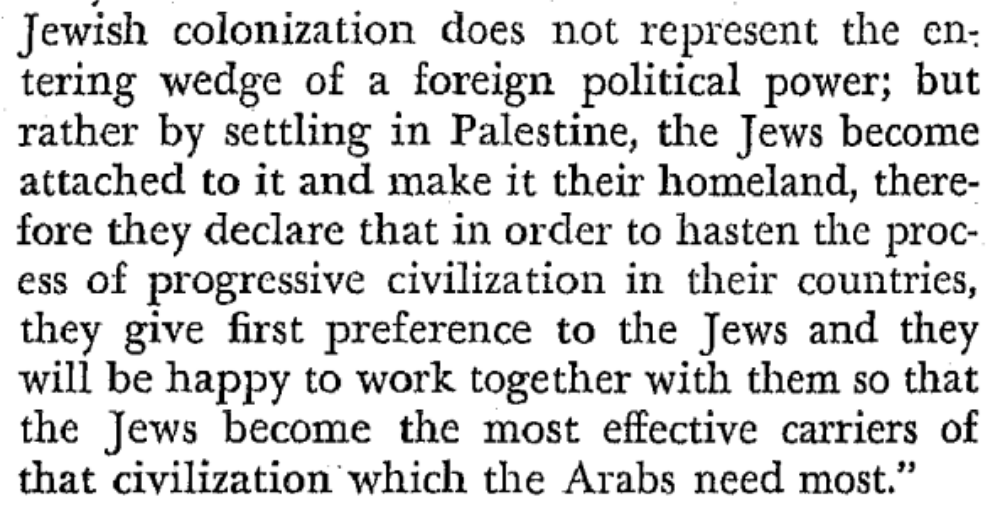
Minutes from a 1922 meeting between Jewish and moderate Arab leaders, quoted in
UN Special Committee on Palestine – 1947, A_364 Add-2, p. 196. UN.org.
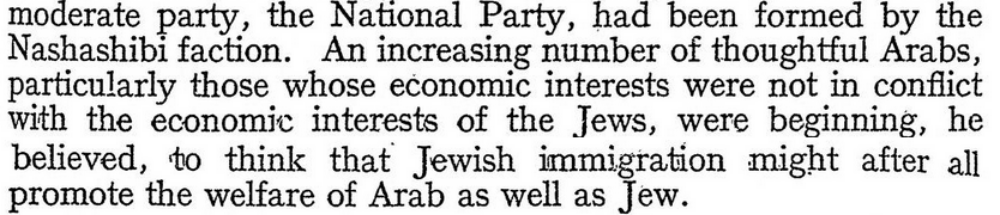
Re: Early 1920s. Peel, p. 53-54.

Mid-1930s. Peel, p. 395.
The Begin-Sadat Center for Strategic Studies has a report detailing 140 positive Arab responses to Balfour. Wikipedia has a few of the Arab supporters from this period (the site is worthwhile on rare occasions). See Page #3 for the global support of Zionism.
Jews around the world celebrated the Declaration, another example of their nationhood and connection to the Land of Israel.

Canadian Jews rejoiced. Montreal Gazette – November 10, 1917. Full page.

Polish Jews. Reuters (in New Castle Daily Journal) – Dec. 26, 1917. Full page.
Similar:
American Jews. Baltimore Sun – December 3, 1917. Full.
Detractors
In Britain and elsewhere, there were also opponents to a National Home for the Jews, including in their world. Some were religious and most were the assimilated ones in America and Germany. The latter felt that Jews should be accepted in all countries and treated equally. That was easier said than done, according to history.

New York Times – March 5, 1919. Full page.
Their position changed in the 1930s due to the Nazis. The feelings of the religious in Palestine changed after the Hebron Massacre of 1929, one of the many times that violence made things worse for the Arab-Muslims.
Arab opponents were present before World War I. As with later objections, the Zionists saw little difference between it and historical antisemitism, and it reinforced the belief that being a minority in any society was the danger.
Zionist hopes and negotiations
There are many lies out there that say the Jews only insisted on statehood. The dream at the start was about independence and some felt that statehood was the only worthwhile expression of it. However, there were other kinds of independence, such as the earlier clip from the former PM about being in the British Commonwealth.
Even British officials in 1918 were affected by rumours and negative propaganda about Jewish intentions. (This was based on Jewish statements that were called propaganda, but the word then was usually used in a normal sense of publicizing information.)

There Could Have Been Peace by Jon Kimche – 1973, p. 136. Archive.org.
The book focuses on British fault during the Mandate.
In response to the above, Chaim Weizmann met with Syrian Arab nationalists to explain the Zionist position and how they wished to become a British Protectorate like Egypt and live on friendly terms with the Arabs. The Syrians were pleased. (As above, also page 137.)
Other Jewish-Arab discussions and negotiations in this period are covered on pages 112-114 in The Emergence of the Palestinian-Arab National Movement, 1918-1929 by Yehoshua Porath in 1974 on Archive.org. This Middle East Forum article covers similar terrain.
The reality of Arab opposition brought forth different ideas in later years, some of which bypassed independence, and they’re covered on Chronology E: 1922-1947.
Problems start
There was a delay in settling the peace after WWI and the UK was constrained by a law to maintain the status quo of enemy territory, which resulted in minor steps towards fulfilling Balfour.
Drunk with euphoria over the Declaration and international support, many Jews took it to mean the most and they barreled forward with development of the institutions of a government, some that duplicated the Brits’ affairs.
Some Arabs thought the worst. They were also affected by those British officials who were pro-Arab or at least anti-Jewish. At the same time, Jews were influenced by Brits who sided with them. Most of the English were pro-England and their interference, even with good intentions, is covered on the next page.
Life or death
To Jews, this was about more than rebuilding their home. The original Zionists in the late 1800s fled pogroms and many other Jews at this time faced even worse.
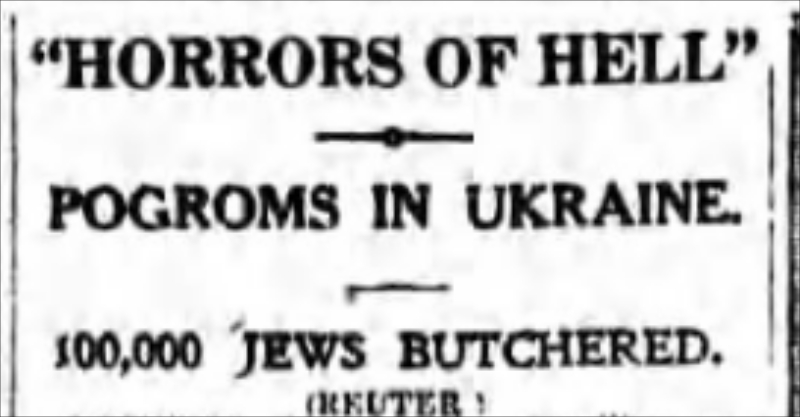
Reuter (in Australia’s Daily Mail) – January 10, 1922. Full page.
(It started in 1918, but wasn’t originally covered by the press. Various Ukrainians and Russians were guilty.)
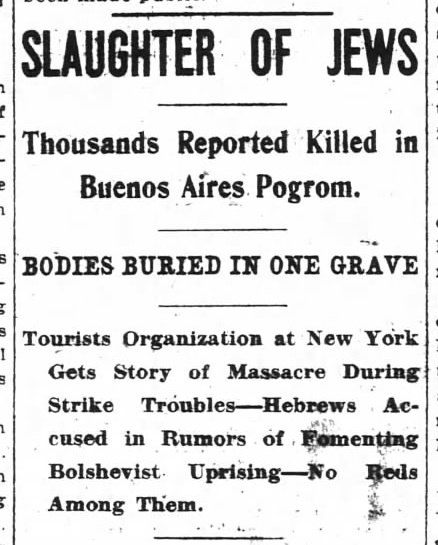
Washington Post – March 27, 1919. Full page.
(The Jewish death toll was later revised to 100.)
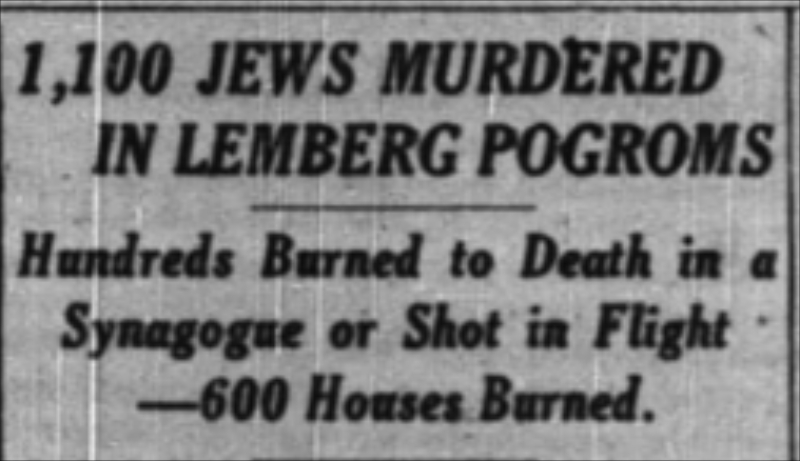
New York Times – November 30, 1918. Full page.
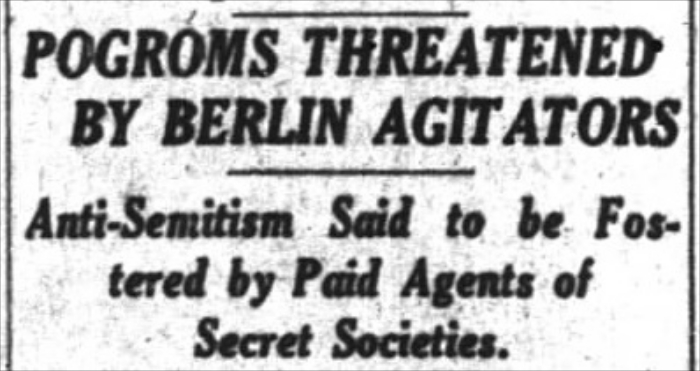
New York Times – March 18, 1919. Full page.
More:
Harvard University’s Davis Center on the Ukraine pogroms.
A review of the book In the Midst of Civilized Europe by Jeffrey Veidlinger.
The Ukraine pogroms of 1918-1921 set the stage for the Holocaust.
Also at this time:
Jews in Orumiyeh, Iran were massacred.
Jews in Yemen were persecuted.
Antisemitism was deadly and pervasive. Jews were the scapegoats for any and all problems. Beating or killing Jews was a way some people vented. The critics of Israel ignore this context.
We’ll jump ahead a little and mention that America passed the Emergency Quota Act of 1921 that restricted immigration from Southern and Eastern Europe. This made Palestine an even more realistic and urgent haven for Jewish refugees and those seeking safety.
The issues
None of the details matter today. Had none of them occurred, the fundamental ones, dar-Islam (further down) and fear of a Jewish majority, would have remained.
The problems at the time can be categorized as Clash of Civilizations, Legitimate/Manageable, or Wrong, But Not Worthy of Violence
Clash of Civilizations included:
- Before the 20th century, the Arabs were used to seeing a tiny minority of Jews in a secondary position. As foreign-born Jews grew in numbers and political strength, they became alien to Arabs.
- Pretty much all Arabs were religious or traditional and the early Zionists were mostly secular.
- Nearly all the Jewish returnees were educated and the vast majority of Arabs were peasants, with most of them being illiterate.
- Jews were industrious and a majority of Arabs were laid-back and comfortable in a centuries-old lifestyle (that would’ve conflicted with the new age even without the Zionists).
- Some Muslims feared vengeance for the way some of their people treated Jews, both recently and historically.
Wrong, But Not Worthy of Violence included:
- The Bolshevik communist movement spread into the wider region and some Jews pushed the cause in Palestine, which was foreign to the population. Most Jews opposed it and the issue resolved before long.
- Some Jews grew arrogant over Balfour, especially young ones amongst the new arrivals after World War I, and didn’t consider the Arabs’ perspective.
- A few individuals, called (non-violent) extremists of that time, said inflammatory things, like Palestine should be “as Jewish as England is English”. While a non-issue on its own, statements like these fueled Arab apprehensions.

A succinct way of explaining the monumental context.
The Palin Report – 1920, page 21.
(More on Palin below.)
For those on the outside or who already have a negative opinion of the Zionists, it's easy to overlook or downplay this part. The Jews were like water behind a dam and Balfour was the wall crumbling. Some acted like they already had a state. A few went outside the lines to benefit the Zionist enterprise. With so much happening so quickly, Arab fears grew. After Palin, the British and mainstream Jews were more effective in tempering the community.
Understandable/Manageable
One concern was about the inability of the Arabs to compete with the Jews. This, too, was temporary and profits earned off Jews- especially from selling land to them- were invested by Arabs in businesses, new villages and social services.

Peel, p. 126.
Lord Balfour in The Daily Telegraph (UK) – June 23, 1925. Full page.
Another concern was about the number of Jews moving to Palestine and the absorption capacity of the land.

Palin, p. 18..
This was not a simple matter because the Zionists wanted to save as many brethren as possible. (Many Jews in safe locations saw no need to uproot their lives and emigrate.) The Zionists also needed greater numbers to reach a point of hopeful independence and security. From 1915 to 1922, the Jewish population remained at roughly 83,000. The Muslims and Christians went from 590,000 to 643,000- without any concern about the capacity of the land.
Some Jews objected in 1919 and some went along with the British regulating immigration. With a few hiccups, Jewish development over time proved the fear false. (For the full context, the land held a few million people in Roman Judea.)
Lies and fearmongering – A
Rumours and propaganda brought the tension to a boiling point. (Page #3 has the instances prior to WWI.)

Buffalo Evening News (USA) – July 5, 1919. Full page.
Jews were 1/9th of the population at this time and the Brits were in charge.
(That many unfortunately became refugees due to the Arab-Muslim war in 1948 is a self-fulfilled prophecy.)
Syrians who saw the hope of Greater Syria evaporating stoked fears amongst the Arabs in Palestine.
Buffalo Evening News.
There was other trouble directed at the British by Germans, Turks, Frenchmen and Hejaz Arabs, which magnified the turmoil in Palestine.

New York Times – October 25, 1919. Full page.

Palin, p. 60.
Buffalo Evening News.
The Protocols of the Elders of Zion
Another thing that poisoned the minds of the Arabs was the mother of all conspiracy theories: Jews were secretly plotting to dominate the world. The pamphlet raced around the globe starting in 1903 and by 1917 was a best-seller in Europe and the United States. It was championed by the likes of American car magnate Henry Ford. Russia’s Orthodox Church distributed it. The Times (London) newspaper wrote favourably of it in 1920 (and a year later acknowledged that it was a fabrication).
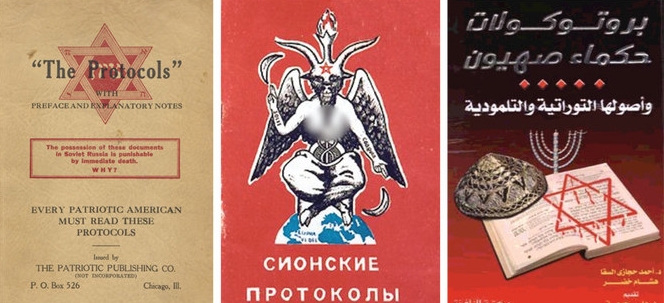
While Egypt was the first to translate it into Arabic in 1925, the gist of it spread verbally before then.
MEMRI and ArabNews.com have reports on the Arab angle.
Atlantic magazine has a good article about the rest.
In August 1948, a Syrian intellectual, Constantine Zurayk (or Zureiq), applied the term “nakba” to the consequences of the war. The booklet does not accuse the Jews of expelling Arabs and is more about the Arabs’ own faults. However, his thoughts about the Zionists sound exactly like the Protocols.

Ma’na al-Nakbah by Constantine Zurayk – 1948. Page 7 on Archive,org.
(Translated by R. Bayl Winder in 1956 as “Meaning of the Disaster”.)
Zionism commenced with history, diplomacy and law (and turned to war in defense), and the foes saw that as control, power and submission.
Same old story: In 2026, this exact same sentiment was behind the accusation that Israel fooled American President Trump into joining the war against Iran. The same Trump who, in the summer of 2025, commanded Israel to stop its attacks on Iran after 12 days and, in April 2026, ordered Israel to stop its operations in Southern Lebanon.
Falsehoods against Jews go back to the Bible
Exodus: As a prelude to slavery, the Egyptian Pharaoh told the masses that the Hebrews- a loyal minority invested in the country’s well-being- were a military threat.
Purim: Haman lied to the King about the Jews not obeying his laws and claimed they were suspicious just because they were different.
Aside from the general slur that the Jews broke their covenant with God, much of the Christian persecution over the centuries was based on two lies: Jews killed Jesus and Jews murdered Gentile children in order to use their blood for rituals.
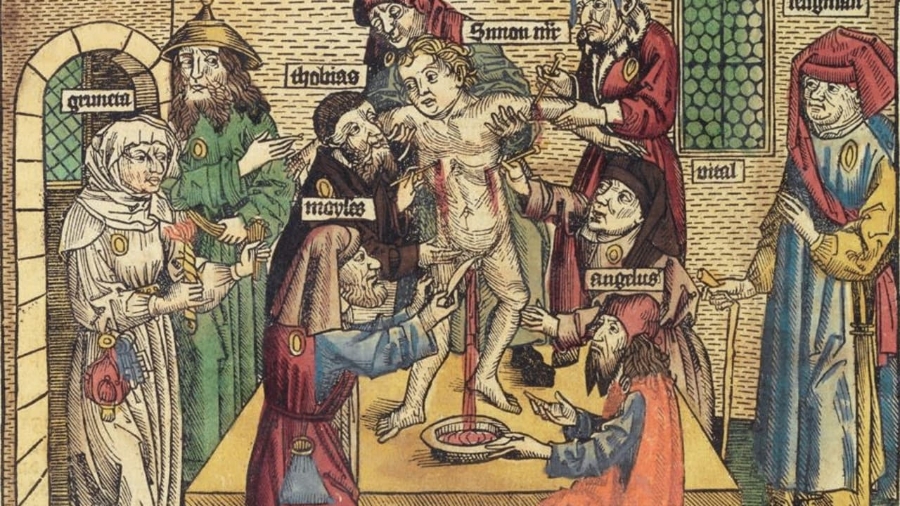
The Simon of Trent blood libel: Illustration in Hartmann Schedel’s Weltchronik, 1493. (Photo: Wikimedia Commons).
This is also known as the Nuremberg Chronicle and at the time was the most lavishly illustrated book in Europe.
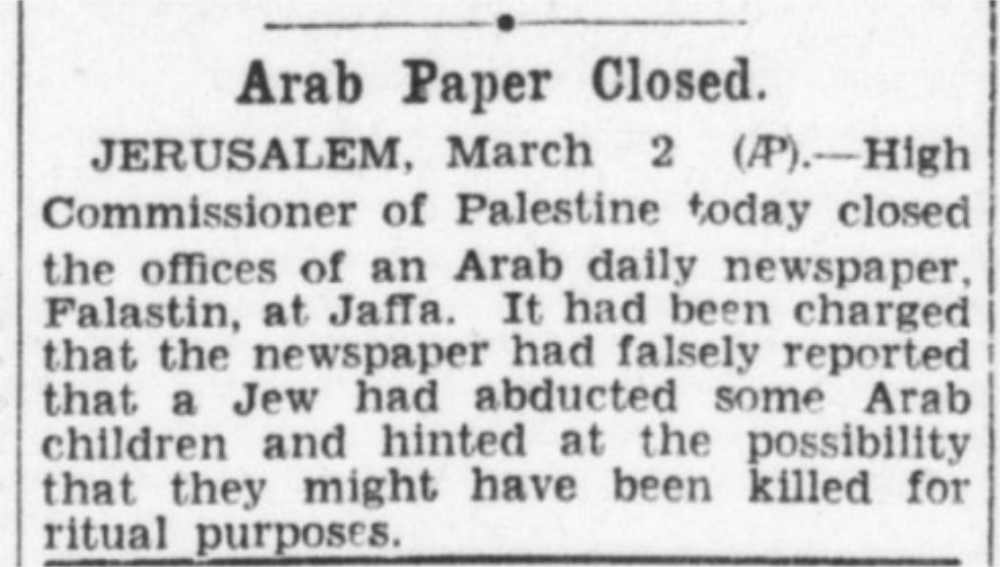
Associated Press in The Washington Evening Star – March 2, 1931. Full page.
Jews were blamed for the Black Plague of the mid-1300s. The Spanish Inquisition featured false suspicions about the Hebrews. The Jews as a people were falsely accused of dominating the slave trade (while few speak of the Arab-Muslims who enslaved 10-18 million Africans, with repercussions still felt today). Nazi Germany turned the practice into an art form. The Arab/Muslim extremists and their supporters are just the latest in a long line.
Is it then hard to believe that countries like Iran and Qatar have invested vast resources into anti-Israel propaganda that has influenced people from all walks of life? Two respectable Muslim women in this Newsweek article and a Syrian activist on her Linkedin say so. A Canadian lawyer goes deeper in The Hidden Hand.

No doubt the Zionists and then Israel committed errors and misdeeds- and that's the difference. The exceptions- within the context of defense against genocidal enemies- have been packaged to make it seem like Israel the democracy is an evil regime on par with Russia.
Our history is replete with examples of those who have refused to see what the Jews are really about, who – through intellectual blindness, racial chauvinism, xenophobia, or just plain evil – have been unable to give this oddball tribe, this raggle-taggle band, this race of wanderers who are the progenitors of the Western world, their due.
Thomas Cahill, The Gifts of The Jews – 1999.
Hatred is blind: Every group that hurt the Jews ultimately lost. The ancient Egyptians suffered terribly, were humiliated and the nation today is a relic of its past; Haman and his supporters were killed; the mighty Babylonians, the Syrian-Greeks of the Hanukkah story, and then the legendary Romans evaporated into history; Spain is a shell of its former glory; the Nazis' Third Reich lasted 12 years and not 1,000; the Church reformed its perspective of Jews; Russia is reviled and has been weakening for decades.
The carving and Mandates
The League of Nations, predecessor of the United Nations, was formed in 1920 and it gave Britain and France Mandates for assisting the inhabitants of the former Ottoman lands. The text for the Mandate for Palestine was finalized in 1922.
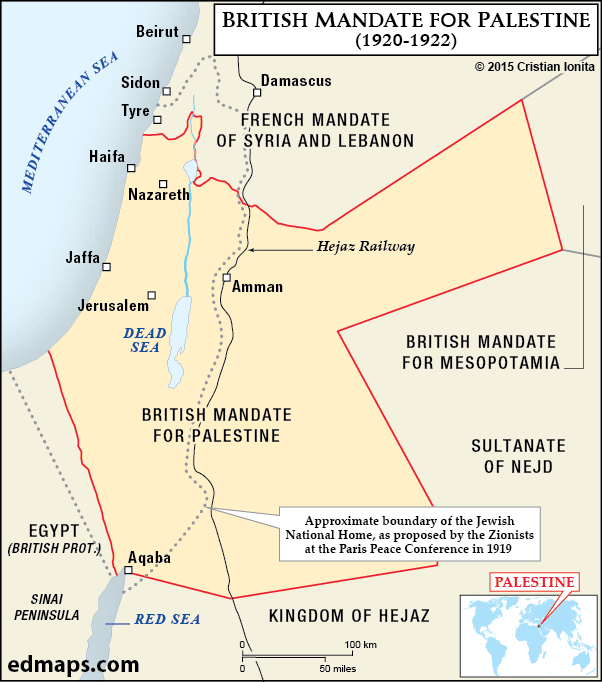
An unauthorized Greater Syria was proclaimed in 1918, though it was short-lived and not attempted again. Then France divided Syrian territory into mini states and one of them became the first modern incarnation of Lebanon in 1920.
In 1921, Britain granted Eastern Palestine to the second son of the King of Hejaz; it became the protectorate of Trans-Jordan (and, in 1946, the independent Hashemite Kingdom of Jordan).
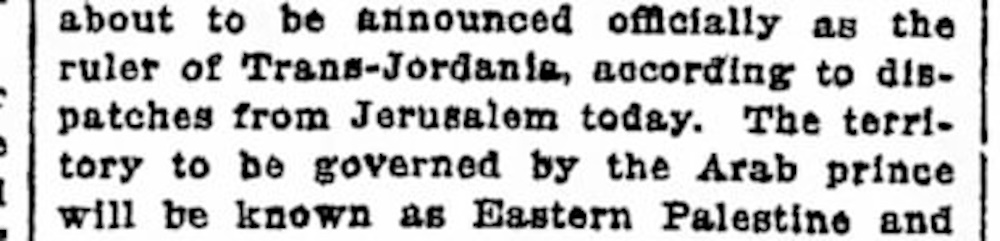
The Washington Post – May 1, 1921. Full page.
Only after this cut did the Palestine that most people think of (“From the river to the sea”) take shape.
Britain barred Jews from buying land and settling in Trans-Jordan, thus institutionalizing antisemitism.
The Mandate incorporated the Balfour Declaration and the San Remo Resolution of April 1920, all of which recognized the special connection between the Jewish people and the land, and gave them the right to develop it.


The British Mandate for Palestine and Trans-Jordan – 1922.
Top: page 1- full page. Bottom: page 2. Archive.org.
The Mandate was an international legal instrument that guaranteed the reconstitution of a Jewish homeland in Palestine. (More about the law.)
Refutation: The League of Nations- most of the world- supported the Jewish cause so this is further evidence that Zionism was not a British colonial project or malevolent.

Like the Balfour Declaration, the Mandate's "national home" was imprecise as the Jews were still far from being able to have independence. Logically, the text would have had to exclude independence, not include it. What is precise is that the Mandate did not say anything about a new Arab state in Palestine.
Arab rights as longstanding residents were protected. (Many were not there for long…and all the other points from Page #2.)
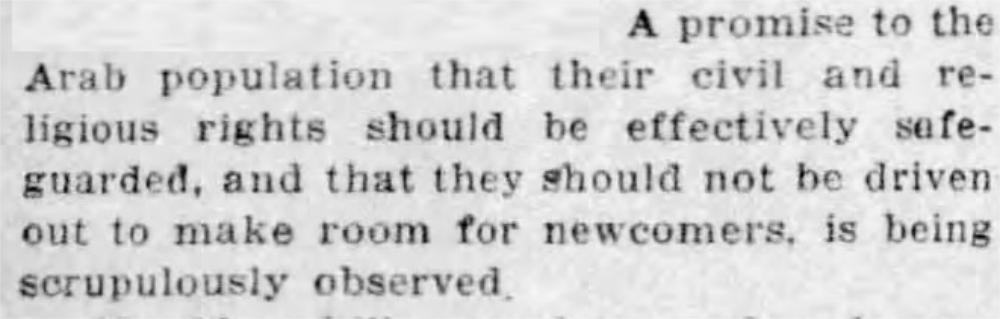
The Ottawa Citizen (Canada) – July 25, 1922. Full page.
Such rights have never included sovereignty, which is why the Kurds and the people of Catalonia, Spain, to name just two, cannot unilaterally form their own states. This is the crux of the matter and those who condemn the Jews base it on a faulty understanding. (Newsweek.)
The Jews wanted more, and Jordan-Palestine
As the above Mandate map shows, the Zionists requested an area based on some of the best borders of Biblical Israel. The lines would have followed the terrain and been defensible. They were forced to compromise.

Peel, p. 38.
Since the Mandate covered Palestine and Trans-Jordan (aka Eastern Palestine), some pro-Israel voices say the Arabs got 79% of Palestine so it shouldn't have been an issue for the Jews to get the balance. On the one hand, some views of history saw Trans-Jordan as part of Palestine/Syria, and nearly all included the eastern bank of the Jordan River (see the maps on Page #1). On the other hand, Daniel Pipes sheds light on the larger "Jordan is Palestine" argument.

While the literal angle has some weaknesses, there is an incredible, practical point. With most of the Arabian Peninsula, Iraq, parts of Yemen, Egypt, Trans-Jordan, Syria and Lebanon, the Arab nation got independence in over 99% of the former Ottoman lands where they were a majority. The part left for the Jews was less than 1%- and that was nearly halved with the Partition Plan of 1947. Similarly, the people in Palestine were just 6% of all those Arabs.
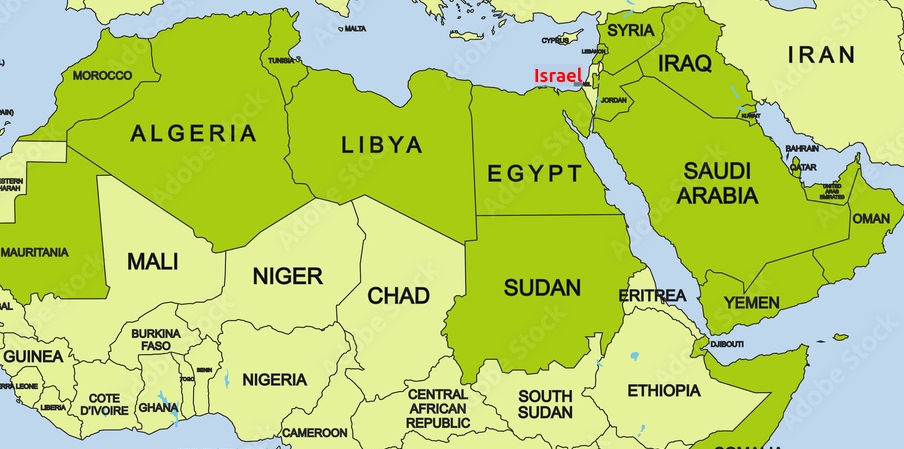
The Arab League states in the Middle East and North Africa. Full map and source.
Imagine if most Arab leaders had sided against the radicals and said the Jews should have this teeny slice.
Violence and religion
(Page #3 has a few incidents before WWI.) The various feelings over these years- anger at the British and French for not acquiescing their vision, turmoil from anti-British activity, legitimate concerns and inflated fear from the rise of the Jews and, mostly, religious conviction- blended into a beast.
In 1918 some Jewish children and their teachers were beaten.

Letter from Ze’ev Jabotinsky to Chaim Weizmann – Nov. 12, 1918. Full page.
Page 17, InfoCenters (pdf).
British officials had been notified about the possibility and didn’t do much to prevent it, though they later imprisoned the perpetrators.
In 1919 a couple of Jewish villagers were murdered.
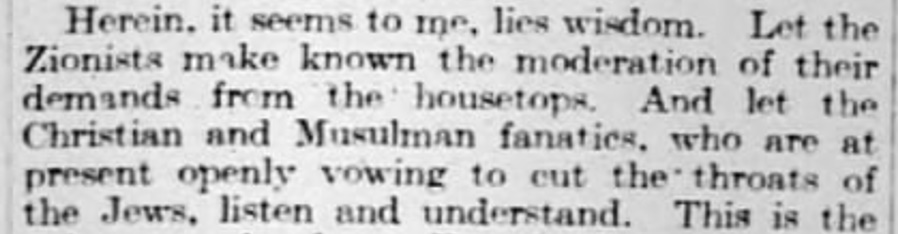
The Times (London) – September 16, 1919. Full page.
In 1920 in the Upper Galilee (under France at the time), an accident turned into a firefight between an Arab militia and the Jewish defenders of a village.
Not wanting to rely on the shaky Brits, Jabotinsky, one of the founders of the Jewish battalions that conquered Palestine with the UK, was tasked with acquiring guns and developing a small defense unit. The Arabs didn’t appreciate it.
Rebuttal: The ill-informed and ill-intentioned ignore the context and make it seem like the Jews armed themselves with a plan to impose their will by force...even though they were 1/9th of the population and the British were in charge.
First major attack in British Palestine
It happened in Jerusalem, April 1920, during a yearly Muslim pilgrimage called Nebi Musa to what they believed was the burial site of Moses.

Palin, p. 73.

Peel, p. 28.
While the precise start is unknown, it shared traits with past and future Arab-Muslim attacks on Jews: savagery, disregard for innocents and religion.

“Muhammed’s religion was born with the sword” is a famous quote from the 1920 riots and the easiest source for it is this 2024 response by noted Israeli historian Benny Morris to an unprofessional New York Times article.
Jabotinsky was arrested for illegal possession of a firearm and sentenced to 15 years in prison. On the Arab side, Haj Amin al-Husseini was a key figure in inciting the violence and he was arrested, but escaped. In absentia, he was sentenced to 10 years. More on both of them in Chronology E.
What the Muslims actually claimed
The Palin Report was compiled by the UK after the Jerusalem riot. Most Arabs didn’t take the proceedings seriously, though the Brits did learn more about their perspective.

Palin, p. 3..
The conquest refers to the armies of Muhammed’s successors who captured Palestine and vicinity by 640 CE.
Notice the honesty:
- They didn’t say they were a nation.
- They didn’t say they were in an independent state.
- They didn’t claim to be an indigenous people or Canaanites (like some have said since the late 1990s).
- They didn’t argue that they were first in the land.
- They didn’t claim ownership based on longstanding residence (which only applied to some of them and is anyway not a thing, which is why the Kurds and people of Catalonia, Spain, to name just two, do not have rights to sovereignty over the lands in which they reside).
- They didn’t say the Jews can have an area that was long uninhabited and that the Jews purchased and developed (Page #3).
Those Arab-Muslims felt the land was theirs because of an extremist interpretation of dar-Islam. That perspective says that land once conquered by Muslims remains Muslim forever- and it’s a religious duty to fight those in it who disrespect Islamic rule and to reclaim the land if lost. That’s why it didn’t matter to them that the British were the new conquerors of Palestine. That’s why they fought the Jews from having even a centimetre of land.
Three articles delve into the concept of dar-islam:
Islam Online, Fathom and JPost.
A basic aspect after WWI that was alongside dar-Islam is covered on the Zionism page.
The British officials agreed with the Jews not to publish Palin out of fear the Arabs would use it to further fan the flames of conflict. It didn’t make a difference as all the issues were known. After this, the UK and Zionist leaders adjusted the community’s temperament, though nothing changed on the side of the Arab radicals.

The Times (London) – June 2, 1920. Full page.
1921 Jaffa riots
This was a turning point because it woke up the Jews to the scope and severity of the threat and made them realize that a small defense unit would not suffice.
A few Zionists had a public quarrel and it quickly shifted into days of Arab attacks, resulting in 47 Jews being murdered.

Haycraft, p. 44.
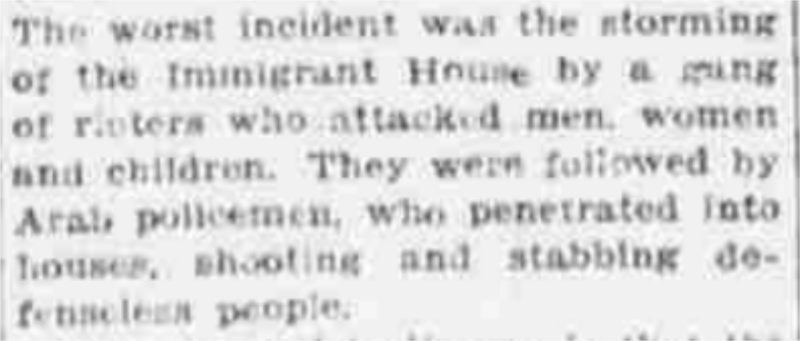
The Evening World New York – May 6, 1921. Full page.
In defense and anger, a few Jews responded with their own brutality, though not at women and children. The Arab death toll was 48, mostly by defensive actions and by security personnel.
There were other bouts of violence after Jaffa. Here’s one from Khedera.

Haycraft, p. 10.
The deliberate attacks against women, children and the elderly is why we don't describe those Arab/Muslims as revolutionaries, guerillas or freedom fighters. They saw all Jews as being guilty.
Aside from not deterring most Jews and Brits, they saw this deprivation as something to be fixed, not appeased. For now.
Lies and fearmongering – B
The propaganda and rumours went into overdrive.
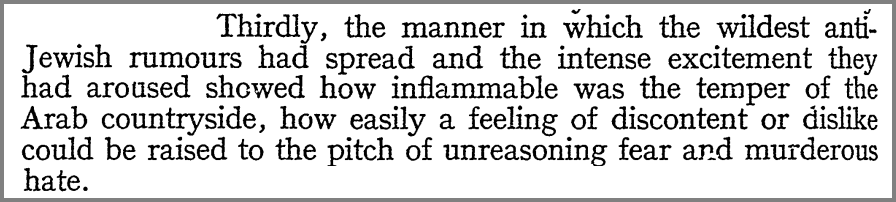
Events in 1921 and earlier. Peel, p. 52.



These are the real roots of the conflict. Aside from the harm in those days, adults who believed rumours, exaggerations and lies about Jews passed the "experiences" and feelings down to their children. With their warped views- solidified by Jewish mistakes and exceptions- the children added new falsehoods. And on and on it's been...

Haycraft, p. 50.
Decades later, modern indoctrination:
An Arab discusses the cancer of antisemitism in the Arab world.
An Egyptian on LinkedIn explains growing up with antisemitism.
Counter Extremism Group on Islamist hate.
While dar-Islam remains a reason for some in 2026, most of the fuel for the fire comes from the institutionalization of antisemitism, lies about the Jewish state, and indoctrination by the extremists to blame the Jews instead of them for the public’s misery.
The Buffalo Evening News article also features a response by one individual Zionist whose words were used by the extremists to grow opposition to the Jews. Any little thing was blown out of proportion. Here, a few Jews spoke about the Third Temple, which can only be built when the Messiah comes-

Peel, p. 66.
Another individual responded to Arab agitation-
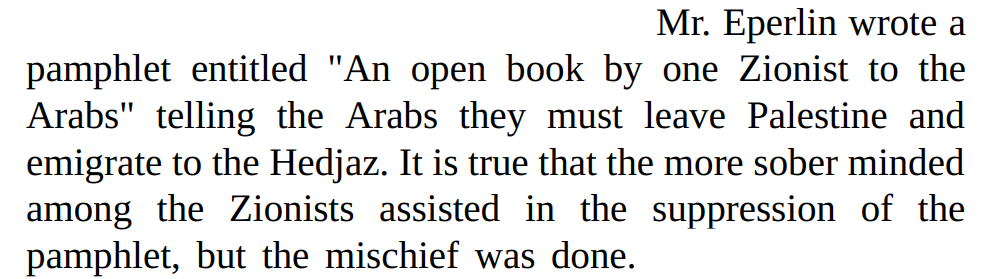
Palin, p. 22.
That it was possible for little things and words from individuals to have such an impact was part misunderstanding- the two sides not knowing enough about each other- and part Arab mentality- the irrational level of fear and ease in which some were swayed to anger and violence.
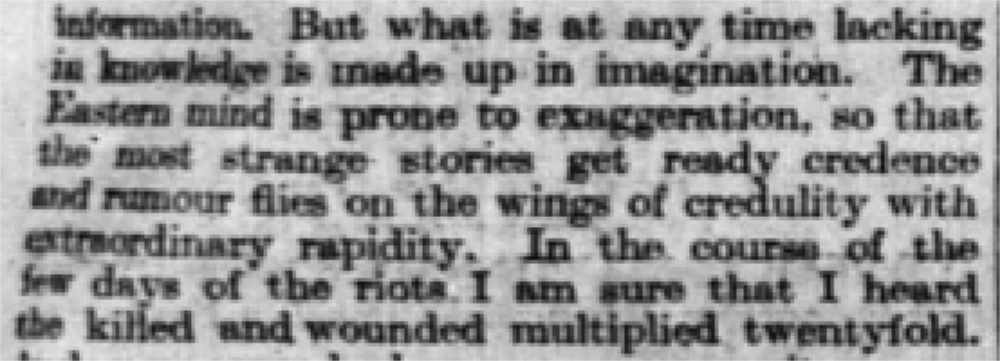
A British MP in The Times (London) – May 12, 1920. Full page.
This even applied to Arabs who had an education, like these people in Khedera-

Haycraft, p. 12.
It became hard to understand how exactly their minds worked…
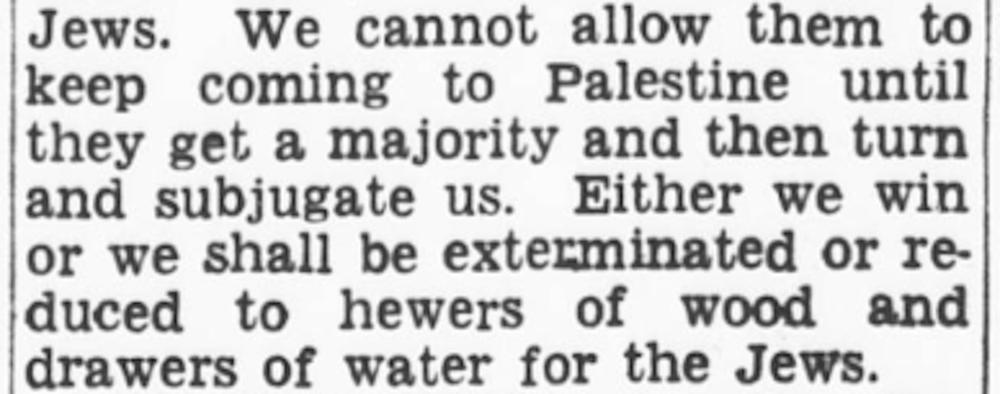
The Washington Times – Sep. 26, 1938. Full page.
(By H.R. Knickerbocker, who won the Pulitzer Prize in 1931.)

Robert Kennedy in the Boston Post – June 3, 1948. Full page.
(Like Knickerbocker above and other journalists, he didn’t seem to realize he was speaking with an extremist.)
[Former President of Iran] Ahmadinejad then leaned toward me and said, ‘Do you know why Iranians die at 62 while Zionists live to 82?’ I told him I did not. He replied, ‘Because Zionists poison rats, send them into Iranian crops, and we eat the contaminated food.’
Mike Evans, a #1 New York Times bestselling author, recounts a meeting.
A few Jewish soldiers act in a rogue manner (as in every Western army, sadly) and it's portrayed as widespread or official policy. The IDF responds to terrorism and it's called disproportionate force. Israel has to fight a war against Hamas hiding behind civilians- issuing warnings whenever possible- and it's labeled genocide. The context of instigation by the jihadists is brushed aside and the rest is exaggerated or distorted.
The bigger picture
Arab-Muslims had much pride in looking back at the heyday of their empires. Despite the foreign and often despised rule of the non-Arab Turks, they were at least coreligionists. Though the “self-determination of small nations” did not apply to them, some Arab leaders in Palestine embraced the air of it, either genuinely or as a counter to Zionism.
At the deepest level is a point rarely touched on: If the Jews broke their covenant with God and Islam is the last, true religion, then how was it possible for Jews to be on the verge of reestablishing their home as God had promised them? (Even just the first stage.) The radical answer was to nullify the question.
The Jews strove to build a national home and the Arab and Muslim extremists did not, instead channeling much of their time, energy and resources into destroying Zionism. All the misfortune that has befallen the Arabs- the refugees, 1967, etc.- has been a consequence of this fight.
If instead of sharing miseries through quarrels you will share blessings through cooperation, a bright and tranquil future lies before your country.
The fact that Palestine shall contain a National Home for the Jews does not mean that it will cease to be the National Home of other people…
Winston Churchill, Colonial Secretary – March 28, 1921. Churchill Project.
In response to an Arab request to abandon Balfour.
Some neutral parties say that Britain created a zero-sum game with conflicting rights to Jews and Arabs. We feel that even these moderate comments are based on a misunderstanding of the rights and who the Arab-Muslims were and the history of the land. It's the radicals who created an all-or-nothing conflict.
Also, it’s not like the Jews were looking to be rulers over the Arabs. If not for the extremists, they would have continued living their lives and with autonomy over their affairs, which is what happened during the Mandate period.
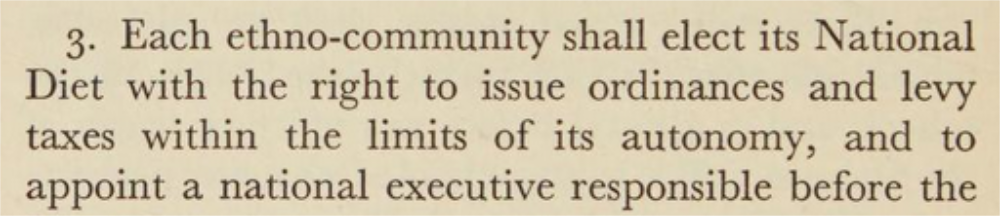
In 1934, Ze’ev Jabotinsky’s Revisionist Party- that some called extremist- prepared a draft constitution that included equal rights for Arabs.
The Jewish War Front – 1940, p. 218. Full page, Archive.org.

From the Churchill White Paper – 1922, page 18. Wikimedia.

Soon-to-be ruler of Trans-Jordan in The Times (London) – April 6, 1921. Full.
Since 1948, Israel has proven that its Arab citizens have a better life than pretty much all others in the Middle East and North Africa. Muslim and Christian Israelis have more rights than their coreligionists in France and Canada. (There are issues, but the fact that elements of the population have always sought to harm the Jews is a much better explanation than why minorities in every other democracy face issues. Foundation for Defense of Democracies article, Dr. Rohit K. Gupta post, CNEWA page.)
Next: Chronology E: 1922 – 1947. Or Home for the top issues.