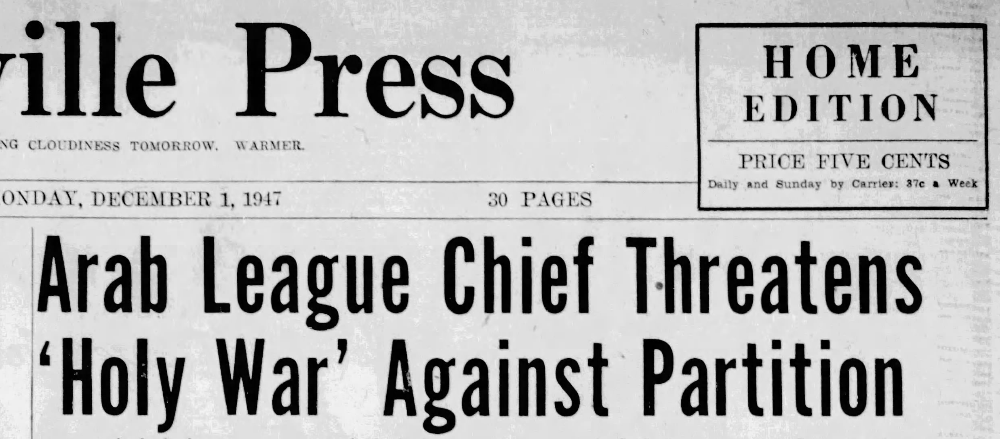
For the best understanding of the conflict, follow the fundamentals as they happened.
A: The history of the land.

Britain’s Royal Commission Report (aka Peel) – 1937, page 40. Archive.org.
(Many had not lived there long.)
B: The Muslims in the land.
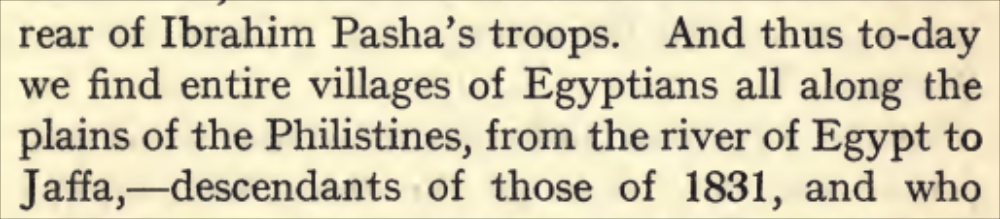
The Immovable East- Studies of the People and Customs of Palestine
by Philip J. Baldensperger – 1913. Page 201, Archive.org.
C: Zionism and through 1914.
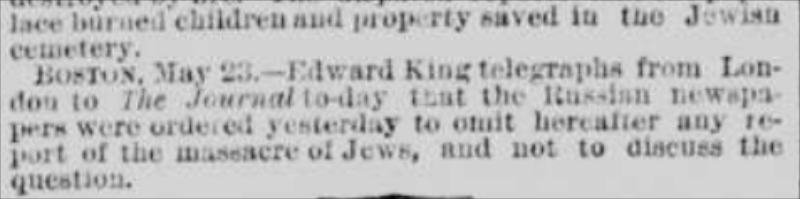
New York Tribune – May 24, 1882. Full page.
The Zionist movement was spawned by horrific antisemitism in the late 19th century- and similar throughout most of the world over the millennia.
D: World War I – 1922.


The British Mandate for Palestine (via the League of Nations) – 1922.
Top: page 1- full page. Bottom: page 2. Archive.org.
The Mandate was an international legal instrument that guaranteed the reconstitution of a Jewish homeland in Palestine.
E: 1922 – 1947.
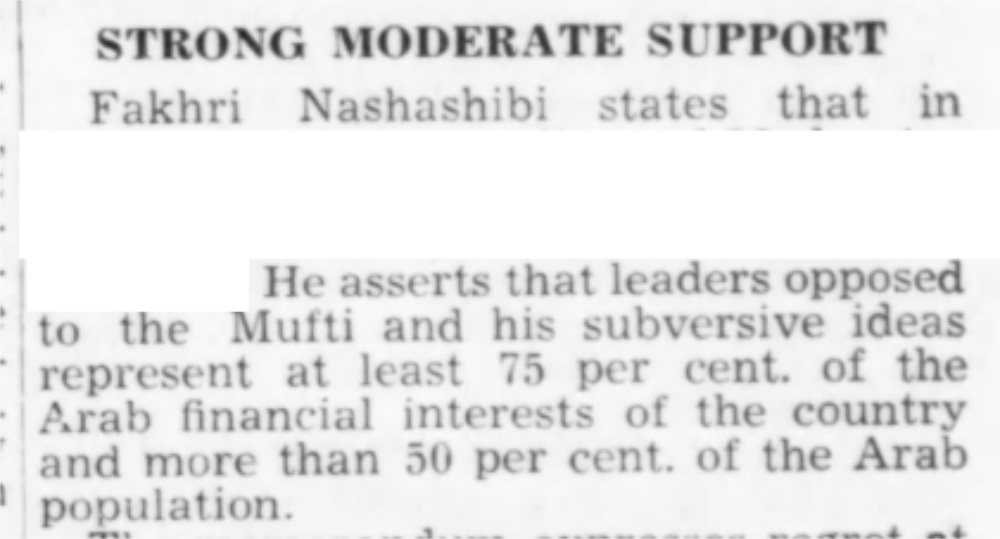
The Daily Telegraph And Morning Post (UK) – November 16, 1938. Full page.
Nashashibi was the main moderate Arab clan. Unfortunately, the non-fanatics were murdered, exiled or intimidated by the Muft’s followers. And robbed, brainwashed, etc.
F: The War of 1948 (refugees).

Beirut Telegraph – September 6, 1948. Quoted in
The Trouble with Islam: a Wake-up Call for Honesty and Change – 2003, p. 105
by Irshad Manji, a Muslim journalist. Archive.
G: The refugees after the war. Preview on Home.
H: 1949 – 1957. (Preview)
After Israel’s War of Independence, Armistice Agreements were signed between Israel and Egypt, Syria, Lebanon, and Jordan. Iraq avoided signing by transferring control of territory it held in the 1948 War to Jordan. From 55% of Palestine that the UN allocated to the Jews in 1947, Israel now legally controlled 78%. Like the refugees, this loss to the Arabs was a consequence of their leaders’ violence.
The former Egyptian president then criticized Arab leaders, particularly those of Iraq, Syria, Algeria and South Yemen, urging them to act and warning that calls to “liberate Palestine from the river to the sea” would only accelerate the loss of Palestinian territory, as happened during the 1948 Arab-Israeli war.
From a recorded conversation in 1970 between Egypt’s Gamal Abdel Nasser and Libya’s Muammar Gaddafi.

General Armistice Agreement between Israel and Jordan, Article VI.9 –
April 3, 1949. Full page. Full PDF on UN site.
The Demarcation Lines were not borders, a point stressed by both parties. The Agreements brought an end to the 1948 Arab-Israeli War, but they were not peace deals, and each Arab nation remained officially at war with Israel and was preparing for the next round.

New Star In The Near East – 1950, page 81. Full page, Archive (login).
By Kenneth W. Bilby, an American correspondent (New York Herald Tribune and Associated Press) who saw the 1948 war and aftermath from both sides.
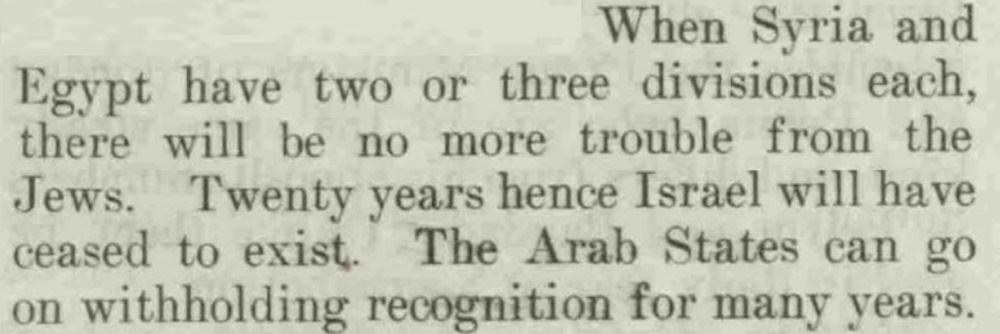
Azzam Pasha, Secretary-General of The Arab League.
British Foreign Office – Further Correspondence Respecting Middle East,
(General) Affairs – Part 3 Jan. to Dec. 1949. P. 10 (14 of file). Full page, doc (PDF).
Also, the Arab League voted against UN General Assembly Resolution 194 (III) that called for the parties to negotiate an end to all issues.
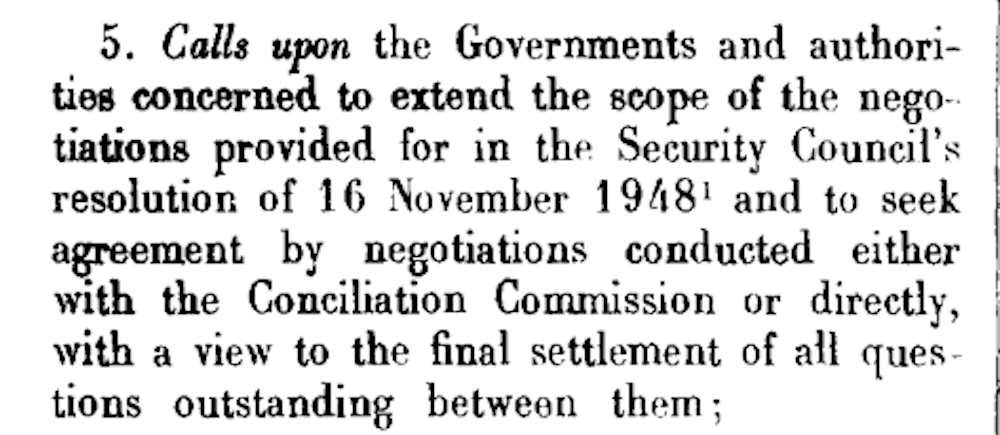
December 12, 1948. UN.org (page 3 of file).
Peace efforts
As for Israel, she hoped to sign peace agreements with the Arabs, but not at any price.
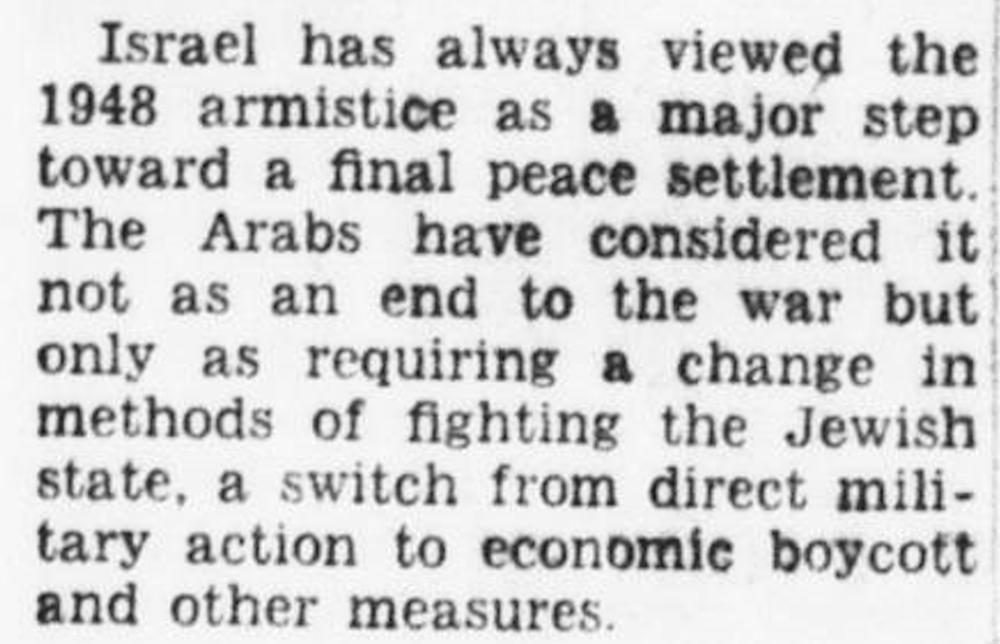
Washington Evening Star – August 29, 1955. Full page.
Same paper, more on the economic measures – Aug. 12, 1953. Clip, full page.

The famous American war correspondent Bill Downs interviewed Israeli Prime Minister Moshe Sharett for CBS News in 1954. Full transcript.
Despite the public posturing and harmful acts against Israel, there were Arab pragmatists who sought peace.
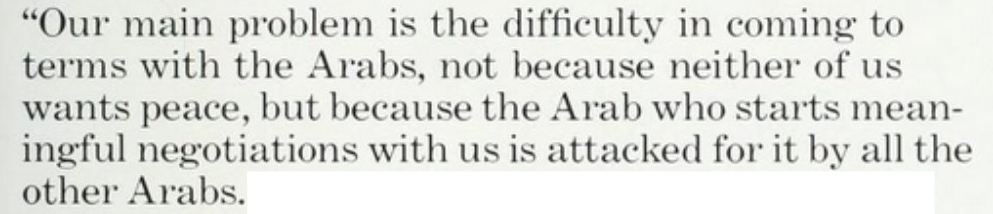
Dr. Egon Riss talks about troubled peace efforts after Israel’s independence
in John Phillips’ A Will To Survive, page 79. Archive (login).
The page will detail the secret talks with Jordan, Egypt and Syria, and explain why Israel didn’t blow the opportunities the way some say today.
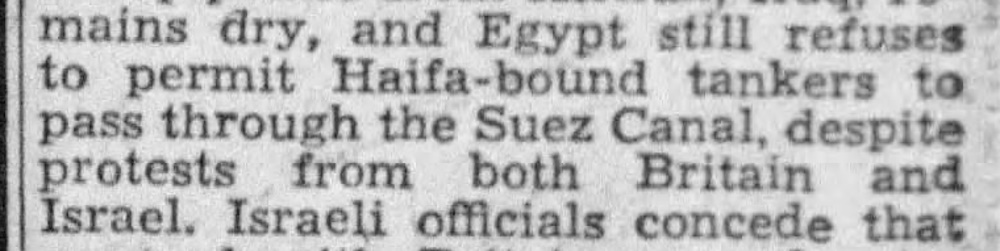
During the War of 1948 in the Suez Canal, Egypt began a blockade of ships to and from Israel and made the practice official in 1950, in violation of the Armistice Agreement she signed with Israel.
The Boston Globe – October 16, 1949. Full page.
It took another year for the United Nations Security Council to pass Resolution 95 against Egypt for this illegal, belligerent act that also harmed Arab interests. Egypt refused to comply and the international community did nothing to pressure her.
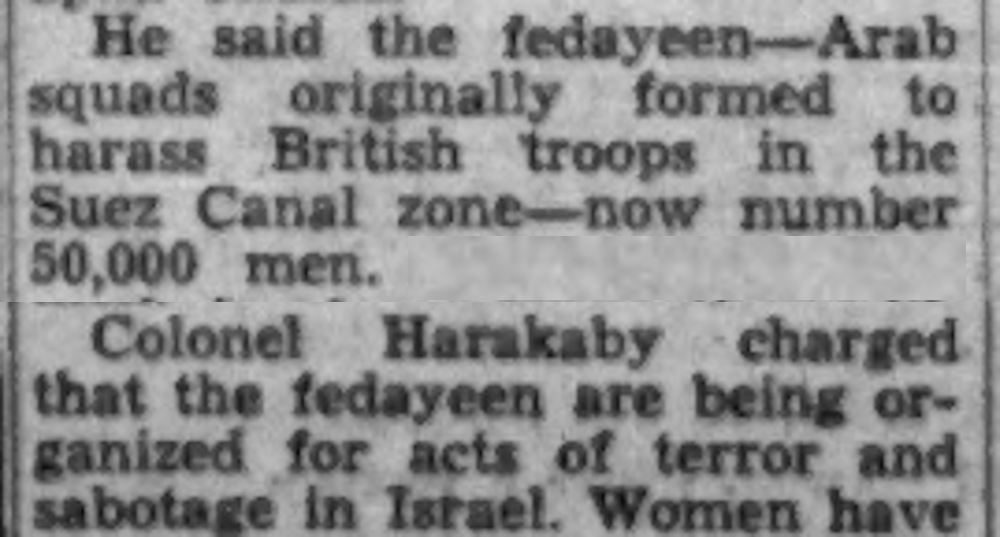
Fedayeen (commandos/terrorists)
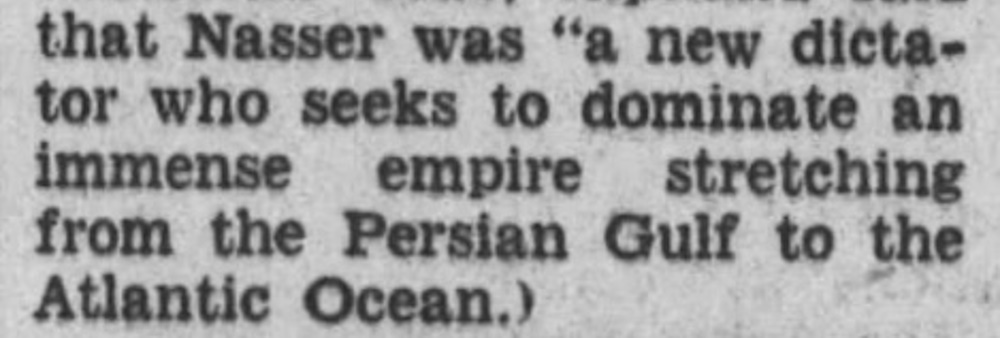
In 1954, Nasser was the new leader of Egypt after his group of army officers staged a bloodless coup in 1952 against King Farouk. He was Israel’s main antagonist and a global menace.
Herve Alphand, French Ambassodor to America, in Washington Evening Star –
Sep. 8, 1956. Full page.

The Guardian (UK) – May 11, 1954. Full page.
Associated Press (in Christian Science Monitor) – October 8, 1955. Full page.
Israel’s earlier claims of Egyptian fedayeen were at first not believed by the UN.
A few hundred Israelis were murdered and many more injured during this period.
In February of 1955, three Arabs from Gaza infiltrated Israel, stole official documents from a government building, and then murdered an Israeli. One of the men was caught and linked to Egyptian military intelligence. Israel responded with Operation Black Arrow that targeted an Egyptian army base near Gaza City, resulting in 38 Egyptian military deaths and 8 Israeli.
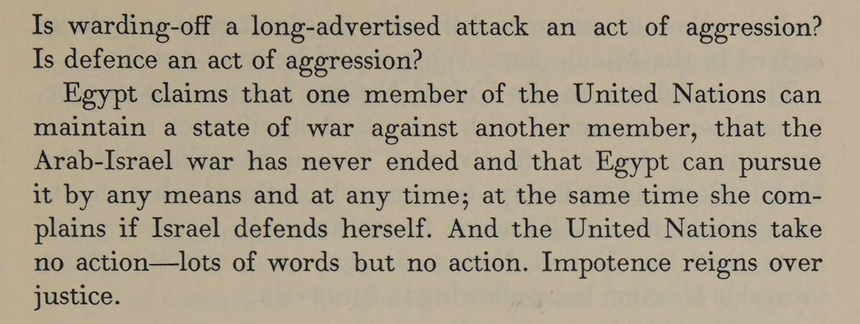
The most significant part came after: The UN Security Council passed Resolution 106 that condemned Israel. Nothing specific against Egypt and its support of fedayeen. A British diplomat, Pierson Dixon, actually said, “…call to Israel to take steps to prevent all retaliatory action in the future.”
The foolishness of the UN’s position was expressed well:
Middle East Diary 1917-1956 by Col. R. Meinertzhagen, p.301. Archive (login).
Similar:
Israel’s legal and moral arguments to the UN, compiled in
Middle Eastern Affairs – December 1956. Full two pages.
Why did much of the world act in a backwards manner even in those days? The need for Arab oil and fear of the Muslim radicals.
The funny part is that Israel did eschew reprisals for a number of months before Operation Black Arrow. It obviously did not win Israel any goodwill with Egypt or the UN.
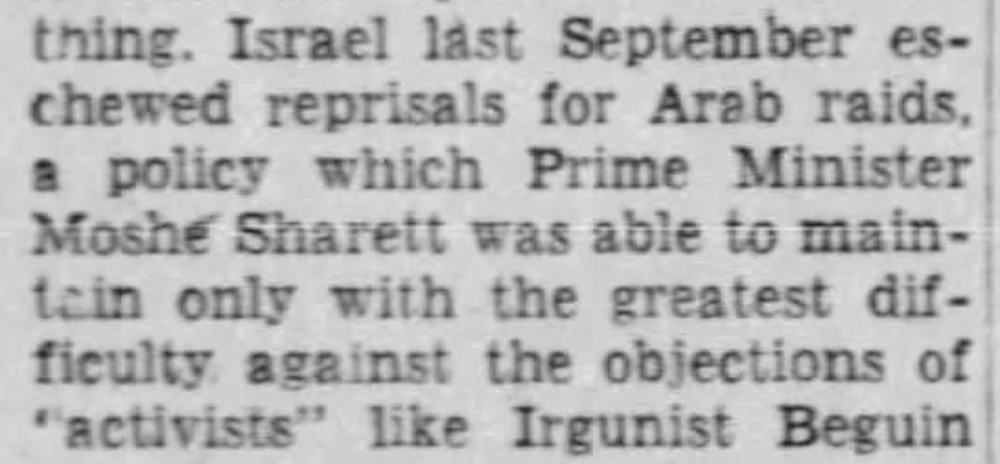
Worldwide Press Service (in Edmonton Journal) – March 11, 1955. Full page.
The article, starting on Page 1, notes the issue of selective media coverage.
Hostilities continued…
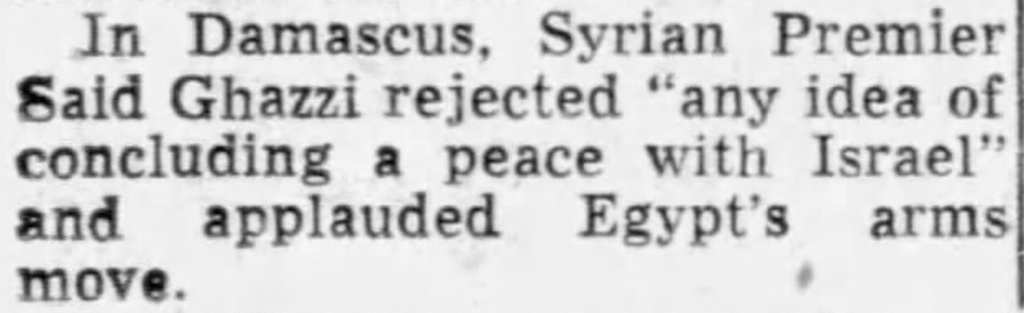
Associated Press (in Baltimore Sun) – October 4, 1955. Full page.
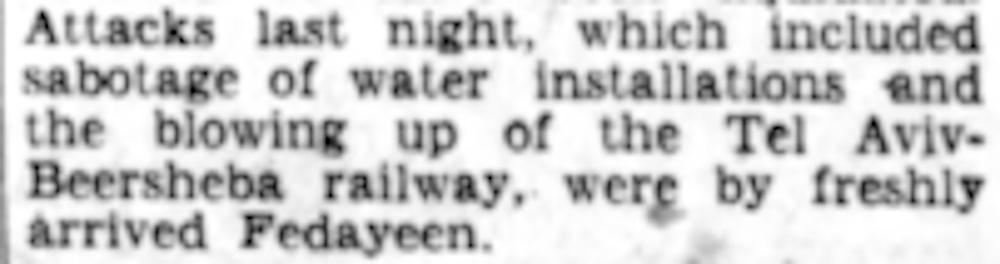
Daily Telegraph and Morning Post (UK) – April 11, 1956. Full page.
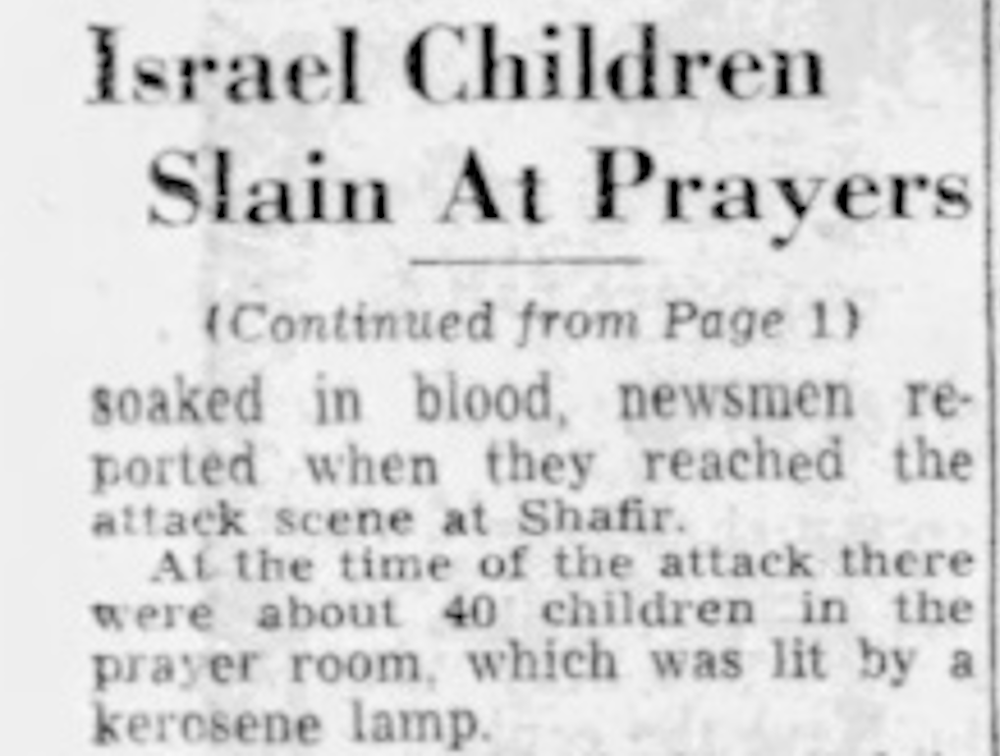
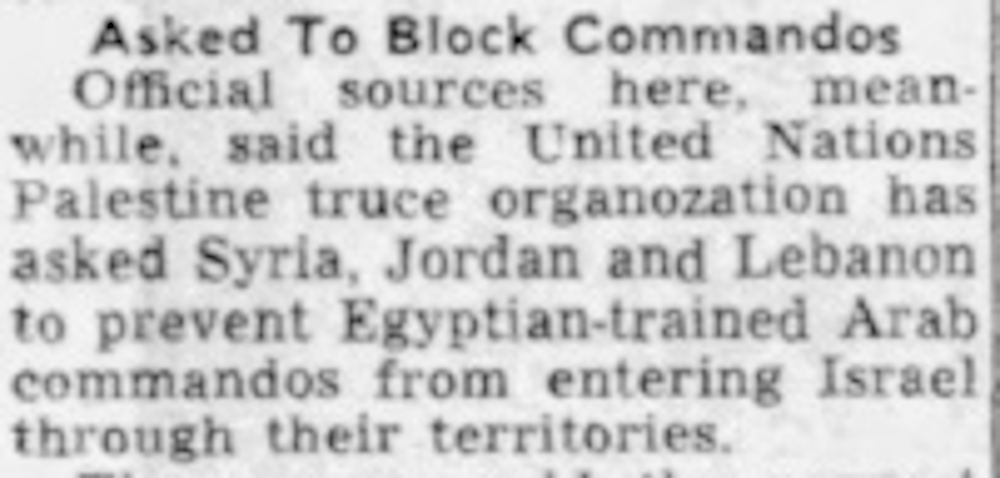
Associated Press (in Baltimore Sun) – April 12, 1956. Full page.
Only when things got out of hand did the UN take a stand.
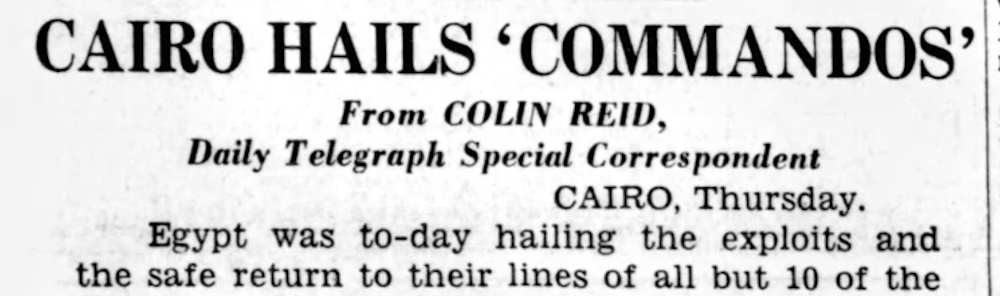
Daily Telegraph and Morning Post (UK) – April 13, 1956. Full page.
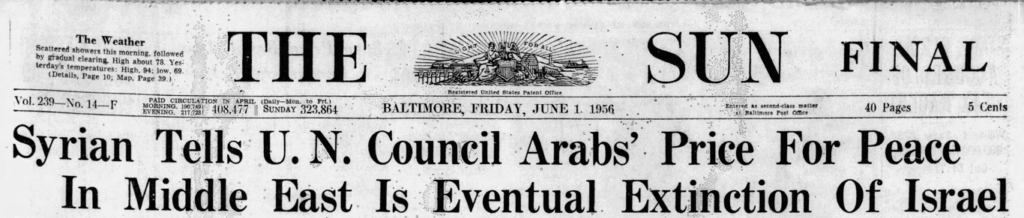
Ahmad Shukairy, assistant Secretary General of the Arab League.
Baltimore Sun – June 1, 1956. Full page.
The 1956 Suez War
Some places call it the Suez Crisis when the focus is on Britain and France, others call it the Second Arab-Israeli War, and some in Israel call it the Sinai War.
On October 29, Israel attacked Egypt with the understanding from Britain and France. Her main objectives were to reopen the Straits of Tiran, end attacks from the Gaza Strip, and weaken Egypt’s military.
Washington Evening Star – November 2, full page.
Boston Globe – October 31, full page.
Daily Telegraph and Morning Post – Nov. 2, full page.
Britain and France joined the war a few days later with the intention to depose Nasser the dictator and regain control of the Suez Canal.
After the war where Egypt was pushed out of Gaza, Israel was pressured to relinquish control of the Strip and did so with assurances from the United States that Egypt would not again rule it.
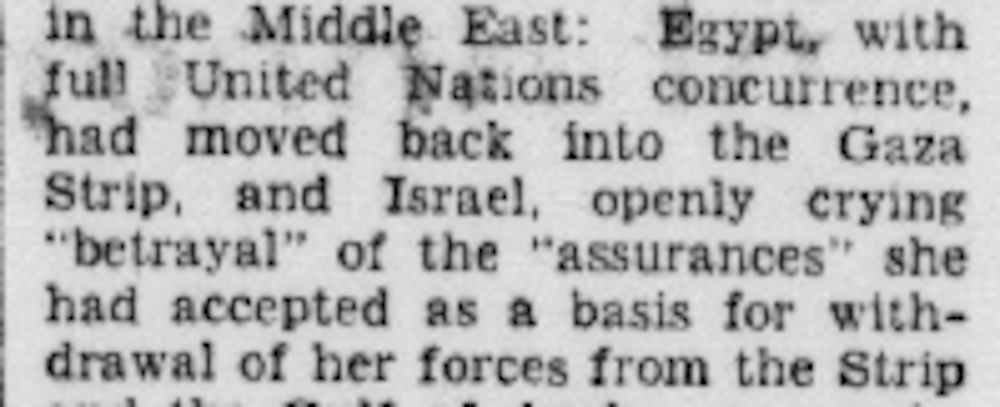
Washington Sunday Star – March 17, 1957. Full page.
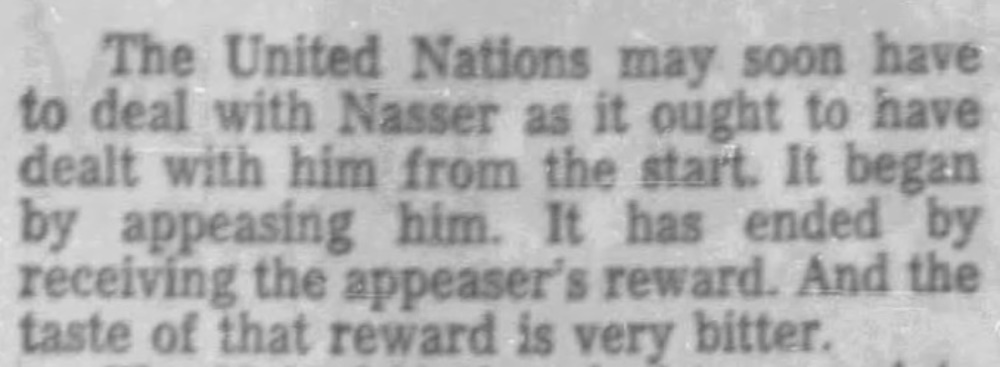

Montreal Gazette – March 13, 1957. Full page.
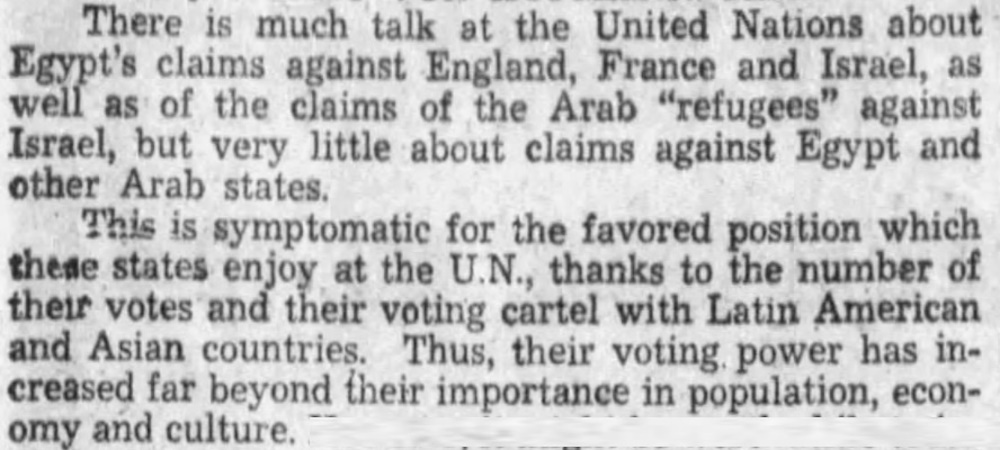
Boston Globe – February 3, 1957. Full page.
Some people saw the big picture very clearly.
Another war was inevitable…