Part 1 – The Irregulars, December 1947 – May 14
(This page doubles as Chronology F.) The title concerns three Big Lies about the war. The first is the origin, and there are degrees of falsehood about it. The second is that the Jews expelled most of the Arabs via a pre-war plan. The last is that there was no valid reason for any number expelled.
Click for a summary of the previous pages.
After the Roman conquest, the Jewish state of Judea became known as Palestine; Palestine was never a state or independent to Muslims since their conquest in the 7th century; the small number of inhabitants were not a nation and identified with their clan, tribe, village or city; Jews always lived there and others returned over the centuries; the Zionist movement began after centuries of persecution and the Jews wanted to return home for security and freedom; for 400 years before WWI the territory was controlled by the non-Arab Turks; there was plenty of room as it was largely barren and malaria-filled when the Zionists bought much land from Arabs and created an oasis; during WWI the Arabs outside Palestine helped Britain in exchange for independence and the UK excluded Palestine- less than 1%; Britain’s Mandate for Palestine from the League of Nations legally established the rights for Jews to recreate a “National Home” while protecting Arab rights as residents; violence against Jews increased; Britain backtracked on the Mandate and the Arab extremists rejected deals that would have given them independence in most and then all of Palestine; the UK failed to achieve peace and handed the matter to the newly-formed United Nations that voted in favour of a plan in November 1947 to divide the territory into two states- with unrealistic borders and the Jewish domain being 40% Arab; the unofficial Arab leader in Palestine and the Arab League states rejected the results.
Sections (many have a short version):
The main points,
The war’s origin, The Jews were not so formidable,
Most Arabs did not want war,
Upper and middle class people fled first, December-February,
Grim March (Jerusalem and roads), Deir Yassin and propaganda,
Haifa- the first mass flight, Jaffa,
Plan D, The rest of the Irregulars phase (Safad, tricks).
The main points
All of the displaced were a consequence of the Arab war against the UN’s Two-State Solution. No war = no refugees. The Arab militants and states started the war and lost. Had they won, the Jews- without a nearby safe haven- would have suffered a much worse fate than 700,000 displaced by a few kilometres. Nakba is propaganda because it erases Arab culpability and distorts the rest. If anything, it should be commemorated as the consequence of Arab/Muslim extremism.

Beirut Telegraph – September 6, 1948. Quoted in
The Trouble with Islam: a Wake-up Call for Honesty and Change – 2003, p. 105
by Irshad Manji, a Muslim journalist. Archive.


Former Prime Minister of Syria in his memoirs. Original Arabic pp. 386-7. Cover.
Mudhakkarat Khalid al-Azm – Vol 1 – 1972. English translation by DeepL. Full.
(“A million” was inaccurate.)
The simplistic breakdown is that a majority of the Arabs fled and a minority were justifiably expelled. A clearer picture emerges with the factors behind departure and the first two were paramount.
- The expectation of returning after an Arab victory
- Messages to leave by political and militia leaders

Ma’na al-Nakbah by Constantine Zurayk – August 1948, p.. 5 (12 of file).. Archive.
Translated by R. Bayl Winder in 1956 as “Meaning of the Disaster”.

Research Group for European Migration Problems (REMP) – Vol. 5 No. 1 1957, p. 10.
Full page (with 11). Cover. (Photocopies, and the publication can be verified.)
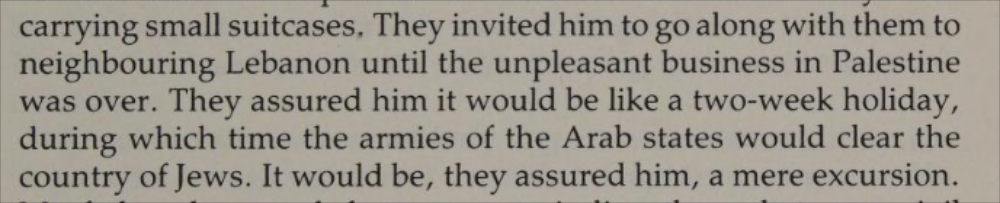
Among Arabs and Jews: a personal experience 1936-90, p. 83. Archive.org.
By P.J. Vatikiotis, a Greek Gentile from Haifa and eyewitness.
Arab political thinking ignored the possibility that Palestinian towns might fall, relying instead on the Arab armies’ ability to liberate them after May 15. This was one of the main causes of the Nakba.
Political Leadership and Institutions in Palestine, 1917-1948, p. 638 (PDF).
By Bayan Nuwayhed. More below on her and the 1981 Arabic book.

Monsignor George Hakim in REMP, p. 10.
Mahmoud Abbas, Chairman of the Palestinian Authority since 2005, and others talk about leaving based on directives from various Arabs.
Palestine Media Watch (PMW) has another video (plus text) with a few different parts.
The leaders and the elites promised us at the beginning of the Nakba in 1948 that the duration of the exile would not be long, and that it would not last more than a few days or months, and afterwards the refugees would return to their homes, which most of them did not leave until they believed the false promises made by the leaders and the political elites.
Mahmoud Abbas’ advisor, Mahmoud Al-Habbash, in the official PA newspaper
Al-Hayat Al-Jadida – Dec. 13, 2006. PMW.
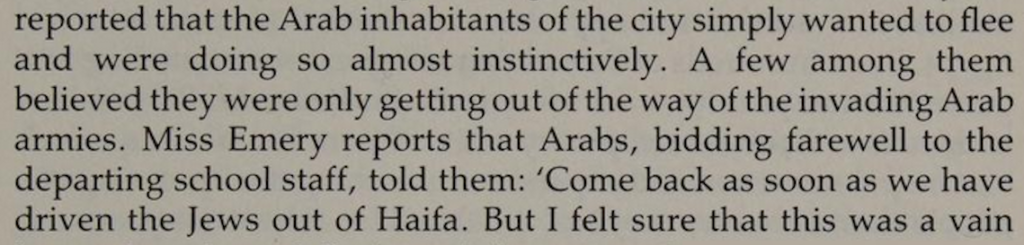
Vatikiotis, p. 81.
The Arab Salvation Army told the Palestinians: ‘We have come to you in order to exterminate the Zionists and their state. Leave your houses and villages, you’ll return to them safely in a few days.’
PA journalist Jawad Al Bashiti in Al-Ayyam newspaper- May 13, 2008. PMW.
The next set also deserves special attention, especially the first as it set the train in motion and established a precedent.
- The early flight of 75,000 upper and middle class people
- The evacuation of women, children and elderly
- Fear caused by the desertion of militants and leaders

Telegram by Alan Cunningham, High Commissioner for Pal. – April 26, 1948. Full doc.
© GB165-0072 Cunningham Collection, Middle East Centre Archive, St. Antony’s College, Oxford.

United Press (in Pittsburgh Press, USA) – May 3, 1948. Full page.
Some officers and military commanders deserted before the final battle.
Nuwayhed, p. 639.
(“Some” is being kind. “Final battle” = Arab League war of May 15.)
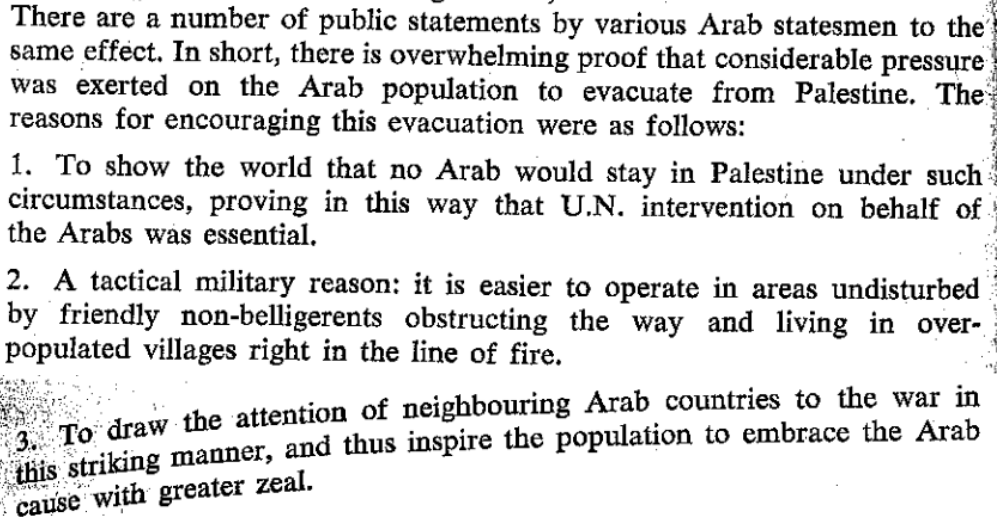
REMP, p. 10-11.

Birth of the Palestinian Refugee Problem Revisited – 2004, p. 176 on Archive.
By Benny Morris. Also p. 174.
With these links, the text can be seen even though the book is unavailable. More below about it and Morris.

The Palestine Arab Refugee Problem and its Origin – 1990 by Shabtai Teveth.
P. 225 (13 of file); also p. 224. Full JStor PDF or on Emory.edu.
It’s a review of Morris’ Birth from 1987 that expertly refutes key points.
The third set is still exclusively Arab.
- Safety from Arab gangs (extortion, looting, etc.)
- Threats against remaining in the Jewish domain or not fighting for the cause
- Demoralization by the flight of upper and middle class folks
- Fear due to ineffective fighters
- Propaganda-expectation of revenge for what the Arab extremists did to the Jews
- Fright from other propaganda and especially surrounding Deir Yassin
- Unease in areas that were isolated
- The snowball effect after the Arab decision to vacate Haifa
- Men who didn’t want to separate from their evacuating families
- After May 15, fear due to the largely ineffective Arab League armies
- No desire to live in the Jewish state, or irrational fear of how they would be treated

Toronto Star – Dec. 1, 1947. Full page.

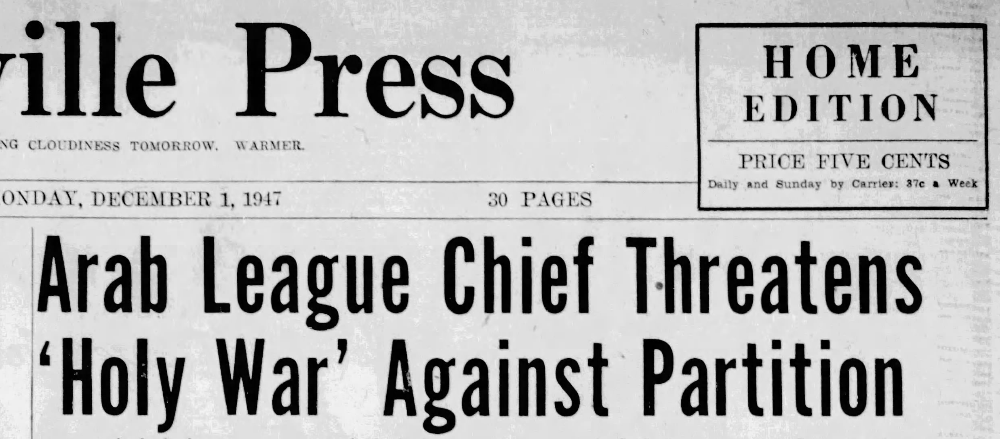
International News Service (in Buffalo Evening News) – December 1, 1947. Full page.

Evening Standard (UK) – January 10, 1969. Full page.
By Harry C. Stebbens, who worked in the British Mandate government.
The most dangerous thing for us was the [Arab] media… Every night towards evening I would read the paper to the elderly… They heard that in a certain town, the Jews did this and that. They killed and slaughtered. Of course, the newspapers lied, and the radio also lied. In other words, they deceived the people.
Muhammad Khana from Zakariya on official PA TV – May 14, 2022. PMW.

Cunningham.
My grandfather and my father told me that during the Nakba, our district officer issued an order that whoever stays in Palestine and in Majdal is a traitor…
A man from Majdal (Ashkelon) on official PA TV – April 30, 1999. PMW.

Teveth, p. 228 (16).
Teveth was a highly regarded Israeli historian and journalist.
The last Arab set is about war, with some overlap with the above and especially the flight of the well to-do as they created a cascade of consequences behind further departures.
- General safety
- A breakdown of services and law and order
- Unemployment
- Skyrocketing prices
- Food scarcity
- The Jewish response to the Arab war
Jewish defence has two categories.
- Legitimate
In the spring of ’48 when the Jews needed to secure certain areas and intended to keep the residents in place, the mere sound of them approaching, yet alone the initial gunshots of a battle with militants, usually caused a departure because the people were teetering from previous factors. The expectation of a return was still decisive.

In a sample of 100 people out of 70,000 in a camp of refugees from 1948, 68% said they left without seeing Israelis/Jews.
River Without Bridges- A Study of The Exodus of the 1967 Palestinian Refugees by Beirut’s Institute for Palestinian Studies – 1969, p. 43 (57 of file).
The sample size is mentioned on page 21 (35).
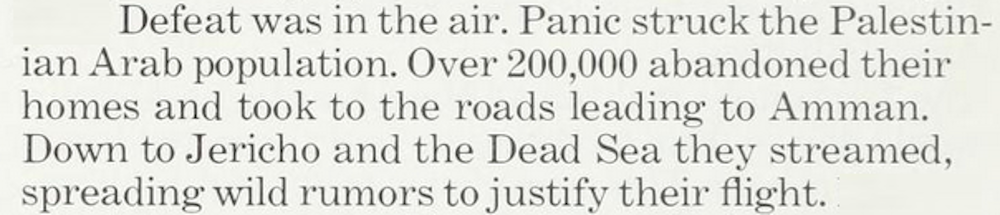
John Phillips’ A Will To Survive, page 7. Archive.org.
Events before May 15. A Life magazine photojournalist, he witnessed part of the war.

A journalist had natural thoughts after speaking with refugees.
Atlantic magazine (USA) – October 1961, page 52. Link.
Even when the Jews needed to clear certain villages, the inhabitants often saw it as a better option by that point. Many times they weren’t instructed to leave the Jewish domain, but did so instinctively or with British assistance.
The Jews were justified in securing or clearing villages that were used, or could have been used, by militants, terrorists or soldiers to attack nearby Jewish areas or infrastructure, and to block invasion routes from Lebanon, Syria and Jordan.

Ismail Safwat, Arab Liberation Army commander – March 23, 1948.
Page 8 (of 10) in his report translated by Walid Khalidi. Full PDF.
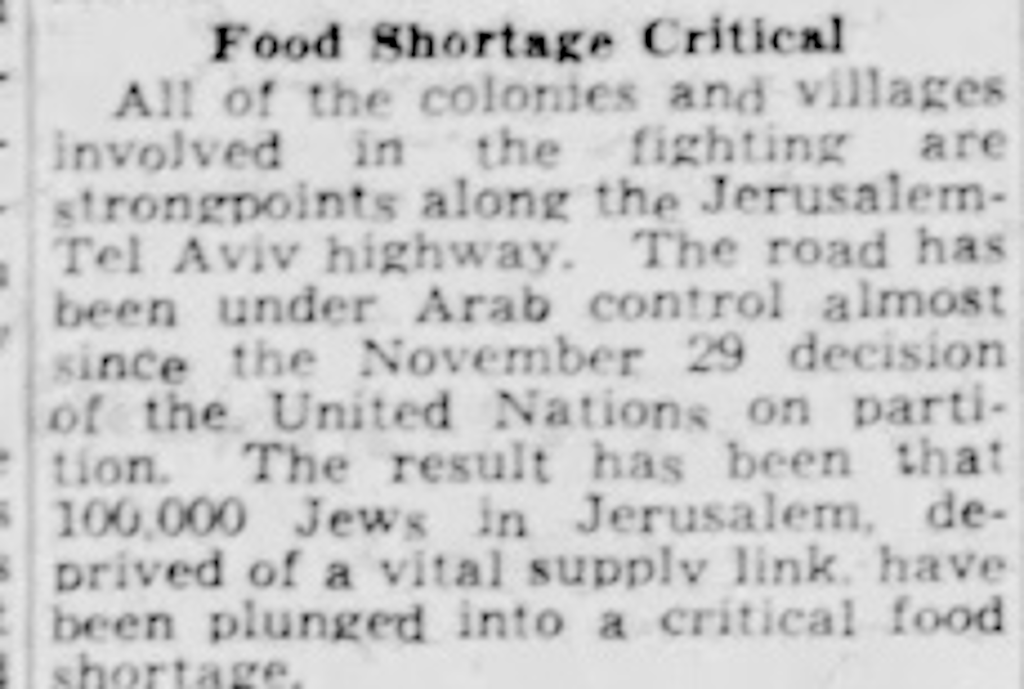
Associated Press – April 11, 1948. Full page.

New Star In The Near East – 1950, p. 30. Full page, Archive.org.
By Kenneth W. Bilby, a correspondent for the Associated Press and New York Herald Tribune who was on the ground in 1948.
That means the Haganah (official Jewish defense force) was behind some of the exiting, but it was legitimate for war so the blame goes in the Arab tally. The only guilt attached to it is minor and mostly from individuals who acted in an unauthorized or rogue manner (some below, also Part 2), and that increased the fear in a small percentage of Arabs as most didn’t know of it at the time.
- The Hebrew extremist groups
Most of their activities were sinful. They left a stain on the whole community and gave the critics and haters ammunition that is still exploited as part of the alternate reality of 1948 where the Jews were the aggressors. At the time, their strikes were magnified beyond their actual reach by Arab propaganda to a gullible populace.

Sir John Troutbeck, head of the British Middle East Office in Cairo,
after a refugee fact-finding mission in Gaza in 1949. FO 371/75342/E7816. Quoted in
The Mideast Peace Process: an Autopsy by Neal Kozodoy – 2002, p. 126. Archive.

Zurayk, p. IX.
As a few of his clips show, the man who applied the term nakba to 1948 did not accuse the Jews of expelling Arabs. (A majority were gone when he published it in August, and twice he wrote “forced” in a general sense.) The booklet is about the Arabs’ own issues in failing to defeat the Zionists.
In most cases, moving saved Arab lives because they would have otherwise been trapped between the two warring sides. Like in Gaza. Clips show that Arab leaders had the same reason- amongst a few- for some of their calls of evacuation. (Also Teveth, p. 229/17.)
Most of those who remained in the Jewish state after the war were Christians and Druze because they did not fight the Zionists. (Some Druze did at first, then they switched sides after a defeat. Teveth, p. 240/38.)
Unfortunately, some armies of the Arab regimes participated in persuading the people and towns to flee and leave their homes, under the pretext of defending and fighting the Zionist gangs. The Palestinians believed them and trusted them, so the families withdrew in the hope of defeating the Zionist gangs and breaking their power. But then the armies were defeated, lost, fled, and surrendered Palestine.
Ibrahim Al-Madhoun, Hamas-affiliated Gazan journalist – May 15, 2022.
Original Arabic site, Google translated, MEMRI article.

The Lesson of Palestine, a translated essay by Musa Alami , in
The Middle East Journal – Oct. 1949 Vol. 3, Issue 4, p. 381. Full page, Archive.
It’s preposterous to say all this evidence- plus below and on Page 2- applies to just a small percentage of the refugees, or that it does refer to most but people somehow didn’t realize the Jews were behind it. (We’re verifying even more and, if any, they’ll be noted in Updates.)
Mr. Alami, after the above clip, contradicts himself and says the Jews were indeed behind the evacuation- and he quotes a Beirut newspaper article from 1948 where the Irgun’s Menachem Begin explicitly says so. It’s such a bald-faced lie that no one else references the paper.
A small degree of necessary expulsion was documented at the time. For many years Israeli propaganda denied the rest and focused on the majority of truth (Part 2). It took until the 1980s for more of the story to come out with the opening of Israeli and British archives. It’s only because so many Arabs fled that the Jews were able to disguise their role behind some of it. The British, UN officials, a few reporters and other neutral parties would have seen or heard if it were the other way around.

Zurayk, p.. 26 (33 of file).
(The “battle” is the Arab League invasion.)
On May 18 when about 300,000 Arabs had already left their homes, Egypt’s representative at the UN Security Council, Mahmoud Bey Fawzi, merely said:

UN SC Official Records, No. 68, 294th Meeting, p. 6 of file. UN.org.
The bigger a lie, the more difficult it is to keep. As it were, people in the years afterwards questioned Israel’s story. If the cover-up had been any larger, the questions would’ve burst the bubble before the 1980s.
Finally, notice the difference in sources from those presenting the alternate reality: excerpts out of context, thoughts over actions, exceptions inflated into norms, disparate truths conflated into a narrative, and unreliable reports or witnesses. Mostly, the interpretation of things by just a handful of Jewish historians after the mid-1980s- whose key points have been refuted by a larger number of their peers, scholars pundits and, of course, this site. (Part 2.)
The war’s origin
Those who are familiar with the previous pages understand that obviously the Arabs launched a fresh round of violence after the Partition Plan vote.
Many anti-Israel voices don’t realize the contradiction: They are proud of the fight against Zionism/Israel since WWI- and those who rejected Partition didn’t do anything about it?
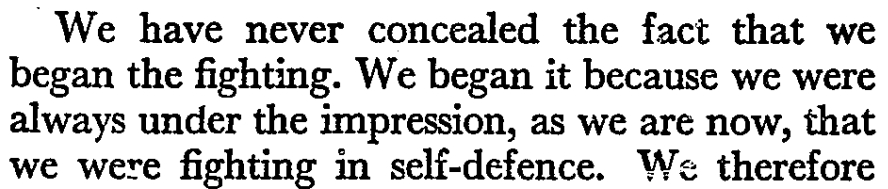
Jamal Bey Husseini of the Arab Higher Committee to the UN Security Council.
UN SC Official Records- No. 62, 287th Meeting, April 23, 1948, p. 14 (16 of file).
“Self-defence” against Partition.

International News Service (in Buffalo Evening News) – December 1, 1947. Full page.
The fighting had developed considerably from the war’s beginning through May 15. What had begun with explosives being thrown at [Jewish] buses on the road between Jaffa and Jerusalem had become a demand for prolonged resistance…
Nuwayhed, p. 616.
She acknowledges the Arab instigation and then calls it resistance when the Jews fought back.
Bayan Nuwayhed al-Hout…(click)
She was a respected journalist, academic and historian in Arab circles, and a member of the PLO (Palestine Liberation Organization). Chapter 4 of the book covers the Irregulars and is replete with disinformation and misinformation, though she states the need for Jewish and British sources to provide a comprehensive study (bottom of p. 630).
The PDF pages are from a scan of the book where OCR did not succeed. Duck AI was able to read them and the quotes are from its translation. Page 616 above has the Chapter 4 title. © Institute for Palestine Studies.

Associated Press (in Indianapolis News) – December 1, 1947. Full page.
More: “1948 as Jihad” by Benny Morris– video (starts at 7:00) or text.

Daily Telegraph and Morning Post (UK) – Dec. 1, 1947. Full page.

Montreal Daily Star – Dec. 1, 1947. Full page.
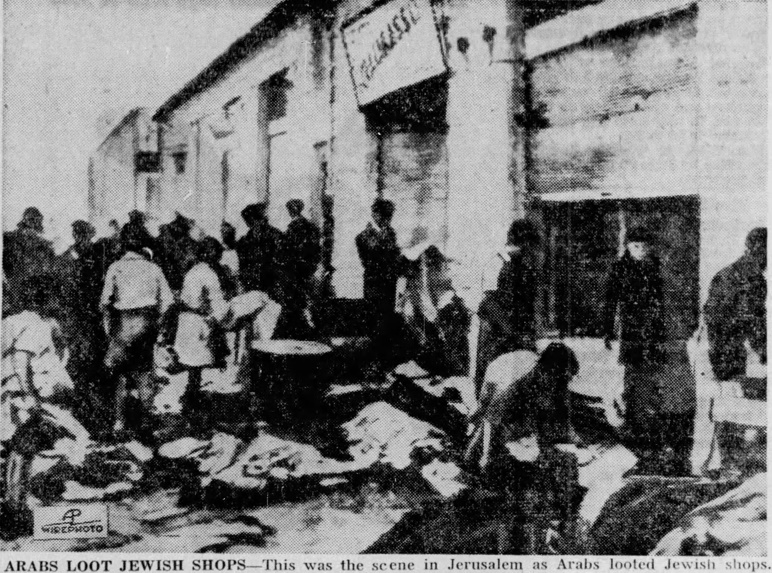
Baltimore Sun – Dec. 3, 1947. Full page.
Arabs loot Jewish shops in Jerusalem after the Partition Plan vote.
The British police stood by and even assisted the rioters (Milstein, p. 39).
Dr. Uril Mistein’s History of the War of Independence Vol. II – 1996 …
Like the man, the four volumes (more were planned) are highly respected, and he poked holes in the lofty image of the Haganah/IDF at this time. They don’t say much directly about the refugees.
The Jewish Agency (pre-state government) spoke of peace, as it did in prior years.

Associated Press (in Washington Evening Star) – Dec. 1, 1947. Full page.
More below in Plan D.
Despite all the evidence that the Arab radicals strove to end Zionism, most of the information out there today is various degrees of wrong. On the seemingly innocent side, some outlets obscure the start by saying things like "fighting broke out" in 1948. Worse are the implications that the Jews were at fault, as with "Israel's violent birth". Outright lies declare the Jews commenced fighting after the Partition vote, and/or the Arab League invasion in May 1948 was a response to Zionist violence.
The last one is covered in Part 2 as there were two phases in Israel’s War of Independence. The Irregulars began after the UN vote and involved militias, terrorists and some Arab League soldiers, and the Arab-Israeli War began on May 15, 1948 when Egypt, Jordan, Iraq, Syria and Lebanon invaded the newborn Israel.
Morris. p. 7.
By Benny Morris…
He’s the biggest name of Israel’s “New Historians”. While the book has flaws, we use it for certain details that are from British or Israeli archives and because anti-Israel propagandists highlight some parts and not others, take some lines out context, etc. More about all this in Part 2.
We hope to eventually replace his references with the originals.
The Jews were not so formidable
The fallacy of the Zionists being the aggressors in 1948 is specifically a portrayal of the war as the Big, Bad Jews against the poor, little Arabs. Does the following reflect that?
April 8, 1948: …tally of casualties reported to the police over a period of about four months, with 851 Jews and 960 Arabs dead, and 1757 Jews and 1967 Arabs injured.
Journalist Robert Conway, who was on the ground in 1948.
From his archive’s home at American Heritage Center, University of Wyoming.
The Zionists had an official militia in the Haganah and two extremist groups, the Irgun and Lehi (aka Stern Gang). Overall, they were more determined, better skilled and more resourceful than the Arab opponents. They had no safe haven to fall back on, no support from a nation’s army, and were defending a millennia-long dream that the UN partially granted.
At the end of December 1947, as Arab militants did not heed their warnings to stop fighting, the Jews were in a fragile position that prompted them to ask the UN and United States for help. It was denied.
Their doubts are reflected in the demands recently made on the UN and the US for help to protect and bolster the nascent state.
Does this sound like aggressors?
The Consul General at Jerusalem (Macatee) to the Secretary of State.
Foreign Relations of the United States, 1947, The Near East and Africa, Volume V
Dec. 31, 1947. Link.
Also: Milstein, p. 190.
The Haganah was not as sterling as they were later portrayed. It was difficult to transition from an underground militia into a state army, units followed different political parties, and there were commanders who shrank in fear or were not the brightest military minds. The pressure was overwhelming- different opinions about the best defense, local battles, external war, and concerns about reactions from Britain, America and the UN. (JewishPost summary of Milstein‘s books.)

Milstein, p. 19.
Assessment by the Haganah’s Commander-in-Chief in October 1947.
In December, the Haganah had 2,000-3,000 commandos and a few more regular combatants. The rest of its 35,000 members- mostly guards and civilians- were trained as the months passed. The Irgun also numbered 2,000-3,000 and Lehi fewer than 500.
The Jews had more automatic guns than the Arabs, and acquired better ones from Czechoslovakia in early April (Milstein, Vol. III, p. 162; Morris, p. 16).

Safwat, p. 4 – March 23.
If the Jews had been vastly superior, their morale would have been high.
The Irgun and Lehi opposed Partition, but were too small to affect it. Early on, the Haganah issued orders against them (Milstein, bottom of p. 62 and p. 63), and the two groups acted on their own and usually in violation of Haganah policy. Later, the Haganah needed their assistance to defend the impending state.
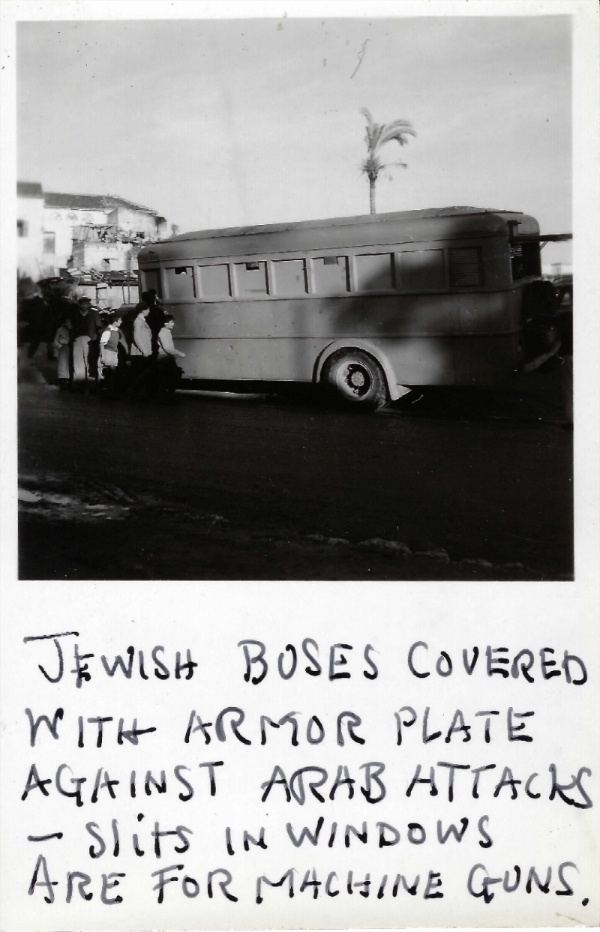
Picture and caption by Conway.
The Jews were on the defensive.
Only in early May did they get artillery- and its shells were merely the equivalence of two grenades (Teveth article). Two platoons deserted, there were food shortages and a hunger strike over a lack of financial support (Ben-Gurion diary with English).
Other examples appear below and in Part 2: outnumbered, ill-prepared.
Teveth argues that Arabs didn’t flee because of Jewish superiority, but that the fleeing allowed the Jews to attain superiority.
Early on, Jewish officials proclaimed the Haganah had tens of thousands of trained soldiers (AP article), but that was an exaggeration in the hopes of deterring the Arabs. The likes of Safwat, Khalidi and Nuwayhed took it at face value. Only in May were all the Haganah members combat-ready to match a similar number of Arab League soldiers, and they were under-equipped (Morris, p. 16).

The line between perspective and extremist-Arab delusions sometimes gets blurry. Meaning, some people who opposed Partition and Zionism viewed Jewish defence as offence. Instead of survival and necessity, they saw "conquest" in the Jews' training, attempts to smuggle in weapons, and Jewish factories for ammunition. This has been a constant throughout the conflict- whatever Israel has done has been framed as aggression against all Arabs instead of a reaction to the Arab/Muslim radicals.

The elephant in the room: The Arabs in Palestine were double the Jewish population and there were approximately 60 million more in the Middle East.
Most Arabs in Palestine did not want war
Some call the Irregulars period the Palestine Civil War, but that’s specious when a majority of the Arab militants were from outside Palestine. In the continuation of feelings from years earlier, most locals opposed violence and the primary goal of the leaders in rural areas was to continue their clan way of life, whether that was in an independent Palestine, Jordan or Israel..

Foreign Relations of The United States, The Near East…, Vol. 5 Part 2 – 1948.
Conclusion from the American Consul at Haifa, Aubrey E. Lippincott.
Safwat, p. 6.
It is an often-forgotten fact that only a few thousand Palestinians out of a population of 1.3 million volunteered for the Arab Liberation Army…
Army of Shadows: Palestinian Collaboration with Zionism, 1917–1948 by Hillel Cohen in 2008 on JStor. Full page 2, similar page 3.

Morris, p. 87.
AHC = Arab Higher Committee. HIS-AD = Haganah Intel. Service – Arab Dept.

Palestine Post – December 1, 1947. Full page.
Many Arab villages and quarters turned away Arab militants at first, and had nonaggression pacts with the Jews.

City of Oranges: An intimate History of Arabs and Jews in Jaffa – 2006, p. 109.
By Adam LeBor, UK journalist (The Independent and The Times).
The text can be seen on Archive even though the book is unavailable.
More:
Morris, p. 90, p. 91, p. 94, and clips below in specific instances.
The fighters
The Arabs had a major militia- the Arab Liberation Army (ALA), aka Rescue (ARA) and aka Salvation (ASA)- that mostly comprised of volunteers and paid actors from outside Palestine. Their numbers grew as the months passed. Then there were a few smaller groups and individual terrorists. In total at the peak, about 10,000 – 12,000, and this excludes defenders of their own village or area.
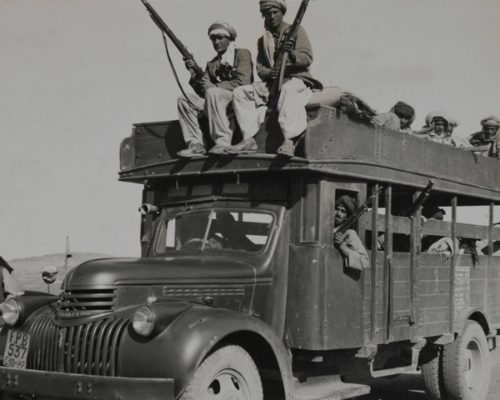
Unbeknownst to the Jews at first, the Arab League states had an agreement with Britain not to interfere while she was still present (Milstein, p. 178).
Time magazine (USA) – Dec. 22, 1947. Full page.

Phillips, p. 7.

al-Azm, p. 386.

Zurayk, p. 26..

Phillips, p. 7. (A few months into the war.)
Though he was in exile, the unofficial leader of Muslim affairs in Palestine was the Mufti Haj Amin al-Husseini. He did not have a war plan per se and, via the AHC, called for assaults against Jews as a way to induce the Arab League invasion and to “show” the UN that Partition was unworkable. Many militants acted beyond his directives or on their own.
The ALA had larger weapons than the Jews, such as artillery and cannons (Milstein, p. 57). They were eventually defeated because of inferior training, organization, and unity.
The lack of a unified and effective military command, which meant there was no comprehensive defense plan. Instead, there were multiple commanders in the field, with all the problems this entailed—particularly a lack of coordination.
Nuwayhed, p. 638.
The page has many specifics on the topic.
Arab society in Palestine was still largely fragmented by clans and tribes.

Safwat, p. 8.
His report details the inefficiencies of the ALA, issues with Arab League support, etc.
Also, since WWI the Jews developed the institutions of a government that prepared them for independence (Archive), while the Arab extremists spent their time and energy trying to stop the Zionists.
More:
Zurayk, pp. 26-27.
The Myth of Palestinian Centrality by Prof. Karsh – 2014, bottom p. 27.
Milstein, p. 62 and 159.
Upper and middle class people fled first
75,000 Arabs with the financial means departed between the Partition vote in 1947 and the end of March ’48. This was colossal and set the tone for everyone else.

Vatikiotis, p. 81.
Monsignor Hakim quoted in a US Congressional Record – July, 1949.
People did not want to be harassed and robbed by Arab gangs as they were during The Revolt of 1936-39. Also: Morris, p. 594.
Two more clips about the Revolt…

Vatikiotis, p. 30.

A Survey of Palestine Vol. I- 1945-46, page 211. Archive.org.
Sydney Morning Herald (Australia)- May 6, 1948. Full page.

Time magazine – May 10, 1948. Full page.
Similar:
The Times (London) – May 5, 1948. Page.
St. Louis Post-Dispatch – April 24, 1948. Page.
Another reason:

REMP, p. 10.
Some pundits treat the departure of the well-to-do as a minor affair. It cannot be understated. It had more than a ripple effect, it had a tidal wave effect: unemployment, a breakdown of services, demoralization, etc. It pushed the rest of the populace closer to the edge of flight. The huge and obvious impact was understood at the time.
Cunningham. (Brits were usually understated.)

REMP, p. 11.
Daily Telegraph and Morning Post (UK) – May 5, 1948. Full page.
(Other specific consequences are in other sections.)
Again, the feeling that flight would be temporary due to an Arab victory made it easy to leave behind most of their belongings.

Vatikiotis, p. 60.
Meanwhile, attacks caused about 10,000 Jews to flee southern Tel Aviv (Milstein Vol. III, p. 72) and the new part of Jerusalem (p. 88), even though Britain was supposed to protect the latter until it became a separate UN entity as per Partition (p. 193).
December – February
The Irregulars was an ugly guerilla war mostly conducted in civilian areas. (The unification of Saudi Arabia by 1932 had far more death and violence, but the world has never cared when Arabs kill each other.)
Aside from rifles and some automatic guns, there were grenades, mortars and homemade bombs. Some fighters had helmets. The British occasionally used their superior weaponry. Forces from Jordan’s Arab Legion- trained and headed by Brits- were deployed in parts of Palestine, but mostly acted as guards until May.
The short version…
Despite all the Arab rhetoric, Zionist leadership felt that the outbursts after the Partition vote were similar to the Revolt of 1936-39 and not a prelude to a war. Just a week later, after their warnings to the militants were not heeded, they focused on attacking Arab transportation and militia bases.
Arab attacks served no purpose other than to kill or expel Jews.
Associated Press (in SF Chronicle) – Jan. 16, 1948. Full page.
..and they [Arab volunteer fighters] excelled in ambushes and road battles, particularly on the Jerusalem–Jaffa road and in attacks on settlements, especially those in the Hebron area.
Nuwayhed, p. 619.
Occasionally the truth about the fighting slips from her.

Milstein, p. 63.
The Jews assumed the British would continue policing affairs and feared their response. Instead, the English largely let the two sides fight it out.
Boston Post (USA) – June 5, 1948. Full page.
By Robert Kennedy, on events from 2-3 months earlier when he visited.
The Jews minimized civilian casualties.

Milstein, p. 134.
Concerning Haifa. The Times (London) – April 22, 1948. Full page.
On the other hand, the extremists…
Associated Press – December 31, 1948. Full page.
Jump to next section.
The full version:

Associated Press (in Washington Evening Star) – Dec. 1, 1947. Full page.
More: Milstein p. 1.
Britain and the Soviets knew more about Arab League intentions- Milstein, p. 158.
On December 9, as assaults continued despite Haganah warnings, the Zionists revised their cautious response and focused on attacking Arab transportation and militia bases. (Milstein pp. 113, 131 and 154; Karsh, Betrayed, p. 144.)
Unlike the Arabs, the Haganah debated guidelines that would balance morality and defence.
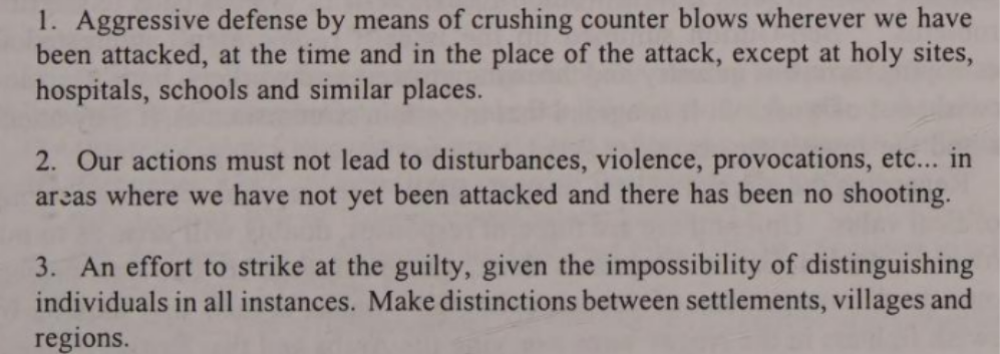
Milstein, p. 219.
More:
JPost article about the evolution of the IDF’s rules, including concerns that restrictions have unwittingly prolonged the conflict.
These refute another type of propaganda that acknowledges the Arabs instigated the violence in December, but says it was minor and the Jews turned it into a war.
Despite written plans since May 1946 about defending their likely domain, the Jews weren’t actually prepared for it and they believed the British would suppress Arab and Zionist actions until their withdrawal (Milstein, p. 24).
They then feared that too strong of a response might cause Britain to intervene against them. Even when they were forced to elevate their responses, they still acted with restraint and this was a factor that led to their dire predicament in March. (Milstein, pp. 24, 103 and bottom of 185.)
The Brits largely let the two sides fight it out.
There were numerous perspectives amongst the Zionists, which explains the different angles in books and articles. Some Jews felt the British were not going to relinquish Palestine and would ultimately help them, some felt the UK was acting against Partition, some were dovish and others hawkish, etc.
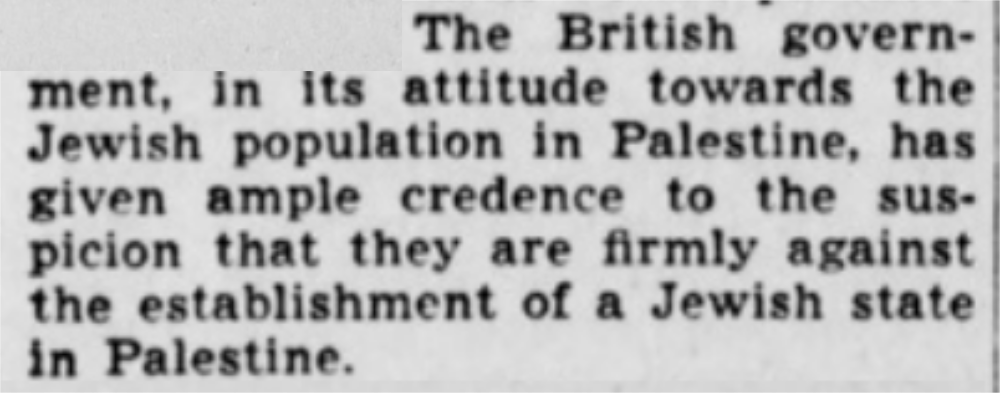
Kennedy, Boston Post.
The Arabs complained that the British helped the Jews and, in typical fashion, the truth has only a few minor examples of it. Kennedy’s article has a few damning specifics.
Escalation
In mid-January, over 400 Arabs- a militia and locals- carried out a well-planned attack south of Jerusalem with the intent to destroy the Jewish communities in Gush Etzion. No military objective. The Zionists repulsed the invasion.
Associated Press (in SF Chronicle) – Jan. 16, 1948. Full page.
More: Milstein, p. 338, JewishAction.
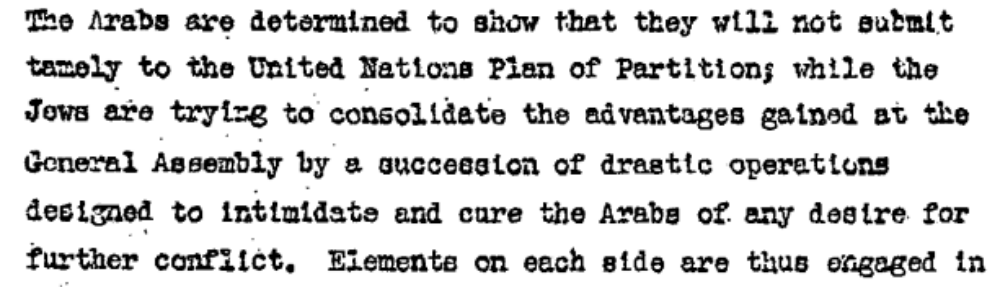
First Monthly Progress Report of UN Palestine Commission to Security Council – p. 7 (8 of file) – Jan. 29, 1948. UN.org.
By the end of January, the British rep quoted did not call the Jewish response purely defensive because they naturally looked beyond temporarily stopping the militants and extremists.
Arab actions
Since 1918, Arab extremists have attacked Jews wherever they were and have seen no difference between security personnel and civilians. The Irregulars phase/war was no different, which also meant that militants hid in, or launched attacks from, civilian areas. (Hamas, with its tunnels under Gaza in the 21st century, took the practice to the extreme.)

Ibid.
..and they [Arab volunteer fighters] excelled in ambushes and road battles, particularly on the Jerusalem–Jaffa road and in attacks on settlements, especially those in the Hebron area.
Nuwayhed, p. 619.
Occasionally the truth about the fighting slips from her.

Safwat, p. 7. Another casual slip.
Milstein, p. 63.

Associated Press (in Galveston Daily News) – January 9, 1948. Full page.

Re: Haifa. Bilby, p. 27.

Bilby, p. 30.
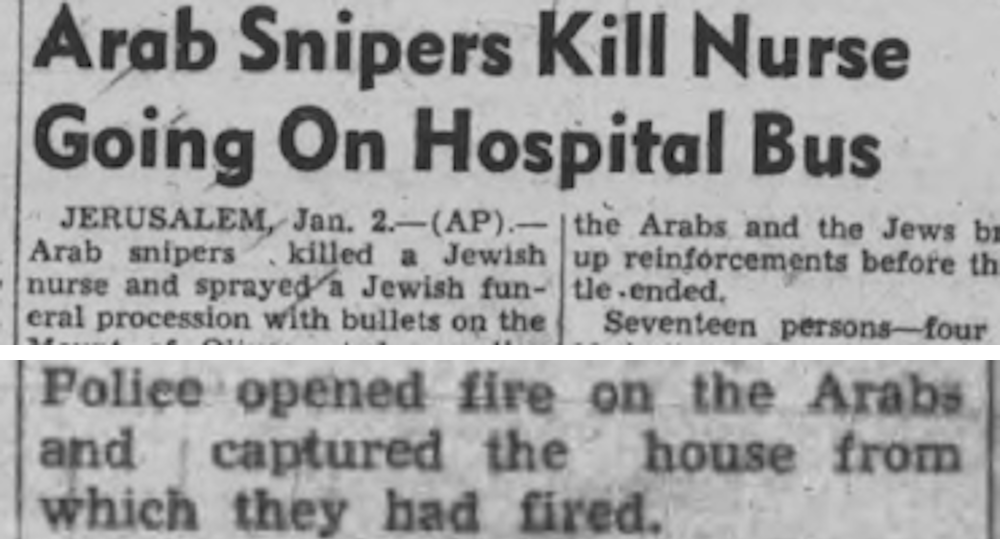
Associated Press – January 2, 1948. Full page.

New York Times – April 14, 1948.
The attack killed 78 people. The hospital served Arabs, too, so once again the militants hurt their own. (Disinformation calls it a battle.)
A Jewish woman, mother of five children, was shot in Jerusalem while hanging out clothes on the roof. The ambulance rushing her to the hospital was machine-gunned, and finally the mourners following her to the funeral were attacked and one of them stabbed to death.
Macatee.
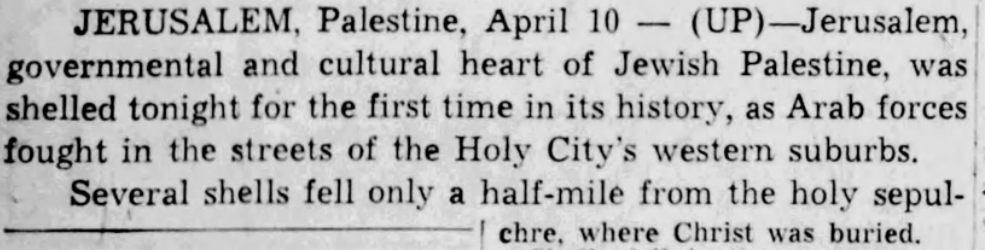
United Press – April 11, 1948. Full page.
More clips…

Events from 1936-39. Vatikiotis, pp.38-39.

United Press (in New York Daily Worker) – Feb. 27, 1948. Full page.
Jewish actions
Specific operations appear further down in context.
Anti-Israel outlets love to emphasize the worst aspects of the war (as if any is decent) and that also means excluding the evidence that the Jews sought to minimize civilian casualties. Alongside stronger measures in December were campaigns of distributing flyers with warnings to not join the fight (Morris, p. 74).
Even when the Irregulars period intensified…
Concerning Haifa. The Times (London) – April 22, 1948. Full page.
Similar: Bilby p. 31. Full page.
From loud speakers mounted on trucks, warnings were shouted in Arabic to women and children to run for shelter.
Concerning Jaffa. New York Times – April 26, 1948. (Use Reader View.)

Concerning Jerusalem.
Associated Press (in Washington Evening Star) – May 5, 1948. Full page.
Milstein, p. 134.
Similar: Pages 141 (bottom), 68 (middle), 77 (top), 94 and 132.
Morris, pp. 76 and 81.

The New York Times – April 27, 1948. Site..
Owning leavened food on Passover is one of the most serious prohibitions in Judaism. Saving a life overrides that and that’s why Jewish bakeries in Haifa made bread during the holiday for the Arabs who remained.
Similar: Morris, p. 91.

Bilby, p. 215.
The truth is that the Jews brought a mediator to us, a person we knew and who knew us. They gave us choices. The first choice was that you hand over your weapons and stay on your land and live [peacefully in Israel] the way you live. The second choice was that you leave if you don’t want to hand over [your weapons]. If you don’t want to leave and go away, prepare yourselves for battle. All three were hard… For me, handing over my rifle at that time was just like handing over my wife, [so we left].”
Abu Muhammad Amara on official PA TV – May 15, 2013. PMW.

A village chief has only good things to say about Israeli officers.
Philadelphia Inquirer Weekly – August 7, 1949. Full page.
On the downside, the ethics of 1948 saw the Haganah kill a number of innocent adult men as part of reprisals.
Arab attacks since December caused Jews to flee the new part of Jerusalem as few locals had been trained (Milstein, p. 32.) In response, a Haganah unit in early January decided on its own to bomb the Semiramis Hotel in Katamon that served a militia. However, it turned out that none of the fighters were present that night and 26 innocent people were killed. Another headquarters was in a mosque, which the Jews didn’t touch. (Milstein Vol. III, p. 88.)
Some call this a terrorist attack, but that’s the slanted version since there was a legitimate military objective by the Haganah. The problem was in the execution of it and not consulting their higher-ups, who wouldn’t have approved it.
The unauthorized actions and mistakes, including collateral damage of women and children, led to punishments, investigations, soul-searching, and anger from other Jews (Milstein, pp. 96 and 148. Teveth ripped Morris’ claim that Ben-Gurion overlooked discipline, p. 239/27.)
The extremists
The Irgun and Lehi brought shame to the Jewish people, as with a handful of retaliatory bombings against civilians in December (Milstein, pp. 81-82).
Associated Press – December 31, 1948. Full page.
It was especially disturbing as relations were good between the two.
The larger context remains: No war = no bombings. Had the Arab moderates been in charge, each side would have handled their extremists, as the Jews did earlier and as they did later in the war (Part 2)

REMP, p. 10.
Also, Arabs expected revenge for Hebron in 1929 and the Revolt of ’36-’39.
Near the end of December, a Haganah office produced a review:

Milstein, p. 202.
The anti-Israel crowd exaggerates the impact of the Irgun and Lehi. Their actual reach was modest, but Arab propaganda and naivety magnified their threat.
Another argument against the two groups is that they caused more damage than their Arab counterparts. Considering how hard the Arabs tried, it means the Jews did a good job at defence.
Grim March (Jerusalem and roads)
Access roads were the Jews’ weakness.
The short version…
100,000 Jews inhabited Jerusalem, yet it was surrounded by Arab villages.
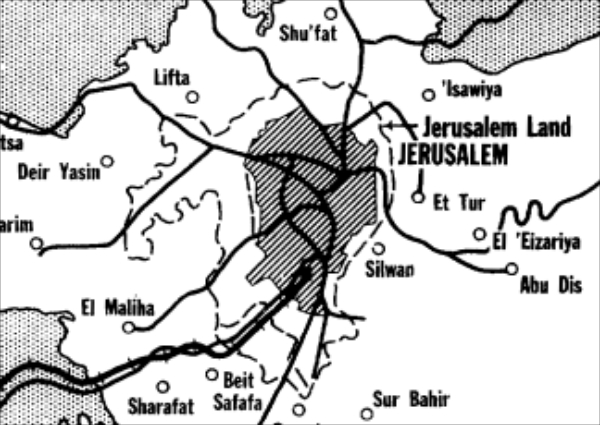
One road connected Tel Aviv/Jaffa and Jerusalem, which supplied the latter with nearly all of its needs. Arab militants enacted a siege in order to starve the Jews to death or drive them out. They did so via ambushes and gunfire on Jewish trucks from the numerous Arab villages that overlooked the road. Through March, the Jews acted defensively by sending guards with vehicles, or they responded to active threats.

Reuter (in Hong Kong Telegraph) – March 3, 1948. Full page.
Aside from Jerusalem, a number of Jewish villages were being choked by similar Arab control of key roads, and this was a factor in March for the United States to consider reneging on the Partition Plan in favour of a trusteeship for Palestine.
It’s imperative to understand the layout of the land. On the Jewish side of Partition, most Arab and Hebrew villages were close to each other, and the cities were mixed.
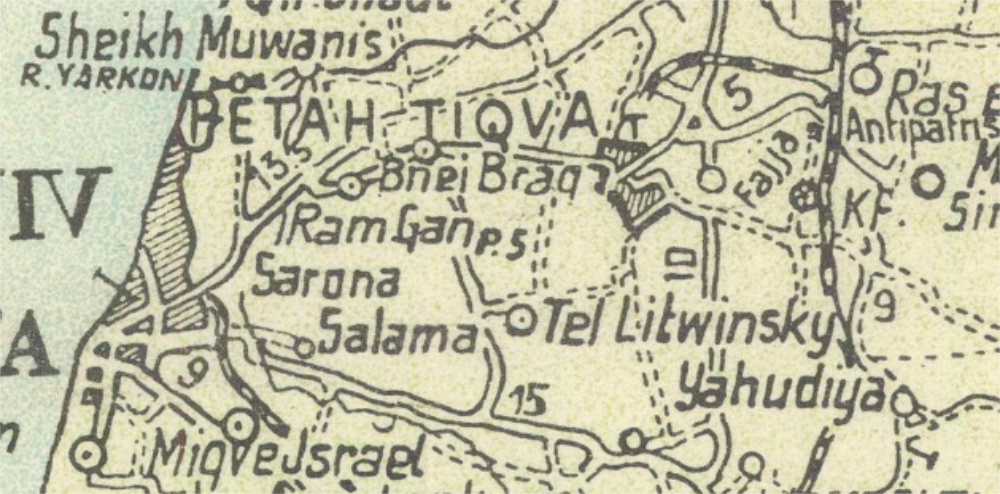
This section near Tel Aviv is about 35km wide.
Empty circles are Arab villages and circles with a dot are Jewish. Full map.
Similar:
A book about the mixed city of Haifa.
Associated Press – April 11, 1948. Full page.
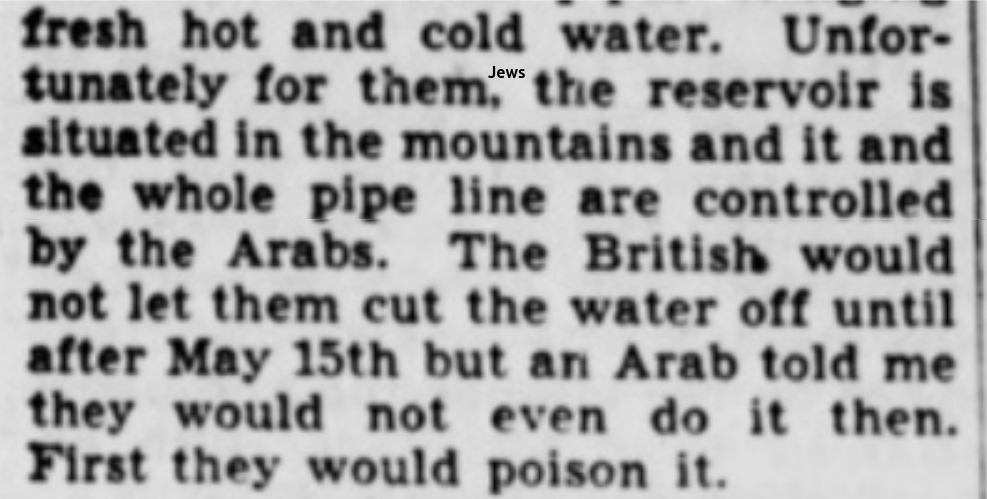
Kennedy, Boston Post.
This critical aspect of the war is forgotten by modern outlets.
As for the departees…
Through early March, Arab leaders didn’t see a problem with those who fled.

Bilby, p. 31.
Only later in March did the Mufti attempt to stop it- with little success. Women, children and elderly still left due to Arab orders or encouragement.
Jewish officials were surprised by the flight and especially from areas where there was no violence (Morris, p. 166).
In March, most of the peace deals between Arab areas and Jews withered, and militants took control. The Mufti regained dominance over much of the population. (Morris, p. 98.)
Jump to next section.
The full version:
The Arabs are constantly erecting barricades on the highways and even in the cities. The [British] police say that they cannot cope with all activity of this kind.
Macatee.

Associated Press (in Washington Evening Star) – Jan. 27, 1948. Full page.
More:
Earlier clips from Nuwayhed: buses, ambushes.
100,000 Jews inhabited Jerusalem (in the Old City and new part), yet it was surrounded by Arab villages.
One road connected Tel Aviv/Jaffa and Jerusalem (above Deir Yasin in the image), which supplied the latter with nearly all of its needs. Arab militants enacted a siege in order to starve the Jews to death or drive them out.

Phillips, p. 7.
They did so via ambushes and gunfire on Jewish trucks from the numerous Arab villages that overlooked the road. Through March, the Jews acted defensively by sending guards with vehicles, or they responded to active threats.
Reuter (in Hong Kong Telegraph) – March 3, 1948. Full page.
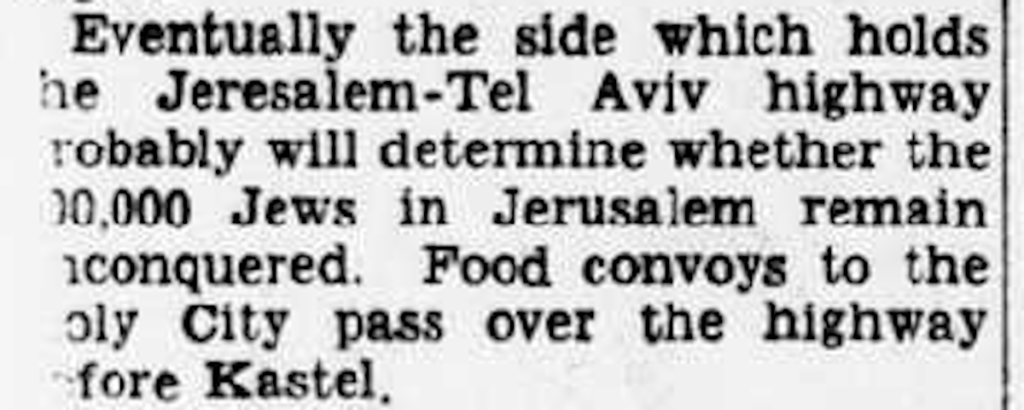
Associated Press (in Washington Evening Star) – April 12, 1948. Full page.
Arab success on the roads was a factor in March for the United States to consider reneging on the Partition Plan in favour of a trusteeship for Palestine. (They also saw the move as a way to counter the USSR’s ambitions in the region; Bilby on page 3 covers the international complexities.)
It’s imperative to understand the layout of the land. On the Jewish side of Partition, most Arab and Hebrew villages were close to each other, and the cities were mixed.
This section near Tel Aviv is about 35km wide.
Empty circles are Arab villages and circles with a dot are Jewish. Full map.
Similar:
A book about the mixed city of Haifa.
Associated Press – April 11, 1948. Full page.
Kennedy, Boston Post.
In attempts to break the blockade, hundreds of Jewish fighters died and nearly all of their armored trucks were destroyed.

Ibid.

The Times (London) – April 2, 1948. Full page.
More:
Milstein, p. 102.
This critical aspect of 1948 is forgotten by modern outlets.
As for the departees…
Through early March, Arab leaders didn’t see a problem with those who fled.
Bilby, p. 31.
Only later in March did the Mufti attempt to stop it- with little success. Women, children and elderly still left due to Arab orders or encouragement.
Teveth, p. 225 (13). Also: Morris, p. 136.
Many adult men ignored warnings about being tried for treason if they left as they feared their families would not be taken care of if they were killed in combat. (Morris, p. 112 and p. 137.)
Jewish officials were surprised by the flight and especially from areas free of hostilities. One was even frightened that it meant preparations for a terrible plot against the community (Morris, p. 166).
In March, most of the peace deals between Arab areas and Jews withered, and militants took control. The Mufti regained dominance over much of the population. (Morris, p. 98.)
Deir Yassin, propaganda and lies
Embellished accounts of what happened in this village on April 9 terrified many Arabs into leaving their homes, either at the time or later when Jewish forces approached their areas- though they still thought it would be temporary.
First, to dispel a few myths about Deir Yassin for those who have heard the false version…
An Arab broadcaster admits to fabrications about Deir Yassin.
BBC documentary The 50 Years War – 1998. Part 1, Land Divided, at 14:18.
Key parts from the transcript (also found on YouTube):
Arab radio stations passed on the false reports, ignoring the protests of the witnesses.
Mahmoud: “We said there was no rape.” He said, “We have to say this so that the Arab armies will come to liberate Palestine from the Jews.”He [Khalidi] said: “We want you to say that the Jews slaughtered people…”
(We haven’t watched the entire series, out of fear of having to refute parts. Many sources here have a mixture of facts, opinions, outdated info, etc.)
The death toll was 107, not 254 as reported for decades- Harif Kanani and Nihad Zitawi in 1987 from Birzeit University’s Destroyed Palestinian Villages Documentation Project, Monograph No. 4 Deir Yessin. The original is in Arabic and even Al Jazeera relays 107, though persists with the other lies.

The Britannica website has some truth.
The higher number and the portrayal of a slaughter were mentioned for decades, even in respectable books and articles that are referenced here.
While not the first to say so, The Massacre That Never Was is the authoritative book on the subject and was published in 2017 by the former dean of Bar Ilan University, Eliezer Tauber. Knowing Arabic, he poured through decades of material from all sides, especially ones only recently available. He also interviewed Arabs and Israelis who were involved and found they had virtually the same recollections. The publisher offers the first 26 pages; “inside“.
For a summary of the book, Middle East Forum has an article and a link to a video with Tauber.
The lies
Three sides twisted events out of shape, leading to the confusion over the facts.
1) A few hours after the battle, one Irgun commander told reporters that 254 Arabs were dead. No journalist bothered to verify it. His reason for giving an inflated number was to scare Arabs elsewhere (instead of getting caught in similar battles).
2) The Haganah went along with it- for years- and called it an outrage because they wanted to discredit the Irgun as extremists. (They had an hours-long civil war; Part 2.)
3) The nationalist Arabs added more lies in order to hasten the Arab League invasion.

Associated Press – April 11, 1948. Full page.
For the Jews, the magnified tale caused tremendous harm to their reputation, and is still promulgated by the anti-Israel crowd and even well-meaning Jews who haven’t studied more than the old or biased documentation.
For the Arabs, their constant propaganda about it by radio, newspaper and word-of-mouth- especially the false charges of rape- unwittingly became a major stimulus to flight.
[Broadcaster Nusseibah:] It had a devastating impact on everyone in Palestine, and the exodus began… It was the biggest blunder that could have happened.
BBC doc.
(It didn’t begin then, but accelerated.)

al-Azm, p. 386.
[Arabs] would come, for example: ‘Leave! [The Jews] committed atrocities in Deir Yassin. Leave so they won’t do horrible things to your wives.’ We left to Hebron, not out of fear for our bodies but for our honor.
Ahmed Al-Anati from Ajjour on official PA TV – Feb. 19, 2022. PMW.
Decades of Arab lies, fearmongering and rumours conditioned the masses to believe the worst in 1948. (Before WWI, soon after WWI, 1928-29.)
What really happened
“Operation Nachshon” was part of the Battle for Jerusalem and designed to end the Arab stranglehold on the city and its road. Deir Yassin, designated for the Arab state, was a village on a hill that overlooked part of the city and was close to the road.

The north side of Deir Yassin overlooking the Jerusalem-Tel Aviv road.
The trenches were constructed by the Turks in WWI.
Tauber, p. 9.
There was also a flat area that could’ve been used as an airstrip. Either the Jews would control the village for security or the Arab militants/army would use it for harm.
On April 9, the Haganah reluctantly tasked the Irgun and Lehi with occupying the village- no expulsion- while they focused on nearby Kastel (and joined later in the ten-hour battle). To minimize civilian casualties, the Irgun forwent a surprise attack and issued a typical warning by loudspeaker, however the truck it was mounted on ran into a new trench and few heard the message. Still, within minutes of fighting residents took the opportunity to flee via a safe corridor, a number that quickly reached 730, or 3/4 of the village. (The regular population was swollen with those who had left other areas.)
The Jews faced unexpectedly strong opposition from the remaining Arabs armed with machine guns, which they believed, due to poor intelligence, were militants and not residents with their families still inside. There was further chaos all around: some Arab gunmen disguised themselves as women; Jewish fighters panicked as they were not trained for this kind of warfare and they did not have radios to call for help; grenades were needed to blast open iron doors and to finally subdue some threats, but even then the Jews issued warnings to each building.
When it was over, almost half the dead were combatants and those who assisted them, with both groups featuring women. The rest were collateral damage due to the close quarters, and a handful were murdered in anguish over the battle. Five Jewish soldiers were killed and dozens wounded. 200 Arabs were taken as prisoners and released into the Arab quarter of Jerusalem.
It was sad and ugly. It was war. It was not a massacre.
Rebuttals and refutations
Accusations and reports of atrocities before the 1998 BBC documentary or 2017 book by Tauber are null and void. British officials, a Red Cross representative and other contemporary figures all failed to fully investigate and instead relied on tainted accounts or assumed the worst based on the superficial fact of dead civilians..
Some people still try to use the term massacre based on the handful who were murdered, but that’s misleading.
Was Deir Yassin a peaceful village? It’s true that the residents fended off Arab militants at earlier points (Morris, p. 97), however that also proves it was a strategic location. And they wouldn’t have been able to keep out an Arab army after May 15. It’s also true that the notables had a non-belligerency agreement with the Zionists (Morris, p. 91), but not everyone upheld it and it became irrelevant with Jerusalem under siege. In the years before 1948, there were numerous violent incidents originating from DY (Tauber, p. 5+).
No war = no need to occupy DY.
Haifa, the first mass flight
The developments beforehand:
The miraculous battle at Mishmar Ha’Emek
April 4-13. From Lebanon, around 1,000 ALA militiamen attacked a northern Jewish kibbutz that was located near the vital road between Haifa and Jenin. While they caused much harm thanks to their artillery from Syria, they were eventually repulsed by just a few hundred Jewish residents and fighters.
For the Jews, it boosted their morale and secured the pivotal location. For the ALA, it was their last major act and, for other Arabs, it was depressing and contributed to their loss in Haifa two weeks later. (British Police report, Jewish Virtual Library.)
Tiberias
This was the first urban community affected. It was home to 6,000 Jews and 4,000 Arabs, and was one of the exceptions that saw many Jews flee along with Arabs.
Minus a few incidents with guilt on both sides, relations were good until March. By mid-April, Arab irregulars forced the Haganah’s hand and they responded, which caused a panic. An Arab militia leader prepared for the town’s evacuation even though the residents wished to remain. The British assisted, and the departure surprised the Jews, including many who wished to stop it. (Morris, p. 184.)

Teveth, p. 223 (11).
Haifa
The 70,000 migrants from Haifa were 10% of the later refugee total and they set a massive precedent.
The port city was slated to be part of the Jewish territory and it had a large Arab minority. In January, a delegation of Haifa Arabs pleaded with the Mufti in Cairo to stop the hostilities. They were unsuccessful. (Morris, pp. 103 and 104.)
The short version…
A disproportionate percentage of the community were upper and middle class so their absence was acute. As assaults by Arab irregulars increased in the early months of 1948, so did the Zionist responses, inducing more and more people to desert the city and creating further consequences.

Time magazine – May 3, 1948. Full page.
The Haganah plan for Haifa was to wait until the British withdrew in mid-May and then secure control of vital infrastructure, and clear Arab areas that posed a threat; most of the Arab population would remain in place and those close to the Jewish centre would be moved to the Arab centre. However, late in April Arab militants launched a battle and the Jews won.
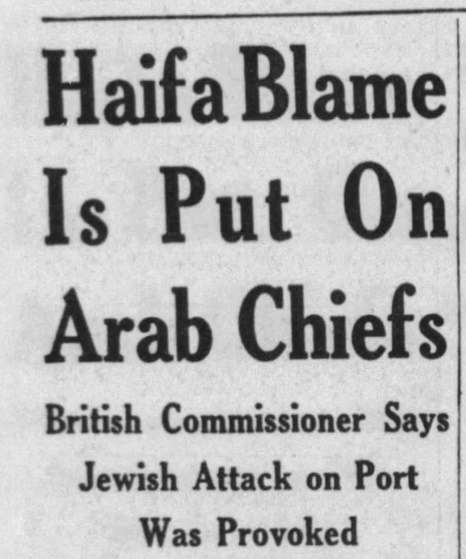
Associated Press (in NJ Daily Home News) – April 24, 1948. Full page.
Similar:
Ottawa Citizen; St. Louis Post-Dispatch.

Cunningham.
Rather than accept a truce, the people were encouraged to leave by the few leaders who remained.
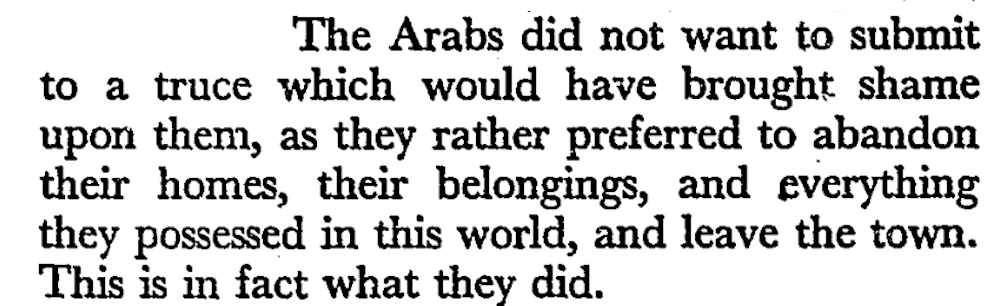
Jamal Bey Husseini, representative of the Arab Higher Committee, to the United Nations Security Council – April 23, 1948. UN.org.
Most of the Arabs did not feel this way, but did what their superiors told them.

The Daily Telegraph and Morning Post (UK) – April 24, 1948. Full page.
Arab leaders refused a truce and continued their people’s evacuation.
Similar:
The Washington Evening Star – April 23, 1948. Page.
The Jews wished for them to stay. (The misguided and promoters of hate focus on the exception of a handful who had a bad attitude or encouraged a few Arabs to leave.)

British Police Report – April 28, 1948. Full page.
The British assisted the people. The only way to accuse the Jews of expulsion in Haifa is through ignorance or malice.
Jump to next section.
The full version:
A disproportionate percentage of the community were upper and middle class so their absence was acute. As assaults by Arab irregulars increased in the early months of 1948, so did the Zionist responses, inducing more and more people to desert the city and creating further consequences.

Cunningham. More: Morris, p. 104.
Time magazine – May 3, 1948. Full page.
The Haganah plan for Haifa was to wait until the British withdrew in mid-May and then secure control of vital infrastructure and clear Arab areas that posed a threat; most of the Arab population would remain in place and those close to the Jewish centre would be moved to the Arab centre.
A young [Jewish] man from Haifa’s municipality proposed making the city an open or demilitarized zone, where no one would be shot. Some Haifa leaders agreed, convinced that a final military stand was impossible. … When the National Committee and the Arab Higher Committee learned of the proposal, they feared that Haifa’s leaders would be accused of treachery. The answer was categorical rejection.
Nuwayhed, p. 629. (Not clear exactly when.)
However, late in April Arab militants launched a battle- and at that point they had at least double the number of fighters than the Jews (Ben-Gurion diary with English). The Zionists brought in reinforcements and won.
Bilby, p. 27.
Snipers targeted Jewish civilians in Haifa for four days before the Haganah launched a counter-attack.
Associated Press (in NJ Daily Home News) – April 24, 1948. Full page.
Similar:
Ottawa Citizen; St. Louis Post-Dispatch.
The heads of the militia ran away.
Cunningham.
Rather than accept a truce, the people were encouraged to leave by the few leaders who remained.
Jamal Bey Husseini, representative of the Arab Higher Committee, to the United Nations Security Council – April 23, 1948. UN.org.
Most of the Arabs did not feel this way, but did what their superiors told them.
Arab leaders refused a truce and continued their people’s evacuation.
The Daily Telegraph and Morning Post (UK) – April 24, 1948. Full page.
Similar:
The Washington Evening Star – April 23, 1948. Page.
The Jews wished for them to stay. (The misguided and promoters of hate focus on the exception of a handful who had a bad attitude or encouraged a few Arabs to leave.)
British Police Report – April 28, 1948. Full page.
Similar: REMP, p. 11.
More: Haifa after the Jewish victory – Morris, p. 206.

British Police Report – April 26, 1948. Full page.
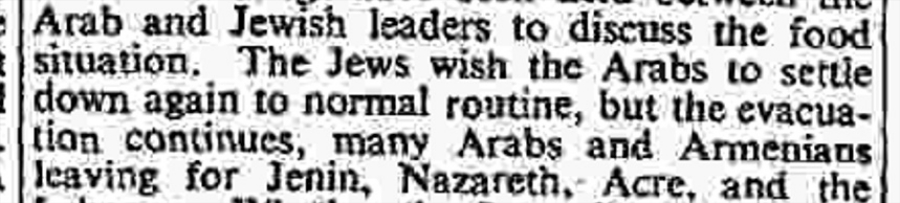
The Times (London) – April 26, 1948. Full page.
The evacuation was orderly and the British assisted.

Foreign Relations of the United States, The Near East…, Vol. 5, Part 2- 1948.
Similar at other times:
Palestine Post – March 28, 1948. Clip, page.

Time magazine – May 3, 1948. Full page.
Another reason for the evacuation was to hurt the Jewish economy.

Evening Standard (UK) – January 10, 1969. Full page.
By Harry C. Stebbens, who worked in the British Mandate government.
More: Nakbat Haifa by Karsh.
The only way to accuse the Jews of expulsion in Haifa is through ignorance or malice.
Typical lies
After Deir Yassin, Arabs again cried massacre.

Top: The Daily Democrat (Florida, USA) – April 22, 1948. Full page.
Bottom: Washington Evening Star – April 24, 1948. Full page.
(The bottom clip was edited to fit the image.)
Newspapers were careful to quote the claim of a Haifa massacre, yet they did so in headlines and, two days later, buried the truth in the middle of articles. This unprofessional approach worsened over time as many outlet didn't bother to mention a later clarification. This is one of the ways people have developed a negative feeling towards Israel.

Modern incarnation: For the Gaza War in 2023, it took over two years for a UN official to acknowledge that Hamas stole and obstructed aid, and few of the major outlets covered it despite them denying Israel's charge of it during the war.
Word spread and more Arabs were prone to fleeing. It was a snowball rolling down a hill…
Within the last month and especially since the capture of Haifa there has been a steady daily exodus from Jaffa.
New York Times – April 26, 1948. (Use Reader View to see the article.)
Haifa was in the Jewish domain so the Zionists didn’t “capture” it.
Jaffa
The largest Arab city bordered Tel Aviv to the south, and in 1947 there were discussions about it being part of the Jewish state, but the Jewish Agency agreed to let it be an Arab enclave within the Zionist domain since around 60,000 Arabs lived there and it would have been their only port. This was a factor to flight, as some felt vulnerable being isolated from other Arab zones.
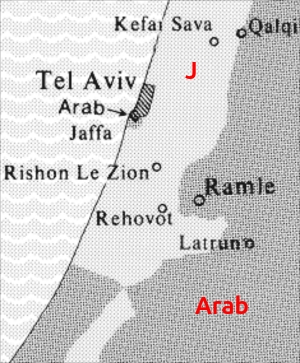
As usual, Arab militant attacks called for Jewish responses.
The short version…

Associated Press – August 6, 1948. Full report.
(Summary of events from months earlier.)
…while the British army abandoned its positions. In this situation, the people of Jaffa refused to accept the surrender terms imposed on the city.
Nuwayhed., p. 630.
Another false charge of a massacre, this one in the quarter of Manshieh:

Bilby, p. 30.
Deek’s family was told to flee the country by Arab leaders, who told them that Israeli forces would kill them.
George Deek , Israel’s first Arab Christian ambassador (to Azerbaijan) and grandson of a man in Jaffa who fled. DailyPrinceton.com.
Only a small number of Arabs disbelieved their leaders. The feelings were genuine- later solidified by exceptions- and became part of the Arab experience and passed down to the next generation.
I couldn’t understand: How could Jaffa’s residents leave this city?
David Ben-Gurion’s diary – May 18, 1948. BG archives (with English).
Jump to next section.
The full version:

Lebor, pp. 106-7.
After the Hatikvah assault, there was an agreement with the Arabs of Jaffa not to initiate further violence against the Jews. However, the militants still attacked Tel Aviv and Jewish civilians from the periphery of Jaffa. (Milstein, pp. 62-63.)
On January 4, 1948 the Lehi bombed the headquarters of an Arab militia- in Town Hall. Civilians, including children, were amongst the casualties. (Morris, p. 112.) Some call it terrorism and Lebor quotes just one Arab who says the militia had moved. Many others say it was present, and this wasn’t terrorism when there was a genuine military objective. Call it legitimate and careless. Lost in the conversation is how inappropriate it was for the militia to base itself in the heart of the city.
This added a few people to the flight already underway and added a little more fear in the rest.
Tit-for-tats went back-and-forth for a number of weeks. The Zionist answer was different than what it had been in Haifa- the commanders awaited orders before any move- and some say this prolonged the misery (Milstein, p. 89). Local services were affected, unemployment rose, there was looting by Arab militants, etc. (Morris, p. 112).
Deek’s family was told to flee the country by Arab leaders, who told them that Israeli forces would kill them.
George Deek , Israel’s first Arab Christian ambassador (to Azerbaijan) and grandson of a man in Jaffa who fled. DailyPrinceton.com. (Not clear exactly when.)
Cars with microphones roamed the streets [of Jaffa], demanding that people leave so the fighting would succeed. They called to us in Arabic to leave our homes: ‘We – the Palestinians, the fighters – want to fight, and don’t want you to impede us so we ask you to leave the city immediately.’
(Not clear exactly when.) Talal Abu Ghazaleh on official PA TV – Oct. 2, 2014. PMW.
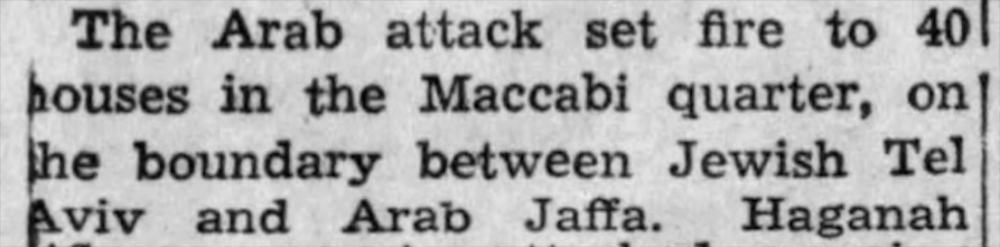
United Press (in Boston Globe, USA) – March 13, 1948. Full page.
Similar:
Baltimore Sun (USA) – March 14, 1948. Full page.
By the end of March, it was impossible for Jaffa to remain under Arab control, especially since Egypt would’ve soon been able to establish a base in the city.
Operation Hametz
The Haganah had two objectives.
First, they captured the Arab villages near Jaffa, like Kebir, that were used by militants to attack Tel Aviv and Jewish trucks on the Jerusalem road.
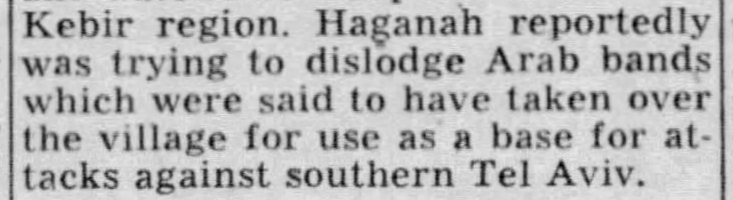
Associated Press (in Baltimore Sun) – March 14, 1948. Full page.
They [an Arab delegation from a nearby village] also apologized for not staying in their positions to secure Jaffa’s communications with the outside world. They withdrew, and discord spread between the residents and the people of Yazur and Bayt Dajan, who hurried to evacuate their villages.
Adil Najm al-Din gave the order to retreat after Mish‘il al-‘Isa arrived. … The city’s young men opened fire on him, and the commander called on them to withdraw with their men and weapons on 30 April. They withdrew, having witnessed the people’s despair.
Nuwayhed, p. 632.
Pretty much all these villagers fled out of fear of war and the weakness of the militants.
Jaffa was already hampered by the usual flight of leaders.

Cunningham.
Second, with control of that part of the road, the Haganah wanted to lay siege to Jaffa and force the militants- blended into civilian areas- to surrender. A humane plan.
Jaffa’s men felt the danger of their city’s imminent fall. During the final month before it fell, they repeatedly tried to contact the leaders and Arab officials, but without success.
Nuwayhed, p. 632.
However, the Irgun felt that Egypt might arrive before a siege had its effect and they also wanted to be the ones to protect Tel Aviv since they had many supporters in the city. They disobeyed the orders of the Haganah and, at the end of April, began a three-day offensive against the militants. (Bilby, p. 29.)
…and the stream of people leaving continued. Eighty percent of the city’s inhabitants left, and Mish‘il al-‘Isa’s forces kept asking for clear and urgent orders.
Ibid.
At times the Irgun fired indiscriminately, a rough parallel to the Arab gunmen.
Sniper fire and tracer bullets, which the Jews said came from the dominating part of Jaffa jutting into the sea, whizzed over Tel Aviv’s seafront during the day. Promenaders scurried for cover…
New York Times – April 26, 1948. (Reader View.)
I remember someone, an Israeli officer, named Monjo. … He was in contact with people from [the Arab village of] Manshiya, with the village chief. He told the chief: “Tell them that no one has to leave the place.” But what did they [Arabs] start to say? The chief is a traitor. And people began to flee.
Israeli citizen Ahmad on official PA TV – July 24, 2023. PMW.
(Not clear exactly when.)
The highest degree of fright and flight came from another fabricated charge of a massacre, this one in the quarter of Manshiya/Manshieh:
Bilby, p. 30.
Only a small number of Arabs disbelieved their leaders. The feelings were genuine- later solidified by exceptions and mistakes- and became part of the Arab experience and passed down to the next generation.
More claims of massacres, though details are not stated:

To Jerusalem by Folke Bernadotte – 1951, p. 226-7. Archive.org.
He was a UN mediator between the two sides.
Modern incarnation: "Massacre" going viral after Deir Yassin is the same as the despicable allegation of genocide spreading after October 7, 2023 (the Hamas attack on Simchat Torah).
For the only time in the war, the British fought against the Jews with the aim of Jaffa remaining in Arab hands. (They didn’t help the Zionists with the Battle for Jerusalem; Bilby, p. 12 clip.)
An initial truce was rejected.
…while the British army abandoned its positions. In this situation, the people of Jaffa refused to accept the surrender terms imposed on the city.
Nuwayhed., p. 630.
The English withdrew in the middle of May and the city fell into Jewish hands.
When the [Arab] Emergency Committee decided to surrender the city, there was no single representative of either the political leadership or the military high command present to sign.
Nuwayhed, p. 633.
The volunteers had little training, and differences in nationality, training, and standards meant that what was needed was strong, decisive military leadership. This was what Jaffa lacked.
Nuwayhed, p. 631.
The militants were good at starting trouble, not much more.
There was no expulsion and just a sliver of the population remained.
Associated Press – August 6, 1948. Full report.
(Summary of events from months earlier.)
After visiting, the head of the Jewish Agency wondered:
I couldn’t understand: How could Jaffa’s residents leave this city?
David Ben-Gurion’s diary – May 18, 1948. BG archives (with English).
More: CAMERA refutes a modern NY Times article.
The vital information in these old reports and Arab sources are omitted in sloppy modern accounts and by the anti-Israel crowd that frame these months-long events by the ending- "The Jews conquered Jaffa".
Plan D
For good reason, this section is partially out of chronological order.
Before March, the Jewish Agency envisioned a state with a (mostly) peaceful Arab minority.
In September of 1947, Partition looked inevitable when two Jewish officials met privately with Azzam Pasha, Secretary-General of the Arab League.
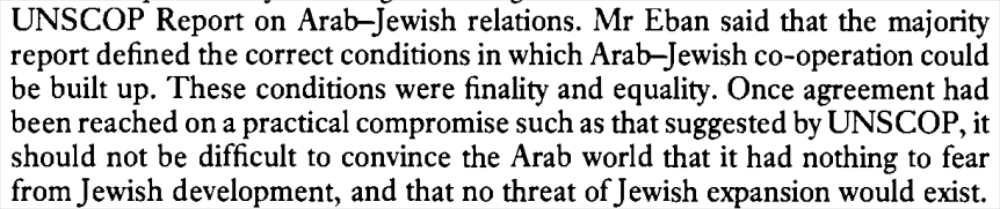
Central Zionist Archives S25/9020. Reproduced in Neil Caplan’s
Futile Diplomacy V2: Arab-Zionist Negotiations and End of the Mandate- 2015.
Page 274, full page (PDF of 3 pages).
Another clip from same doc.
A week later, the Jewish Agency’s Dr. Silver addressed the UN’s Ad Hoc Committee on Palestine:

Before the United Nations, a collection of statements – October 1947, p. 9. Archive.
Also: New York Times. More: “Expansion” on Chronology E.
The Partition Plan that the Jews accepted naturally contained provisions for minority rights in each state.
Only ignorance or hatred explains the perspective that the Jews were insincere about peace. Compared to 2026, the Arabs would have had paradise in 1948 (or earlier) if not for their extremists.
By March the terrible irregular fighting sobered the Jews to the reality of how vulnerable they were- and they now assumed the Arab League states were weeks away from invading. (Milstein p. 104.)
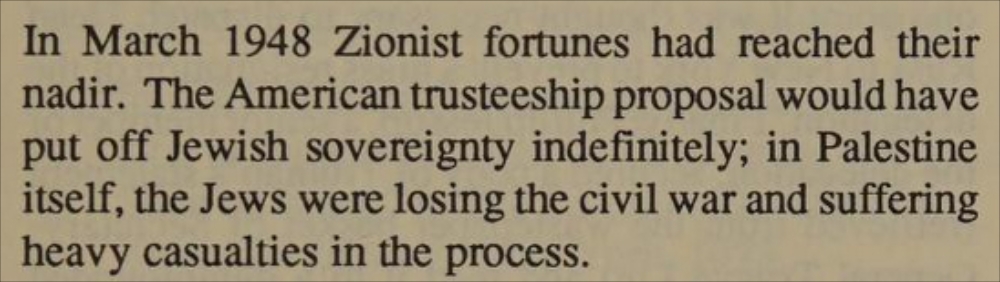
The Rise of Israel: The Recognition of Israel – 1987. P. 1 of Intro, Archive.
The Jews saw two possible outcomes if they stuck to their approach: No state and most Jews slaughtered (there was no safe haven nearby), or a shrunken state living under fire. Remember, the ashes of the Holocaust were still warm in 1948.
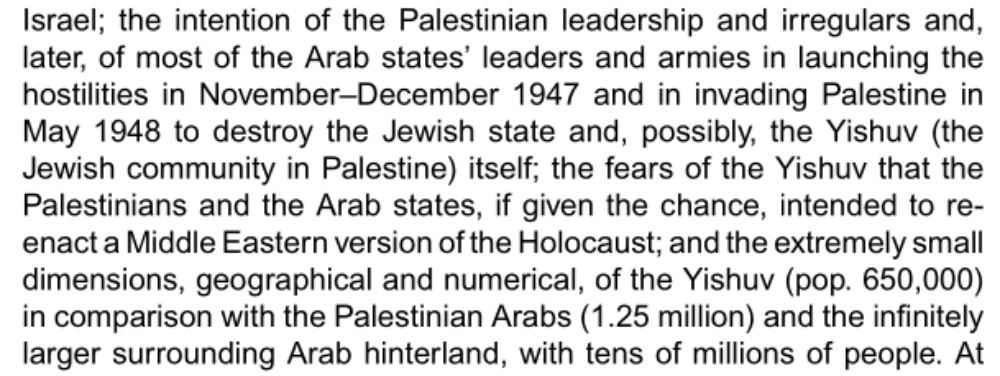
Morris, p. 7.
That’s when the Haganah produced Plan Dalet (fourth letter of the Hebrew alphabet). It was a blueprint for how they would secure the community and face the impending Arab League invasion- each village, town and city neighbourhood according to its specifics.

Khalidi comment in Safwat report, p. 5.
Elsewhere he argues that Plan D was aggression and here the truth slips.
Not all of the plan was enacted immediately, which is why this section appears after the flight from Haifa and Jaffa. It also did not remain in effect for the entire balance of the war (Part 2).
Expulsion was a small part of the plan’s many paragraphs. In the case of resistance to Jewish occupation of an Arab neighborhood in a mixed city, the population was to be sent to the Arab centre of the city (the goal in Haifa), and rural villages where people resisted searches were to have the inhabitants sent outside the borders of the Jewish domain.
Occupation was called for when there was no resistance, though the Haganah didn’t have the manpower to occupy hundreds of villages and neighbourhoods of towns. Villages in sensitive areas, like along the Jerusalem road, were slated for destruction- without harming the inhabitants- so as to halt their use by militants to attack nearby Jews or infrastructure. Such ideas were raised in January, but not acted on (Morris, p. 74), which further proves that the Jews were pushed into Dalet.
Plan D was a moral and natural response to the Arab war against the UN's Two-State Solution.
In 1987, Benny Morris revealed Dalet after the opening of Israel's archives. Since parts were executed in April and the Arab-League invaded on May 15, the ideologues cried that Dalet was a pre-war plan, completely dismissing the Irregulars phase. They also isolated some sentences of his book, took others out of context, and made them the centrepiece of an alternate reality where Israel expelled the vast majority of Arabs for selfish reasons.

Much of the world, namely liberals, accepted it without verifying it. (More in Part 2.)

Morris, p. 164.
The outcome in April and May:
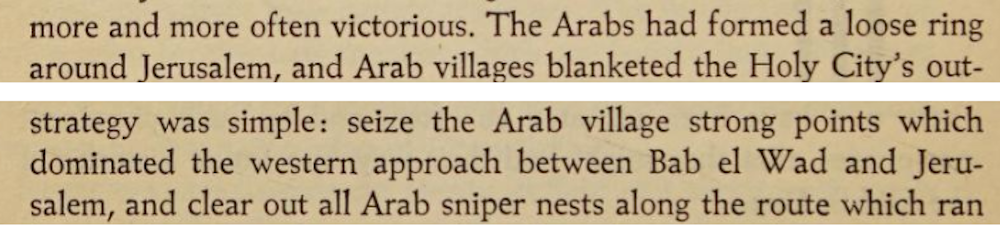
Bilby, p. 26.

Associated Press (in Chicago Tribune) – April 4, 1948. Full page.
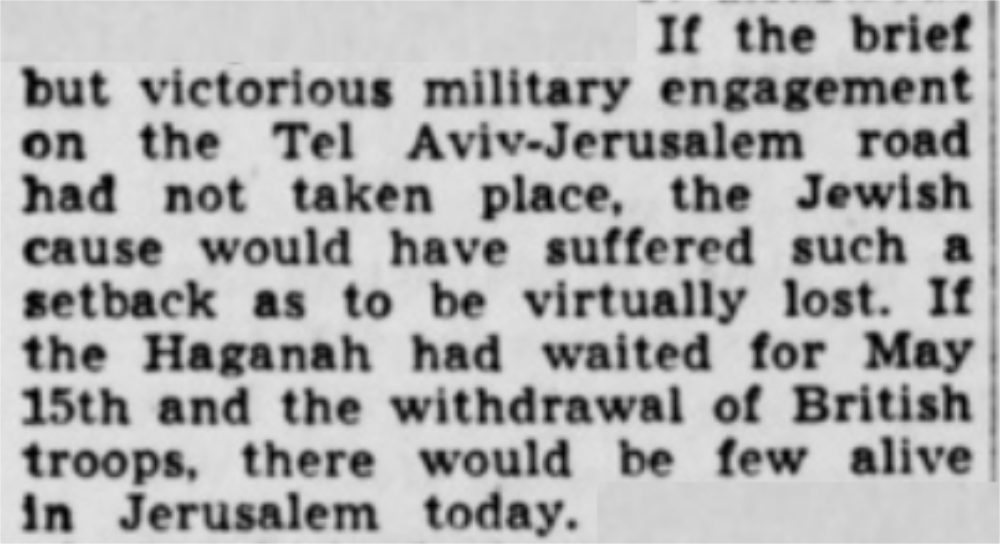
Kennedy, Boston Post.
Few were expelled before July
Many of the Arab villagers who left in April and May were women, children and elderly acting on orders (Morris, p. 174). Similarly, Zionist commanders were usually spared the tough question of what to do with the people in other villages because they either emptied from the sound of the Jews approaching, after their defenders quit, or early in a battle between the two sides.

Morris, p. 165.
We were told [by Arabs] that the Jews attacked our region and it is better to evacuate the village and return after the battle is over.
Asmaa Jabir Balasimah from central Israel in Al-Ayyam – May 16, 2006. PMW.
(From “Main points” section.)
The Jews were nearing our village, the Arab Army – may Allah protect them, they said: ‘Leave, but don’t go far from the village because they [the Jews] will make a short visit to the village, leave, and then you’ll return to the village.’
Ali Muhammad Karake in Al-Quds – YouTube channel, May 17, 2016. PMW.
Re: Allar, southwest of Jerusalem’s Old City.
These refute the critics of Israel who distort a line from Morris, that flight followed almost every Haganah operation from April to June. It doesn't mean expulsion or Jewish guilt. And they omit another line of his, similar to Safwat's earlier one: "Most of the operations were prompted by specific Arab attacks or threats." (P. 164, along with an overview of Plan D.)

Teveth, p. 229 (17).
Preparations for Arab League invasion
The above deals with internal security, and the other side of Plan D was about external. The poorly-conceived Partition Plan put the Jews in a fragile position.
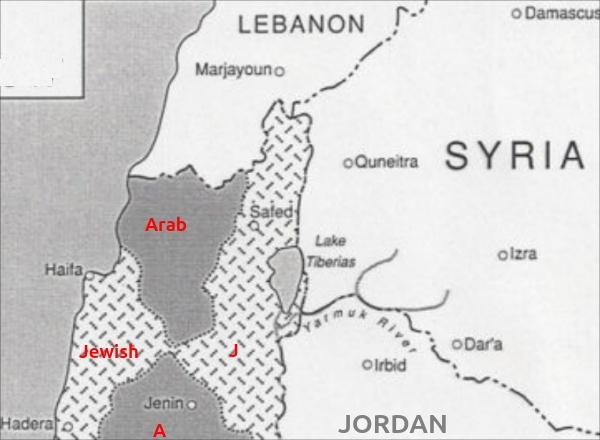
It was crucial to block invasion routes and get civilians out of harm’s way. The latter was one of the reasons why Arab League officials also ordered the evacuation of about 24 villages before their invasion (Morris, p. 176 and p. 177).
Back then, the operations were obvious to none other than Azzam Pasha, Secretary-General of the Arab League.
They were now drawing out the inhabitants of Arab villages along the Syrian and Lebanese frontiers, particularly places on the roads by which Arab regular
forces could enter the country. In particular, Acre and Safad were in very great danger of Jewish occupation. It was obvious that if this continued, the Arab armies would have great difficulty in even entering Palestine after May 15.
Morris, p. 223.
One of the many things that the critics of Israel are unaware of or ignore.
The rest of the Irregulars phase
The fall of Safad
A holy city to Jews, it was part of their domain in the Partition Plan. Arabs were a large majority, 12,000 to 1,700, but the Jews had numerous villages in the rest of the Upper Galilee. As usual, there was already trouble from Arab irregulars as early as December (Milstein, p. 262).
On April 16, the English withdrew completely from Safad. The Arabs mounted a major attack and occupied all the important positions.
Nuwayhed, p. 634.
In May, the Haganah fought the militants for control of the town and the militants abandoned it.
Despite the Arabs’ fighting, Emil Ghubayjan’s soldiers withdrew from the elevated position in the city without justification.
One of the main reasons for the fall of the town was that the commander abandoned his post and left the town before the battle…
Ibid., pp. 634-635.
Similar: Teveth, p.226 (14) and al-Azm.
The [Arab] Salvation Army withdrew from the city, causing the people to begin emigrating. In Safed, just like Hebron, people were afraid that the Jews would take revenge for the massacre in 1929…the people were overcome with fear, and it caused them to leave the city in a disorderly way.
Mahmoud Abbas, PA Chairman, on official PA TV – Jan. 1, 2013. PMW (with video).
Aref al-Aref writes that the Jews were besieged for two full days, and did not believe Safad had fallen; not a single Arab remained in it.
Nuwayhed, p. 635. Aref = Civil administrator.
Safad had a little of everything- flight, evacuation, and necessary expulsion.
Tricks
When possible, the Haganah employed psychological tactics. One northern operation in May was accomplished- along with Arab orders of evacuation- by a “whispering” campaign. With the villagers already teetering from earlier factors, a planted rumour that giant Jewish reinforcements were on their way was enough to induce their departure. No violence in a necessary act. (Morris, p. 251.)
Along with warnings by loudspeaker (above), this highlights the irrationality of hatred. Some people condemn Israel for tricks that spooked Arabs into leaving...instead of being forceful.
Meanwhile, Arab attacks intensified
As all others, these were not based on security concerns.
Early May, hundreds of Iraqi and Jordanian soldiers assaulted a peaceful Jewish village called Kibbutz Gesher (south of Jerusalem). Fighting against Zionist defenders lasted a couple of weeks and by the end the residents were forced to relocate as the village was largely destroyed. (JPost.)
At the same time, other Arab Legion forces and thousands of others invaded Gush Etzion (southeast of Jerusalem). 127 Jews died in defense and 15-50 were slaughtered after surrendering. The rest were expelled and four non-threatening villages were destroyed (JewishAction).
By mid-May
About half of the refugees were gone before the Arab League invasion.

Bernadotte – 1951, p. 112.
Search for “forced” and “expelled”- he wrote of a minor degree of it.
Arab militants chalked up thousands of attacks on Jews (Karsh, p. 12), which included near-daily sniping in one area or another.
Yet more proof about the Big Lie of the Jews being the aggressor: Preparing for an Arab League invasion did not mean they wanted war.
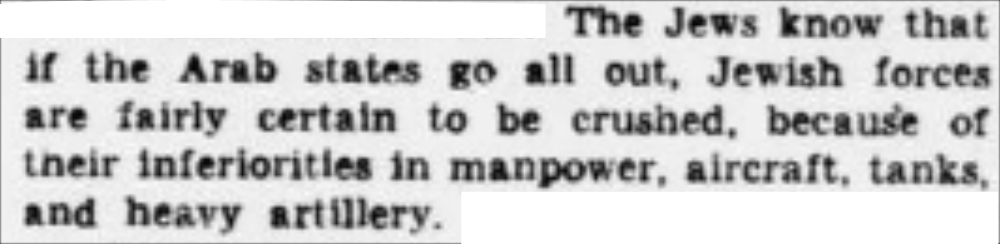
Washington Evening Star – May 4, 1948. Full page.
On May 12, the Haganah was tired from months of battles- and the larger war was days away. America applied pressure to delay independence, likely indefinitely, and the Jewish Agency cabinet held a crucial vote.
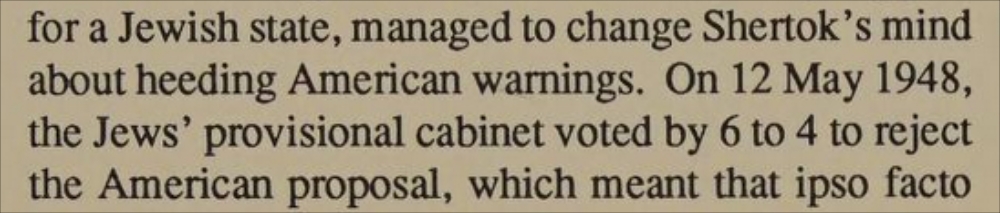
The Recognition of Israel, p. 2 of Intro. Archive.
More: Teveth, p. 222/10.
More Haganah members were combat-ready at this point, though many did not have weapons (Ben-Gurion diary with English).
Rebuttals…
A few people claim that they haven’t seen proof of national evacuation orders by Arab leaders, with a minor exception of Syria in May. The evidence matches the top of this page that says, messages, not orders. To focus on national orders in the strict military or government sense is a mistake or a deliberate distraction, even worse when overlooking actual orders at the village or town level.
Similarly, there’s a claim that no radio broadcasts contain the national leaders calling for an evacuation, based on someone- many years after 1948- listening to all that were recorded by the Brits and Americans. Aside from the above… 1) Two pieces of evidence here say otherwise. 2) Even if it’s true, it doesn’t negate all the various messages issued in-person or by newspapers. 3) Considering how popular radio was in those days, it’s hard to believe that every hour of every day of tens of stations were recorded and well-preserved on old-fashioned tape for many years.
Like the Arabs, Israel engaged in propaganda (Part 2) and there are a few quotes and sources that were not approved for this site. That doesn’t change a thing. The propaganda focused on the majority of truth. (It was understandable at the time, but ultimately a fatal mistake.) We’re still working on other material, namely from the archives and Arab newspapers, and hope to have more clips before long. Keep an eye on Updates.
Next: Part 2 (coming soon) covers the second phase of the war, the New Historians, and more.
A page about ideas for population exchange or transfer- by Brits, Americans, Jews and Arabs- in the years before 1948.
Top Issues or Chronology.