This period was about attempts at peace- moderate and extreme. While there were quiet times, it can be summarized as an escalation of Arab violence, the British reactions to it, and the rise of the Jewish underground in response to both.
Click for an overview of previous pages.
After the Roman conquest, the Jewish state of Judea became known as Palestine; Palestine was never a state or independent to Muslims since their conquest in the 7th century; the small number of inhabitants were not a nation and most primarily identified with their clan, tribe or village; Jews always lived there and others returned over the centuries; the Zionist movement began after centuries of persecution and the Jews simply wanted to return home for security and freedom; for 400 years the territory was controlled by the Turks; there was plenty of room as it was largely barren and malaria-filled when the Zionists bought much land from Arabs and created an oasis; during WWI Britain promised independence to the Arab lands from the Ottoman Empire and excluded Palestine- less than 1%; Britain’s Mandate for Palestine from the League of Nations legally established the rights for Zionists to recreate a “National Home” and protected Arab rights as residents; violence against Jews increased.
Sections:
Summary of these years, Attempts to appease the Arabs,
The Mufti and Jabotinsky, Immigration, Histadrut,
Hebron Massacre of 1929, Arab Revolt of 1936-39,
1937 Partition Plan, Population transfer or exchange,
Rise of the Jewish underground, 1939 unitary state for the Arabs,
1947 Partition Plan, The Arab states,
Rebuttals and Refutations.
Summary
Instead of the minutiae of many events…
One of the falsehoods about these years is that the vast majority of Arabs opposed Zionism. The violence and control of the population by the extremists created this impression. The effendi– ruling class- were 20% of the Arabs and plenty had a moderate perspective. Not all the peasant masses were brainwashed and duped into hatred.
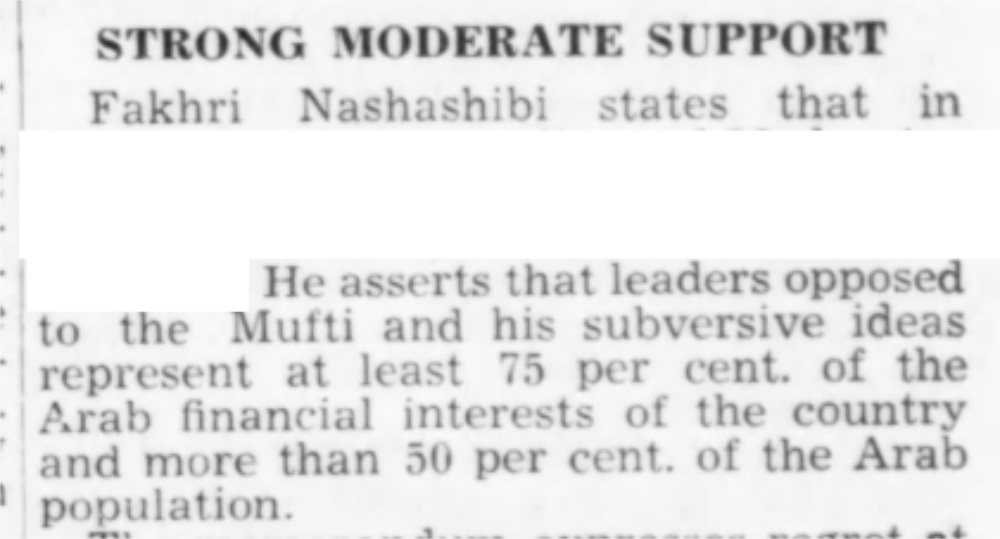
The Daily Telegraph And Morning Post (UK) – November 16, 1938. Full page.
Nashashibi was the main moderate Arab clan.

Nowhere To Lay Their Heads, p. 28. Full page, Canada’s Memorial University.
A 1945 essay by Victor Gollancz, a British socialist.
Another improper attitude is that Zionists were dead set on statehood. The dream in the late 1800s was about independence and some felt that a state was the best form of it. Chronology D shows that the Jews were also open to other forms, like being a British Protectorate.
In response to Arab opposition, Jewish and moderate Arab leaders discussed a number of ideas or made their own proposals, though they didn’t get far. (There were a number of political parties within the Jewish Agency, or pre-state government.)
- David Ben-Gurion, the future first Prime Minster whom many vilify thanks to out-of-context quotes and fabrications (below), favoured a Bi-National State after the violence of 1929.
- Other Jews pushed this “One-State Solution” for a number of years.
- In 1937 before the Peel Report (below) was issued, Ben-Gurion had discussions with Harry St. John Philby, a British Arabist and top adviser to the King of Saudi Arabia. The idea was about co-governing Palestine. (The source is not ideal, but other places also mention the attempt.)
- The Jews fostered ties with open-minded Arabs and sponsored the Muslim National Associations in the 1920s. The president was Hasan Bey Shukri, Mayor of Haifa, and that was the start of Haifa becoming a model of coexistence. See, the Jews had peaceful intentions, and later misfortune was a consequence of Arab violence.
The Arab extremists, headed by the Mufti Haj Amin al-Husseini, were the ultimate obstacle and the best they proposed to the Jews was citizenship as a minority in their hopeful state. (The hope was Greater Syria, then Syria, then Palestine when the first two drifted away.) They had a rosy view of Islam’s historical treatment of Jews, but the reality, while better than Christianity’s, still made it undesirable. On the other side, Zionist ideas about independence included autonomy for the Arabs.
In 1947, after passing the matter of Palestine to the newly formed United Nations, Britain blamed both sides for the lack of peace. In response, a representative from the League of Jewish-Arab Rapprochement and Co-Operation blamed Britain. The rep downplayed particular moments when one side or the other affected relations.
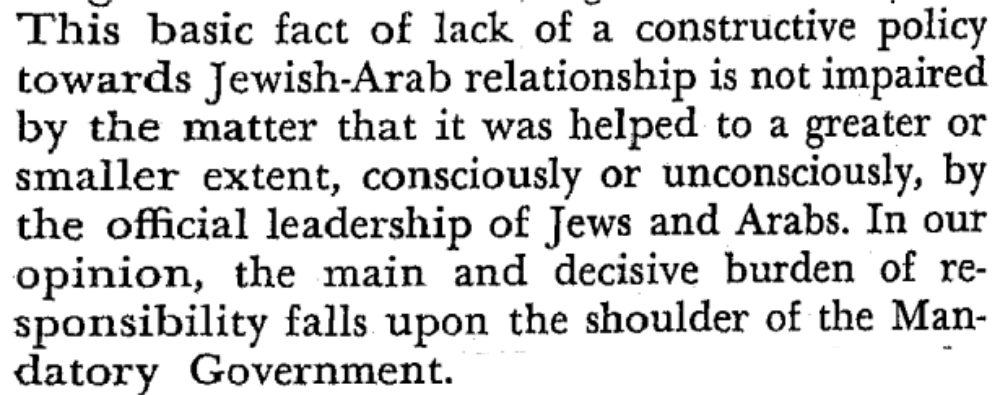
UN Special Committee on Palestine – 1947, A_364 Add-2, p. 195. UN.org.
He went on to list a number of instances where one British official or another interfered with discussions between Zionists and moderate Arabs or that caused a side to see better opportunities outside negotiations. This was due to some Brits being pro-Arab and others being pro-Zionism. Most were pro-UK. (Chronology D covers the What-if? had Britain and France adopted one of the unjust Arab visions for the region after WWI.)
The takeaway is that the Zionists played the cards they were dealt.
Attempts to appease the Arabs
* This section can be skipped for those looking to save time as it’s less significant than others.
First, a step back. In 1920 the British appointed a respected Jewish man, Herbert Samuel, to be the inaugural High Commissioner for Palestine. It was the first time in almost 2,000 years that a Jew had such a position in the Holy Land. He was also responsible for the first step that led to the Balfour Declaration.
Samuel strove to satisfy both Arabs and Jews: He proposed an economic union between the two, granted amnesty to Haj Amin al-Husseini and selected him as Mufti- official scholar- of Jerusalem, pardoned Jabotinsky and assisted the Jews in acquiring more property and in a way to regulate fairness (clip, page).

Britain’s Royal Commission Report (aka Peel) – 1937, page 53. Archive.org.
Similar:
New York Times – October 12, 1923.
Jewish Telegraphic Agency – March 29, 1923
Churchill White Paper of 1922
The British reviewed matters after the violence in 1921 and the official name of this document (on Wikimedia) is Correspondence with the Palestine Arab Delegation and the Zionist Organization.
The Arabs made their case multiple times and their legal arguments were always refuted (page 5). However, to placate the Arabs…

Ibid., p. 18. This confused and upset many Zionists.
Britain emphasized that the Jewish Home is based on right, not sufferance.

Ibid., p. 19
However, they clarified what Jewish immigration entails. This seemed reasonable, but some Zionists feared it would curtail their new rights from the Mandate.

Ibid.
The Arabs saw Samuel as the embodiment of the British and many Jews felt he weakened their position. His term ended in 1925 and the British did not appoint another Jew to the post.
There was more violence (preceded by more rumours and lies) in 1924 that took 135 Jewish lives, and then mostly peace until 1928.
The Mufti and Jabotinsky
With his new position, the Mufti Haj Amin al-Husseini had more power to lead the fight against the Zionists and over the next three decades was responsible for the vast majority of violence towards Jews- and Arabs. Like his successors- his nephew Yasser Arafat of the PLO, Hamas, etc.- he didn’t care about sacrificing his own people and murdered, intimidated and exiled those who got in his way.

World Report magazine – June 27, 1946 – page 34. Full page.

Among Arabs and Jews: a personal experience 1936-90, p. 38. Full, Archive.
By P.J. Vatikiotis, a Greek Gentile from Haifa.
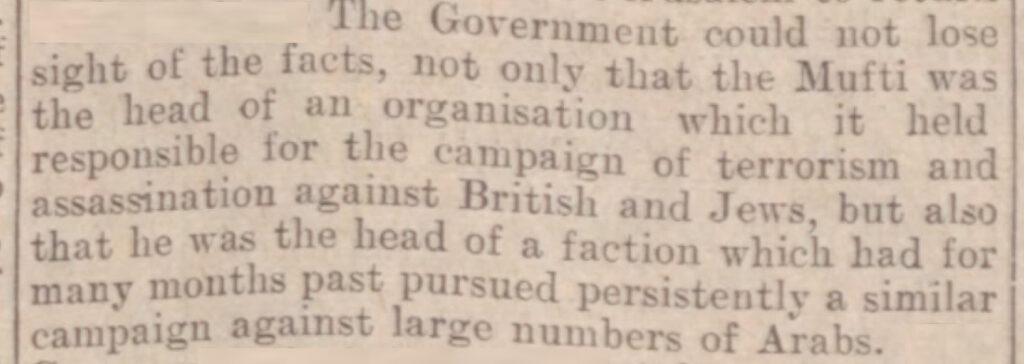
Birmingham Post (UK) – May 18, 1939. Full page.
“In June [1939] an intelligence source reported that the mufti had ordered the liquidation of all suspects, even those in his own family. This repealed his previous directive to murder only proven turncoats. A month later the rebel leadership in Beirut issued an updated list of head prices. Top rewards were for the murders of opposition leaders and commanders of the peace units…”
From the Chapter 7 paragraph on JStor about Army of Shadows: Palestinian Collaboration with Zionism, 1917–1948 by Hillel Cohen in 2008.
What gets little attention is that the Mufti’s motivation was impure: He wanted to rule the Muslim world as its new Caliph and that needed to start with one state.
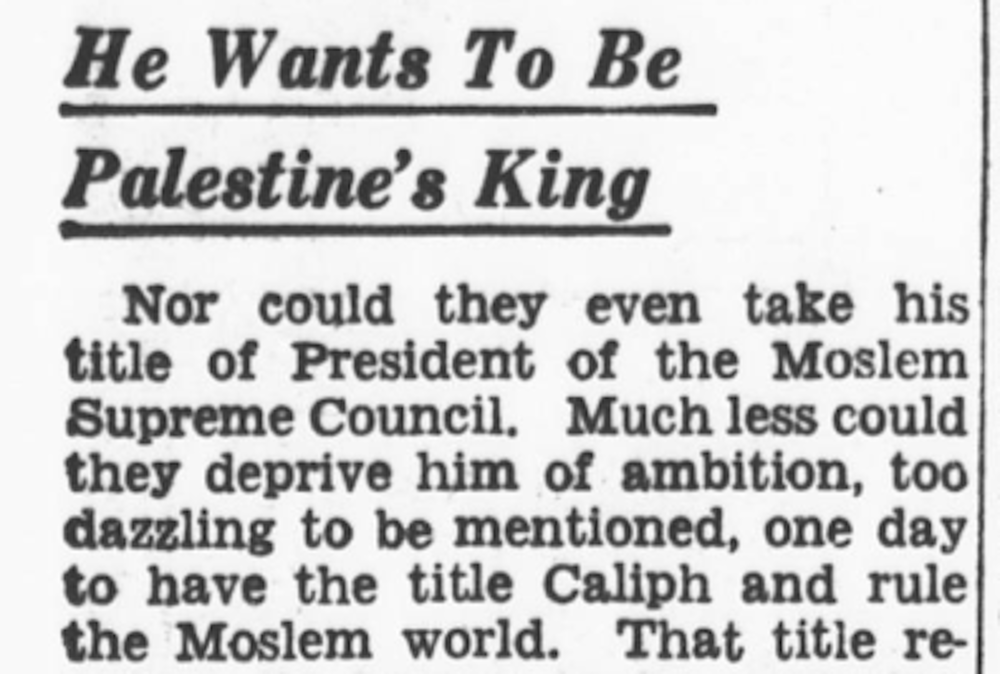
The Washington Times – Sep. 24, 1938. Full page.
(By H.R. Knickerbocker, winner of the Pulitzer Prize in 1931.)
The Mufti’s extremism and control over national affairs was not for the sake of the residents. (More: Page 1 of essay by Kenneth W. Stein, former Professor of Middle Eastern Studies at Emory University.) A small percentage of violence was not pro-Mufti, but anti-Zionism or pro-nationalism.
Nothing changes: So many people in 2026 who champion Hamas don't even realize that Hamas works against the people's interests. No Mufti = peace in the 1920s. No Hamas (and other violent groups) = peace in 2026.
Jabotinsky
On the Jewish side, some call Ze’ev Jabotinsky an extremist and others call him a realist. In 1923 he wrote his Iron Wall doctrine that many have twisted out of shape. A key part that is rarely quoted:
“I am prepared to take an oath binding ourselves and our descendants that we shall never do anything contrary to the principle of equal rights, and that we shall never try to eject anyone.”
(More on Page #3.)
He and his fringe minority understood some Arab-Muslims would fight for what they felt was theirs and not care about Zionism’s material benefits. He believed that only a figurative wall- an impenetrable defense by the British or other world power- would make them realize that the Zionists weren’t going anywhere. At that point, the masses would reject the extremists and accept citizenship in the Jewish-majority state.
The mainstream Zionists first sought agreement with the moderates.
Immigration
Page #2 covers the Arab side.
Today’s anti-Israel voices focus on the Jewish immigrants who were bourgeoisie or came illegally. The former was just one group within the arrivals and they were not the leaders, which makes it especially foolish to harp on them when the Arabs in Palestine not only had similar people- the effendi– but they were the ruling class. Even worse, they abused the lower class.
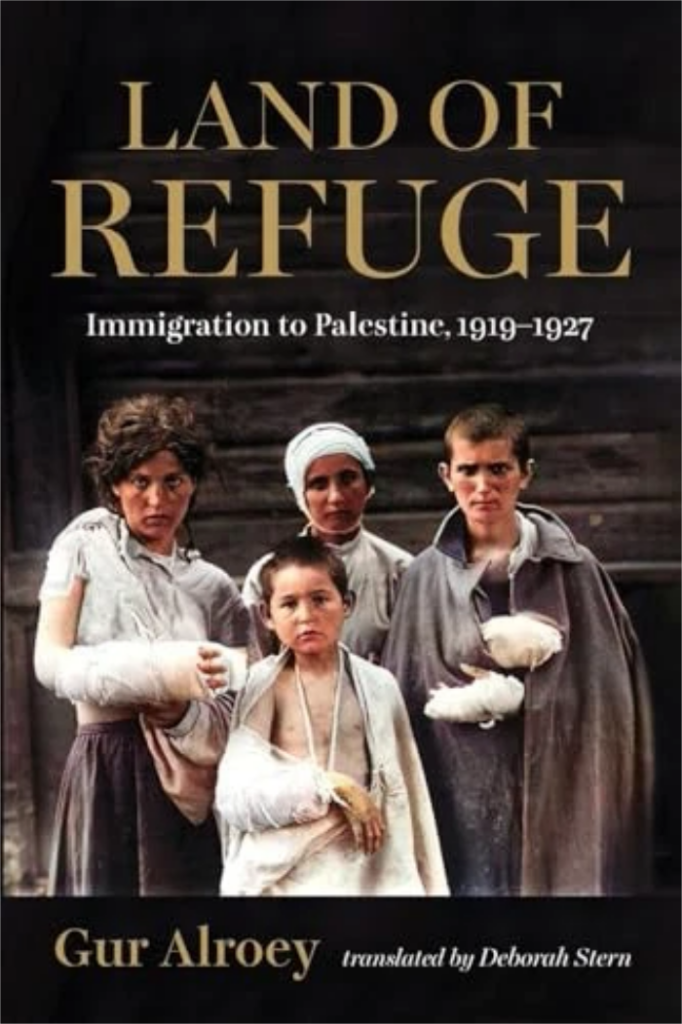
As Chronology D shows, there was new persecution and atrocities against Jews at this time so naturally there were refugees and others seeking a better life. The gist of it can be understood with the introduction of the book by Gur Alroey in 2024, Land of Refuge: Immigration to Palestine, 1921-1927.
The illegals were a response to British restrictions on Jewish immigration that continued even in the 1930s and ’40s during the rise and peak of the Nazi reign of death.

Letter from the Jewish Agency to Britain’s Under-Secretary – April 18, 1944.
Central Zionist Archives Document 168 – 1939-45 in
Archives of the Holocaust V.4 – 1990, p. 406. Full page.
The archives have many similar correspondences. The one above revolves around a measly 18,700 immigration certificates. Hundreds of thousands of Jews who could’ve been saved by going to Palestine were instead murdered. However, it’s only fair to point out that the British did assist and protect those European Jews who were accepted into the Holy Land.
Aside from saving Jews, the Zionists employed tactics to evade English border controls in order to fulfill the Mandate and ready themselves for hopeful independence. Nobody thought that a Jewish minority would govern an Arab majority. The Jewish perspective borne of hatred saw a majority as the ultimate security measure, as they were a segment in host nations over the previous two millenia.
Another significant factor during and after World War II is that most nations barred or capped Jewish refugees, which forced them to see Palestine as their new home.
The Jews were slapped with one hand and then another hand made it difficult for them to protect themselves.
Other sites cover the details:
Jewish Virtual Library, The Holocaust Encyclopedia,
Fathom essay for the British perspective.
Histadrut and the false charge of segregation
* This section can be skipped for those looking to save time.
This Jewish organization and dominant political force was many things rolled into one, namely a labour union and immigration facilitator. Led by the future Prime Minister, David Ben-Gurion, it had a socialist and grand vision of uplifting Arab workers- who were treated poorly by the effendi– and representing them together with Jews.
“Establishing friendly relations between the Hebrew workers and the masses of Arab laborers, on the basis of joint economic, political, and cultural action– is a necessary condition for our redemption as a free working people and for the liberation of the Arab working people from their oppressors– the owners of the ruling estates and property.”
“Proposal for Labor Unity Conference” in “We and Our Neighbours” – 1925.
The original is in Hebrew; Google translated page (first paragraph).
Putting the vision into practice proved difficult as the effendi felt threatened by it and the Jewish workers were more skilled. Some Jewish businessmen preferred the cheaper Arab labour, but unemployment and depressed wages amongst the Zionists would have undermined the whole revival in Palestine. To top it off, 1926-27 saw an economic crisis.
To remedy this, Histadrut from 1927 to ’36 pressured Zionist enterprises to hire Jews. Arab employment in Arab sectors was unaffected. Still, this went too far at times and that’s where the critics draw their material to distort or exaggerate it, along with omitting the context.
More:
A refutation from 1936 that also disproves some infamous quotes.
Histadrut reached its goal after Israel’s independence in 1948.
Palestine Riots and Hebron Massacre of 1929
The end of 1928 was a critical point in the build-up to the Riots and Massacre of 1929 that saw 133 Jews murdered and their ethnic cleansing from Hebron. 116 Arabs were killed, the vast majority by British police.

Peel, p. 67.
What caused such alarm? A screen was placed between men and women at the Western Wall on Yom Kippur.
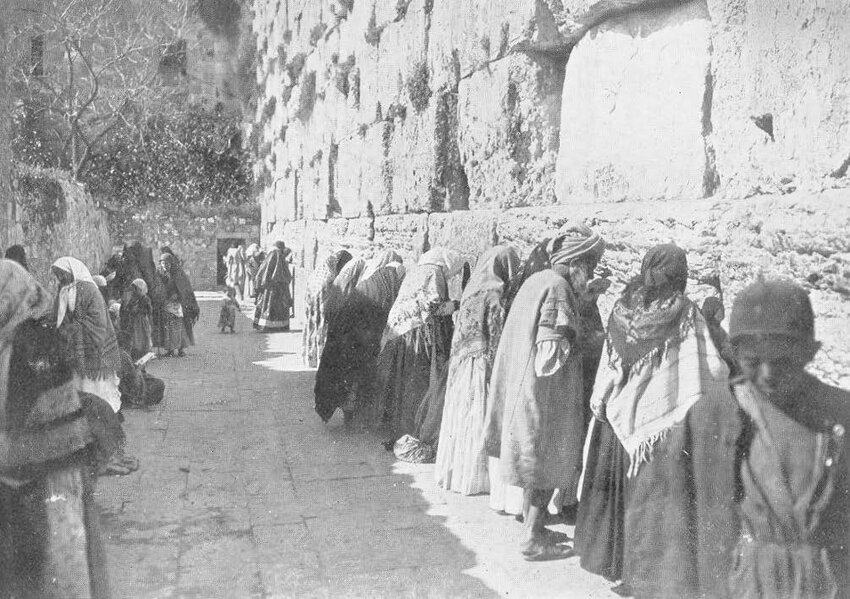
The Old City of Jerusalem’s Western Wall (or Wailing Wall) in 1910.
The only room for prayers was this narrow alley where about 100 people fit comfortably. It remained like this until mid-1967.
Technically, the screen violated a “status quo” agreement that said nothing- not even chairs- can be placed at the Wall. (More about discrimination at the Wall under Muslim rule.)
Today Pro-Palestinian supporters say that Muslims and Jews had good relations in the old days. This agreement is part of the more realistic picture.

Continued from the above clip.
The quote was based on a few Jews who spoke about constructing the Third Temple. Just talk. The Third can only be built after the Messiah comes.

Ibid. p. 66.
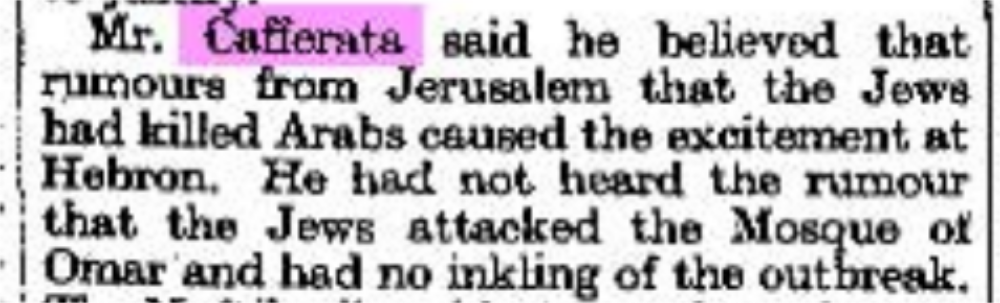
The Times (London) – November 7, 1929. From the British Auxiliaries site.
Raymond Cafferata was the head of Hebron’s police force and an eyewitness.
Along with verbal lies and exaggerations, the Arab radicals doctored photographs.

From “Days of Our Years” by Pierre Van Paassen – p. 370. Full page, Archive.
A journalist and witness to the Hebron Massacre of 1929.
For three days, starting before a Shabbat in August, mobs of Arabs with knives, axes and clubs brutally murdered defenseless Jews and destroyed their property. Women and children joined them by throwing stones.
The vast majority of Hebron’s 800 Jews had lived there for centuries, which made no difference to the attackers.

Testimony by Raymond Cafferata. The Auxiliaries site.
The eyes of some males were gouged. 13 year-old girls, mothers and grandmothers were raped. Corpses were mutilated. (Jewish Virtual Library has more of the gruesome details.)
The death toll would have been higher had not some Arabs protected Jews.
Fanaticism and exploitation of the masses are the real roots of the conflict as the vast majority of Arabs were peasants and many believed whatever their leaders told them. (There were Arab lies and fearmongering before and after World War I.) Is it then a surprise to learn that, decades later, the PLO and Hamas poisoned the minds of the residents in Gaza and the West Bank (aka Judea and Samaria)?
An overlooked aspect of the violence is that it was a play by the Mufti to consolidate power, as a few of his opponents were murdered.
These details weaken the recent argument by some that a Jewish school established in 1925 was the cause of bloodshed. Really, after four years without a sense of danger by the Jews? The school was separate from the Arab and old Jewish areas, and the old Jews were against, or ambivalent about, Zionism. A few days before the massacre, a local leader saw no need for the Haganah defense unit and even turned down their offer out of concern that their presence might upset the Arabs. (More: Cityof72Names.com.)
Aftermath
Once again, the British proved ineffective (and callous and dishonest, according to Paassen) and so: 1) The small Haganah defense force became more professional. 2) Some Jews broke from the Haganah and established the Irgun in 1931, an underground paramilitary group. 3) Many religious Jews who hadn’t cared about Zionism embraced it.
More: Article by Douglas J. Feith, senior fellow at the Hudson Institute.
The Jewish survivors were pushed out of Hebron and it became Judenrein for the first time in ages.
One of the recurring aspects of the conflict is the Arab-Muslim propagandists accusing the Jews of something of which they themselves are guilty. They committed ethnic cleansing in Hebron in 1929 and in the Old City of Jerusalem in 1948 (while hoping to cleanse all of Palestine); they ignore that and accuse the Jews of ethnic cleansing in 1948 when it was really the consequence of their war against the Two-State Solution.
1936-1939 Arab Revolt
First, an aspect that does not get enough attention: The Mufti and his followers murdered moderate Arab leaders and those who opposed him. While it began earlier and continued afterwards, the Revolt was the peak. The total number was close to (or greater, some say) than the Jewish deaths. Others were exiled or got the message and went along or kept quiet.

A Will To Survive by John Phillips – 1977, p. 5. Archive.org.
A Life magazine photo-journalist who was on the ground in 1948.
“Yet the most prominent Arab collaborators were still being pursued. A Haifa police officer, Halim Basta, was murdered.”
From the Chapter 5 paragraph on JStor about Army of Shadows.
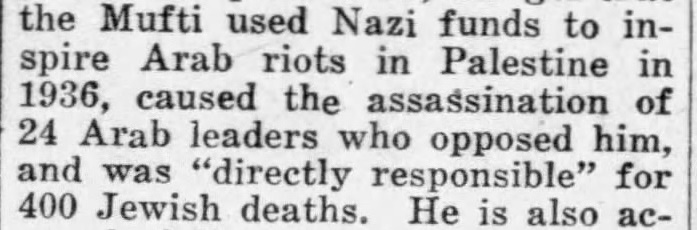
New York Daily News – May 12, 1947. Full page.
The Mufti embraced Nazi ideology and spent time with Adolph Hitler and other German leaders.
More on the Mufti and the Nazis:
German historian Klaus Gensicke on Google Books.
Do a search and note how few mainstream outlets cover the topic, or they focus on a recent, false accusation.
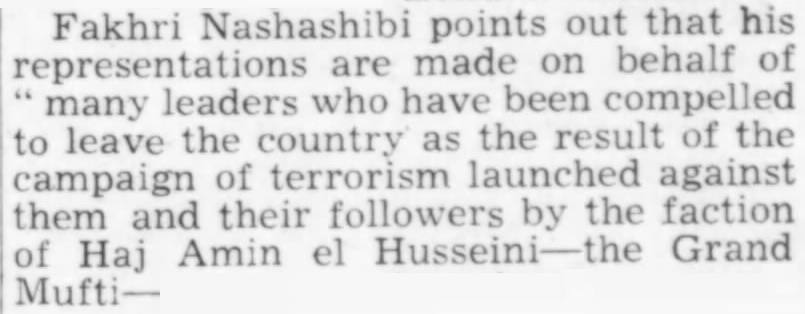
The Daily Telegraph And Morning Post (UK) – November 16, 1938. Full page.
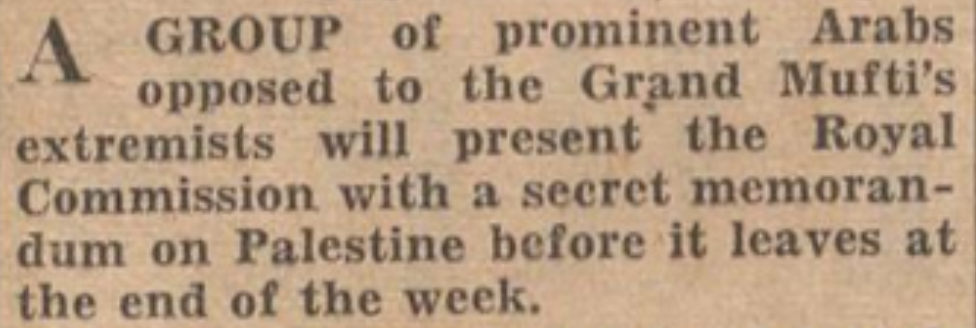
Daily Herald (London) – January 19, 1937 in
British Mandate of Palestine: Disturbances Spring 1936, p. n66. Archive.org.
More: Middle East Forum article.
More on Mufti opponents being killed or silenced after the Revolt:
Page 31 (55 of file) in the book by Benny Morris on PagePlace.
A number of factors led to the uprising: the displeasure with British rule, rising Jewish immigration, land sales to Jews- by Arabs, economic issues and talk of partition (it became a formal proposal in 1937). Not everyone involved felt the same about each issue. The specific flashpoint was the murder of two Jews that led to a retaliation against two Arabs. There was a short-lived sense of unity as an array of leaders formed the Arab Higher Committee (AHC). Others in neighbouring Arab states contributed various kinds of support.
The Revolt began with strikes and boycotts, and didn’t take long to turn violent.
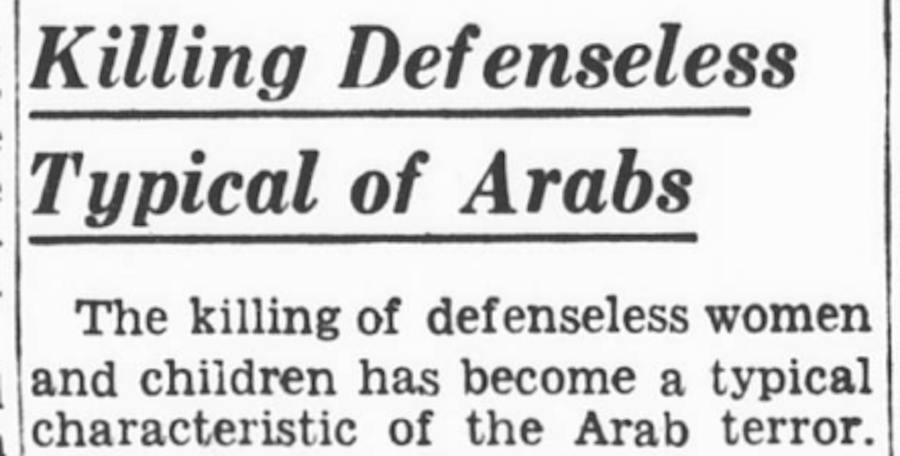
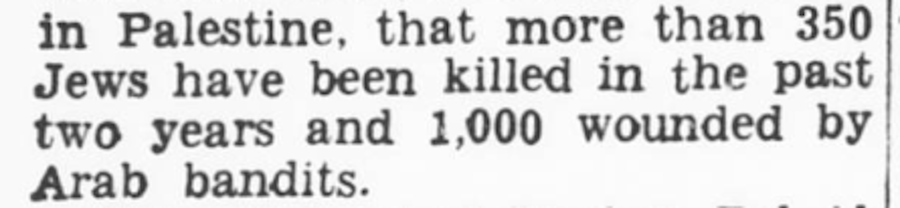
Knickerbocker in The Washington Times – Sep. 21, 1938. Full page.

Peel, p. 105.
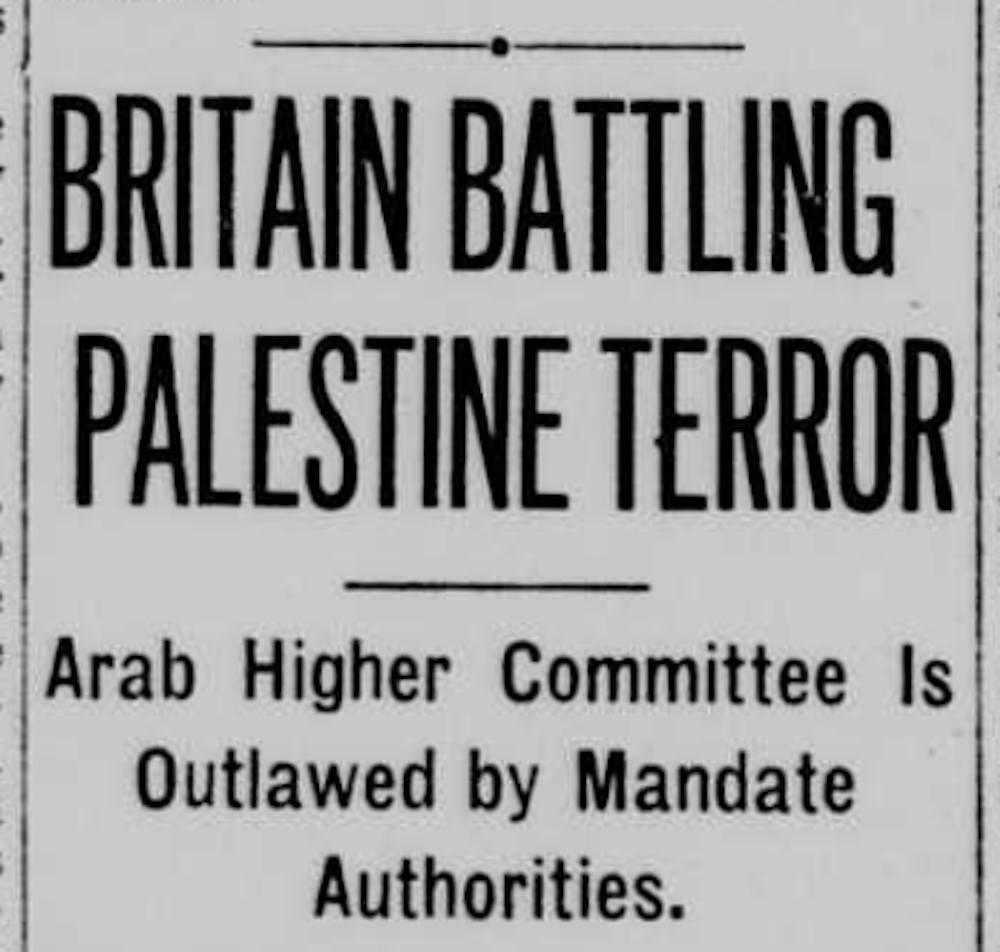
Washington Evening Star – Oct. 1, 1937. Full page.
The chaos got so bad that the British authorized the arming of the Haganah. The group revised its defense-only principle and created a division for ambushes against the violent Arab offenders.
Refutation: In the 21st century, Hamas said they fight dirty because they have no choice. Attacks on civilians, including women and children, in the 1920s and '30s tell the true story. This is the modus operandi of Islamic extremists. From the Mufti to Hamas, they've seen all Jews/Israelis as being guilty. It's the same savagery seen by jihadists around the world (Fondapol) and that existed separately from anti-Zionism and long before it.
The following key aspects of the Revolt are not mentioned by many popular info outlets, like Britannica, so imagine the dishonesty of anti-Israel voices.
- The Nashashibis quit the AHC in 1937 to side with the British. The Revolt was not that “popular” an uprising.
- The Brits worked with Arab anti-rebel militias to eventually put down the Revolt.
- By the end, there was a mini civil war amongst Arab factions.
- Christians were attacked and some peasants attacked elite Muslims.
- Everything above about the Mufti.
(For neutral parties, EBSCO and this Sage Journal article cover these points, but make a few other mistakes that are refuted on this page. Another source for Arab anti-rebels is from the Chapter 6 paragraph on JStor about Army of Shadows.)
Misleading or false parts:
- Arabs displaced from land sales was a factor. They don’t mention it was Arabs who sold most of the land, how minor the displacement was and how they were assisted.
- The discovery of an illegal arms shipment to the Haganah in 1935 was the first spark of the Revolt. They don’t say it was for defense and that the Haganah was against reprisals at this time. Others exaggerate it as “proof” that the Haganah planned to seize Palestine from the British. That should be comical to educated people.
- Similarly, that a cycle of violence existed before the Revolt. No, there were attacks by Arabs on Jewish civilians going back to before WWI and (with a couple of exceptions) defense by the British and Jews. The Jewish extremist group Irgun carried out its first counter-attack in 1937. More below.
By the end, 5,000 Arabs were killed in the Revolt and 15,000 wounded. Some radicals like the Mufti were exiled, though his grip on the populace remained. Many Arabs realized that the militants amongst them did not care for their well-being.
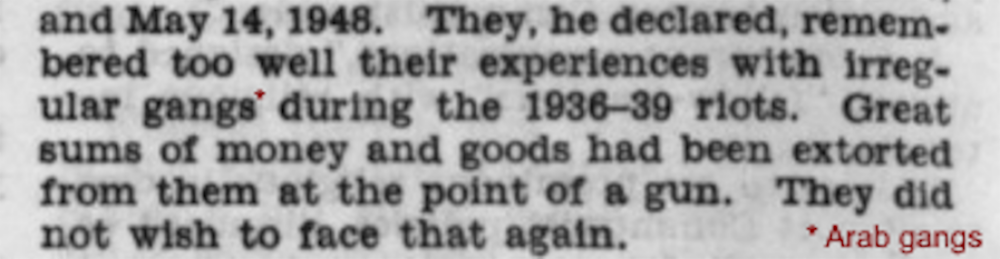
Monsignor Georges Hakim quoted in a US Congressional Record – July, 1949.

Vatikiotis, p. 30 (needs login).
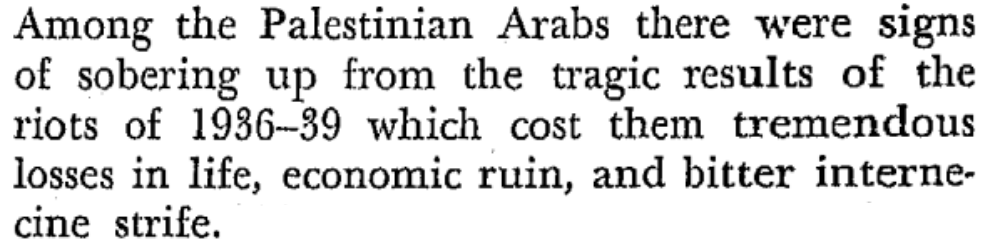
UN Special Committee on Palestine – 1947, A_364_Add-2, p. 196. UN.org.
See pages 197-202 for more about the problematic Mufti.
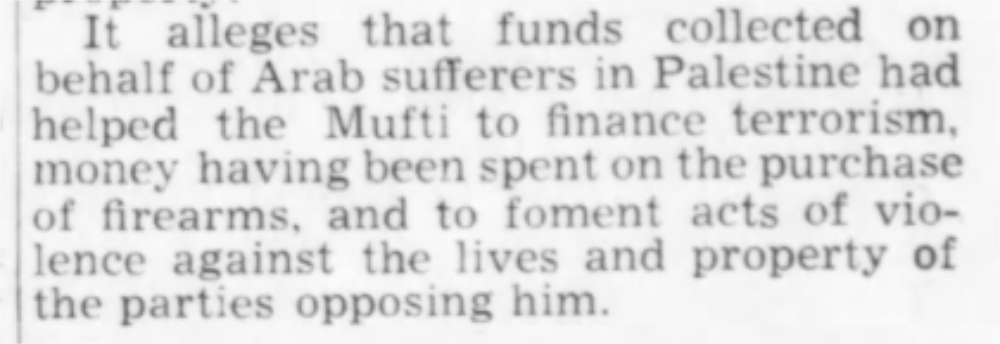
The Daily Telegraph And Morning Post (UK) – November 16, 1938. Full page.
The truth by Nashashibi.
Nothing changes: The PLO, Hamas and other groups have routinely stolen from their own people- and Western governments and individuals have been fools for donating when the Arab and Muslim worlds have more than enough money to help their own. More: OFAC, MediaLine, Global list, PA corruption.

Gollancz, p. 28.
More on the Revolt:
Jewish Virtual Library.
Wall Street Journal review of the book Palestine 1936: The Great Revolt…
Article by Oren Kessler, the book’s author and a journalist and analyst.
1937 Partition Plan
In the early days of the Revolt, Britain embarked on a new study of the conflict and produced its Palestine Royal Commission Report in 1937 (also known as the Peel Report, after its main author). Its chief criticism against the Jews was that their population was growing too quickly and the main criticisms against the Arab-Muslims were their inclination to violence and uncompromising attitude. The highlight of the Report was a proposal to partition the non-state, non-independent territory of Palestine, with the Arab area to join Trans-Jordan. (Archive, p. 380.)
Partition went against the Jews as the Mandate did not even hint to such a thing. It was also the seed that produced the myth of Palestine’s Arabs being a nation with an equal claim to the land.
Two factors caused the British to reimagine the Mandate for Palestine. Mostly, it was due to a likely-imminent war with Nazi Germany, which meant the need for Arab oil and that meant appeasement. (For more about oil and the geopolitics surrounding Palestine, see There Could Have Been Peace by Jon Kimche – 1973, page xviii of the Introduction on Archive.org.) The second was that many of the original pro-Zionists like Balfour were no longer in the government.
The Arabs would have received 75% of Palestine, the Jews just 17-20% and the balance was seen as an international corridor from the coast to Jerusalem.
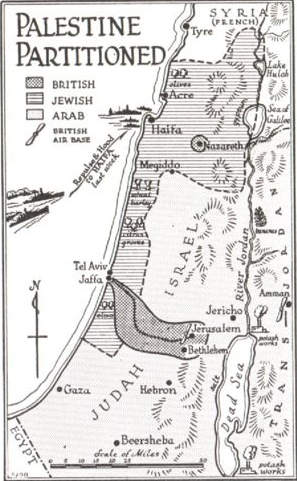
Newsweek magazine (USA) – July 19, 1937. Full page.
Remember, Palestine was already less than 1% of the land in which the Arabs got independence at various points after WWI. Aside from the small size of 4,662 km² (1,800 miles²), the Jewish state would have excluded much of Judea and Samaria that hold most of Judaism’s holy sites.
The boundaries were based on the respective population centres and the Plan encouraged the two sides to negotiate final borders.
Led by the Mufti, the Arabs in Palestine rejected the Plan. Some were opposed to joining Trans-Jordan. At first the Jews also said, no, but then they agreed to it as the basis for negotiations. Many on the right still resisted it, but they were overshadowed by the majority.
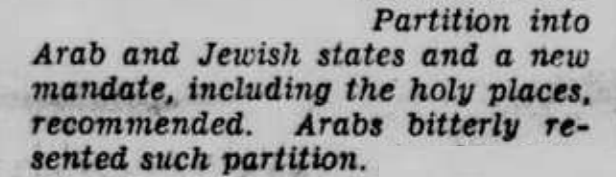
Associated Press (in Washington Evening Star) – Oct. 1, 1937. Full page.
Similar: Washington Post – July 18, 1937. Clip, full page.
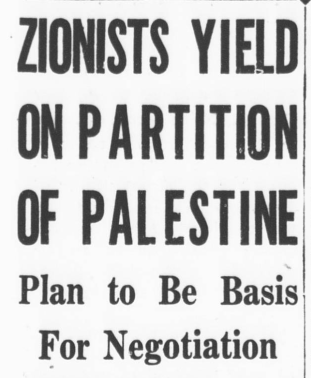
Washington Times – August 11, 1937. Full page.
Similar, plus varied reactions:
Time magazine -July 19, 1937. Full page.
While the Arab position was clearly ideological, they still argued that the Jews would have received most of the fertile land. 1) Partition didn't mean the Arab owners of land on the Jewish side would have lost it. 2) This overlooked the fact that the Jews made much of the land fertile and all the Zionist advancements in agriculture (and medicine, etc.) were available to the Arabs.(Page #3.)
Many people saw the Partition Plan as a betrayal to the Jews.
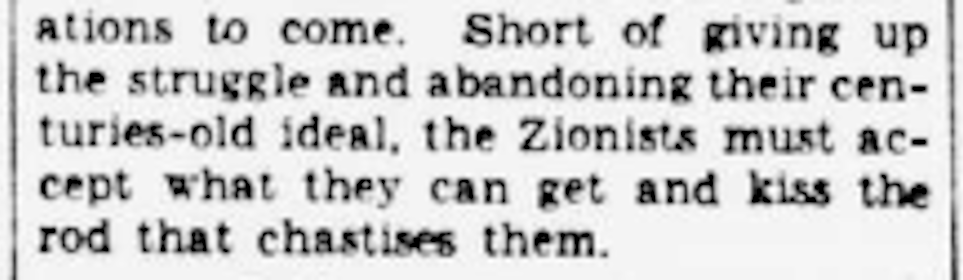
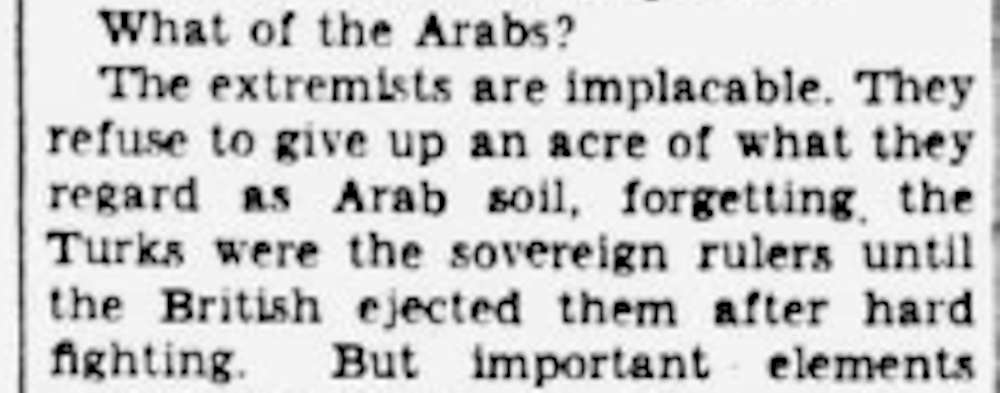
Britain’s Right Honorable Lord Strabolgi
in the Washington Sunday Star – Aug. 29, 1937. Full page.
Those in favour of the split acknowledged that the Jews still deserved a home and especially in areas that were long uninhabited and that they purchased and developed.
The main moderate clan on the Arab side was the Nashashibis, who originally opposed independence for the Zionists, but also opposed violence. For the sake of peace, they accepted Partition.
It’s rare for us to do so, but the clan’s Wikipedia page is clear about this.
Other Muslim supporters.
Had they been in charge all along, there would have been peace. (Realistically, each side would have handled its extremists.) Shortly after, they also proposed a new one-state solution.
Some people who were anti-Zionism supported partition as a way to contain the Jews. According to Alec Kirkbride, a British diplomat in Jordan, Iraqi Prime Minister Nuri al-Said was one.

The Road To Jerusalem: Glubb Pasha, Palestine and the Jews
by Benny Morris. Page 71, full page, Rahs-open-lid.com.
The original source is in the British Archives and not available online:
Kirkbride to MacMichael, 28 November 1944, PRO FO 921\149.
Aftermath
The radical Arabs’ response to Partition was further violence (during the Revolt). A report from The League of Nations’ Mandates Commission unambiguously blamed them.
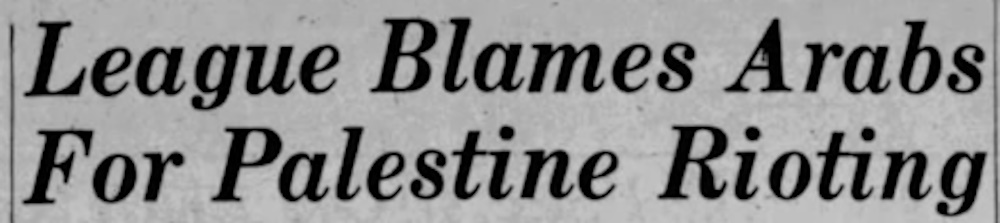
International News Service (in Washington Herald) – Sep. 6, 1937. Full page.
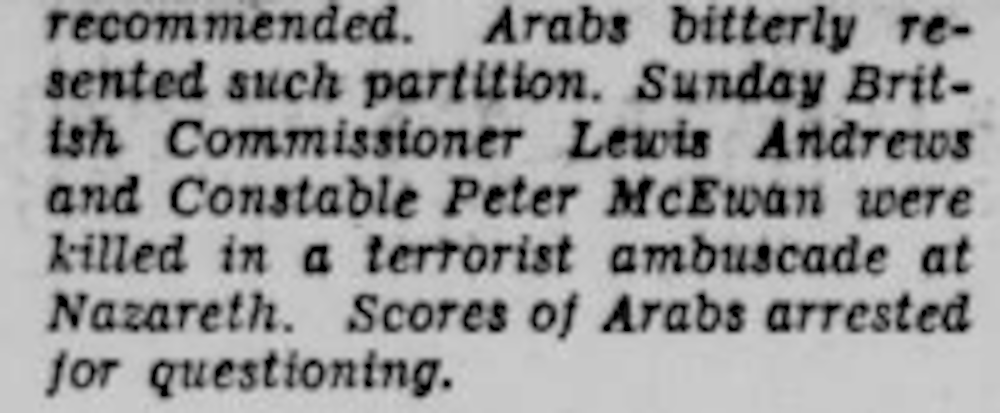
Associated Press (in Washington Evening Star) – October 1, 1937. Full page.
The inherent problems with the Two-State Solution (2SS) is that it did not appease the extremists and its borders put the Jews into a dangerous position. Imagine if the Brits had stuck with the Mandate: There still would have been war (1948 or sooner), still some refugees, but then none of the other hardships. Even with the wars after 1948, Israel would have had defensible borders and 1967 would not have led to a military control of the "territories". No intifadahs. No Gaza war. Arabs in Israel living well as they do now. The extremists would have been outside Israel and that would have forced those governments to eventually control them, as they do now (except Lebanon).

Of course, it's impossible to say for sure what would have happened, but the 2SS is like forcing a miserable couple to remain married in a tiny apartment. Some say the opposite: There shouldn't have been a Jewish state. That downplays all the points on the previous pages and also overlooks the fact that Palestine and the region were not at peace before Zionism.
The concept of transfer or exchange
The 1937 Partition Plan also called for some degree of population exchange.

Peel, p. 389.
The rest has its own page, complete with the Arabs and other Gentiles who had ideas about transfer or exchange, how the thoughts involved the peasants and assistance and compensation, were for the sake of peace, and in response to Arab violence.
Rise of the Jewish underground
The attempt to appease Arab/Muslim violence with Partition emboldened the radicals and legitimized their position.
Another myth about this period is that the Jewish extremists were no different than the violent Arabs. The only thing in common is that both were a minority (and the Jews were a smaller percentage).
| Arabs/Muslims | Jews | |
| Before WWI, though same depravity throughout Islamic history | First attack | 1937 |
| Destroy Zionism and, for most, make Mufti Caliph | Objective | Defense, save brethren, freedom |
| Yes | Controlled majority | No |
| Yes | Targeted own people | No |
| Regularly, no difference between them and security forces | Targeted women, children and elderly | Sometimes didn’t care who got caught in an attack |
| Forced into agreement or silenced | Response of moderate majority | “Cancelled” and reported them |
(In 1924, an anti-Zionist Jew was assassinated and it was condemned by the Jews on an assumption that one of their own did it. Naturally the anti-Israel crowd glorifies it.)
The Irgun formed in 1931- 11 years after the first major outbreak of violence in Mandate Palestine and in response to the non-retaliatory posture of the mainstream Haganah defense force. The early years were spent training and acquiring weapons.
International News Service (in Washington Herald) – Sep. 6, 1937. Full page.

Concerning 1936 and the start of the Revolt. Peel, p. 105 (#26).
Knickerbocker in The Washington Times- Sep. 26, 1938. Full page.
The context:

The Palestine Problem Today; Israel and its Neighbors – 1953. P. 20, full, Archive.
By Carl Hermann Voss of the American Christian Palestine Committee.
The Revolt was the turning point and the Irgun conducted its first counter-attack against Arab militants in 1937. They opposed Partition so the White Paper of 1939 (below) was even more infuriating and caused them to target British personnel and installations. Along with tighter restrictions on Jewish immigration from Nazi Europe that was costing lives, the Irgun viewed them as the main obstacle to Jewish freedom. (In 1945, the Haganah commenced attacks on British facilities.)
Some Irgun reprisals killed civilians, especially a few bombings in Arab marketplaces during the Revolt. When it came to British infrastructure, they sometimes issued warnings to avoid casualties to personnel. At other times, they targeted British police and authorities.
In 1940, some members of the Irgun broke from the group and formed the more extreme Lehi, or Stern Gang.

Voss, ibid.
The page is a good summary of all the underground and anti-British activity.
While a considerable degree of their actions were at the level of guerillas or revolutionaries, the Jewish majority denounced them as terrorists and largely “cancelled” them. (They were then needed in late 1947 and ’48 to help defend the Arab war against the Two-State Solution.)
The Rise of Israel: Jewish Resistance – 1987, p. 1 of Intro. Archive.org.
Ibid., p. 2 of Intro.
British Command Centre in the King David Hotel
A notable attack by the Irgun took place on July 22, 1946. It was in response to the British raiding a Jewish Agency office a month earlier and taking sensitive documents to the Hotel. There was no plan to kill people and the Brits ignored warnings to vacate the building, plus the Irgun first detonated a smaller bomb outside in order to scare people into fleeing.
…apparently he was there on the very day of the explosion and he wrote me that ‘a warning’ was passed on to the officers in the bar in rather jocular terms, implying it was ‘Jewish terrorist bluff’. But despite advice to ‘ignore the bluff’ he decided to leave and thus was out of the hotel when the explosion took place.
British Parliament website – May 22, 1979 (vol 400 cc233-432).
Until then, the UK had denied that there were warnings. More proofs.
Still, the Irgun was responsible for the deaths of 91 people, including 15 Jews, and the bombing dampened the enthusiasm some had for the Zionist movement. Similar to the Stern Gang’s assassination of Lord Moyne at the end of 1944. One perspective is that acts like these were the same as what freedom fighters have been doing throughout history. The other perspective is that the British were not a true enemy and Jews have to operate at a higher level.
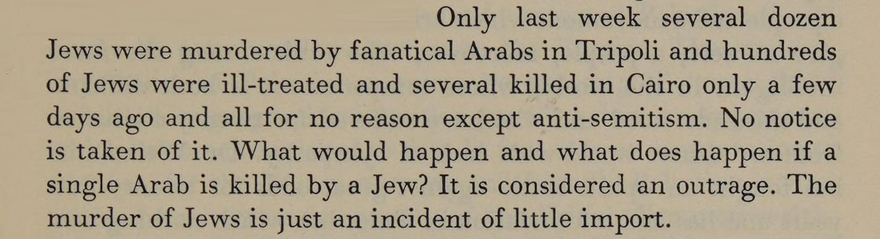
Re: 1945. Middle East Diary 1917-1956 by Col. R. Meinertzhagen, p.201. Archive.
Aside from distorting their actions, pro-Palestinian sites are insincere in highlighting the Jewish extremists because the Arabs also desired the departure of the British.
In the end
In June 1948, the Irgun- still opposed to Partition- and the Haganah had an hours-long civil war. For the sake of internal peace, the Irgun laid down its arms, accepted the rule of law in the land and many members were absorbed into the Haganah’s new incarnation, the IDF. The Sterns also disbanded. If only the same had happened on the Arab side.
Rebuttal: The haters say that certain Jewish politicians who were part of these groups, like former Prime Ministers Yitzchak Shamir and Menachem Begin, shouldn't have been allowed into office, or portray them as "proof" of Israel's bloodthirsty nature. The normal perspective is that it's common for newly-formed states to overlook the excesses or sins of their fighters who turned their backs on such tactics. Begin (and Egypt's Anwar Sadat) won the Nobel Peace Prize of 1978 for the Camp David Accords. Shamir pursued peace, just not on suicidal terms.

Also, newspapers and magazines in those days used the term "terrorist" in its original sense of irregular fighters creating fear even when authorities or infrastructure were the target. Only later, because of jihadists, did the word become more specific to the targeting of civilians or having an immoral objective.

On that note, isn't it a problem in 2026 when people talk about genocidal Hamas joining a new Gaza police force? Or Lebanon encouraging genocidal Hezbollah to join its armed forces? How does anyone think that will end well? The answer is already seen with many members of the Palestinian Authority (article, MEMRI).
More:
Jewish Virtual Library.
Jewish and Arab militias after the Partition Plan vote in 1947 and ’48.
Britain’s attitude
Both sides had a list of criticisms against the UK. All agree that the Mandate authorities were harsh- including doling out capital punishment- in response to anyone’s violence.
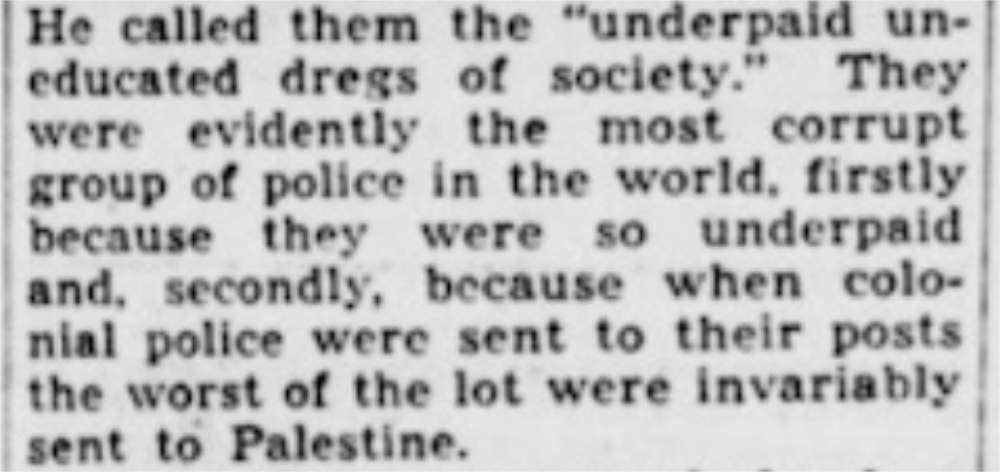
Individual British authorities were another matter, as the top of this page shows. Some were pro-Arab, some pro-Zionism and most pro-UK. The real problem is that many of the officers on the ground were of poor character.
Robert Kennedy in the Boston Post – June 3, 1948. Full page.
Quoting a British army sergeant.
1939 White Paper and Unitary State
Going further in reaction to Arab violence, Britain abandoned the Partition Plan and proposed that Palestine become a single state over a ten-year transitional period (because the Arabs were not prepared for statehood). Jewish immigration would be limited for the first five years and then stopped at 1/3 of the population, thus ensuring a wide Arab majority. For the first time in history, the Arab-Muslims in Palestine would have sovereignty over it .
The Zionists saw it as a new betrayal and deeply resented it. To the Mufti and the neighbouring Arab governments, it was still not enough and they rejected it.

Arab Higher Committee reply to British White Paper of 1939. Full, loc.gov.
Shortly after, the King of Saudi Arabia, Ibn Saud, sent delegates to plead with the Mufti to reconsider. He did not and the King predicted that the fanatical Mufti would unwittingly bring about a Jewish state. (Article.)
The anti-Israel crowd either lacks this knowledge or disregards it, and persists in blaming the Jews for the lack of a viable Arab state. While the extremists created the opportunities, they also prevented the Arab-Muslims from having all or the vast majority of Palestine.

This is another case of inverting Muslim extremism: They call the Zionists greedy for wanting the return of their home and yet it's the Muslim radicals who fought them from having any autonomy on even an inch of land.
In 1939, the Permanent Mandates Commission of the League of Nations was about to strike down the While Paper, but then World War II broke out. It remained Britain’s official policy until 1947, which included discriminatory and deadly legislation against Jews. (Start at the bottom of the first column of page 14- 16 of file- of this 1947 UN doc.)
Minor- click for the “Racial Land Law”.
Another topic that gets bent out of shape is the Land Transfers Regulation, a Zionist law from 1940. As usual, the context is stripped away as the act was a response to the White Paper and British discrimination. (Pages 13, 14-16 and 58-59 of the above doc.)
1947 Partition Plan
After its failures with Palestine, Britain transferred the matter to the United Nations in early 1947. (The UN succeeded the League of Nations after World War II.) The UN General Assembly proposed a new Partition Plan and a large majority voted in favour of it on November 30, 1947.
Unlike ’37, the Arab area was to be independent and not unite with Jordan. Once again, this would have been the first time in history that Arab-Muslims in Palestine ruled a sovereign state.
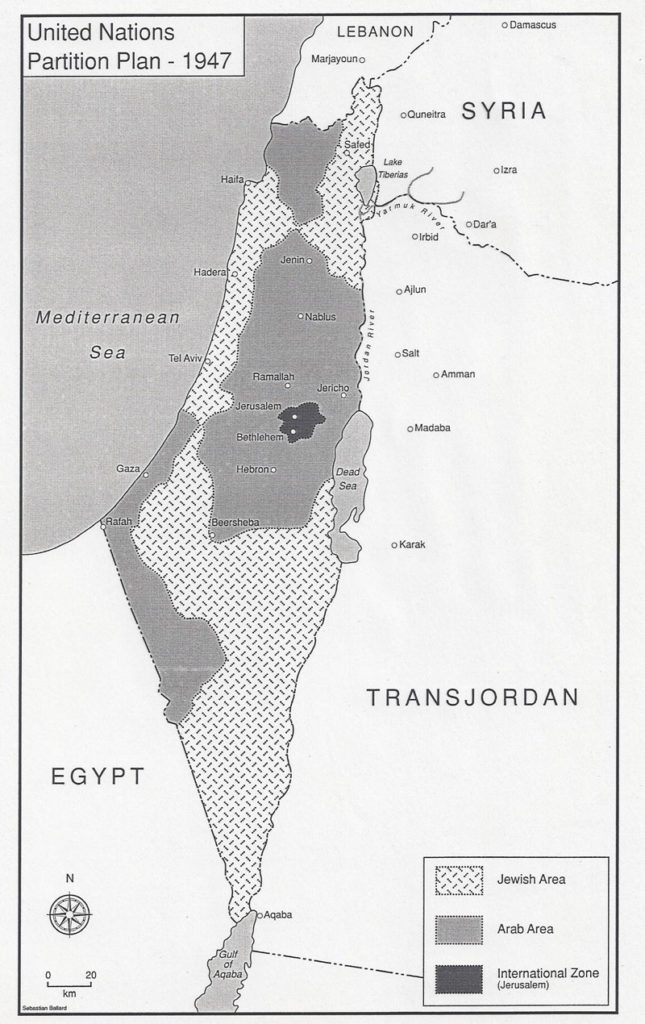
By not agreeing to the plan of 1939 or ’37, the Muslim radicals caused the consequence of this Partition presenting them less land, 43%. The Jews got 55%, though most of that was desert. Again Jerusalem was to be an international city, under UN control, even though Jews were the majority of the city since 1910, had 100,000 residents at the time and had been the plurality since the 1860s.
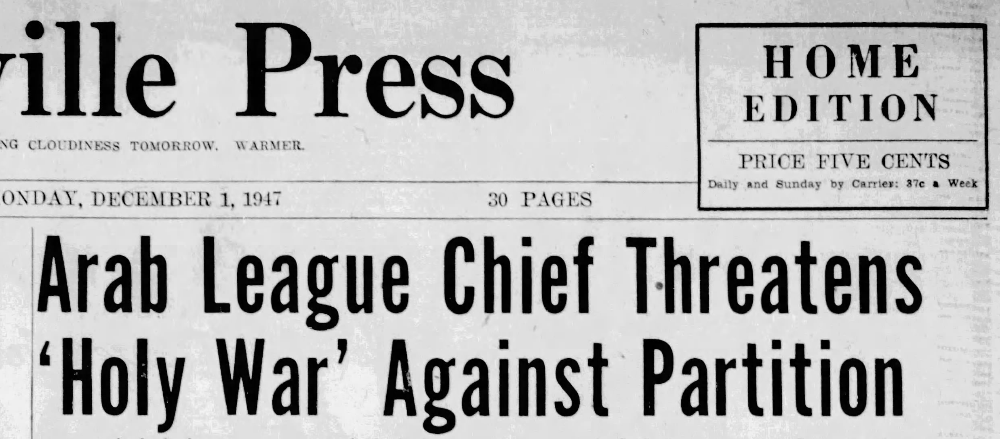
The recently created Arab League (Egypt, Iraq, Jordan, Lebanon, Saudi Arabia, Syria and Yemen) and the Arab Higher Committee in Palestine rejected the result and initiated a new round of violence.

Associated Press (in Indianapolis News) – December 1, 1947. Full page.
The reaction to Partition continues on the next page about 1948.
The reason why Jordan seized the Arab side of Partition- with approval from the British and Jews- is covered on the peace process page.
The Jews and moderate Arabs had specific issues with the Plan, namely the borders. They could have worked in an ideal scenario of peace, but were laughably indefensible for reality. It was much worse for the Zionists because they were targets of the local extremists and because of the direct exposure to Syria and Jordan, and proximity to Lebanon.
Israel’s geography is especially unfortunate: physically small, its frontiers have few obstacles and much of its industry and population lie on exposed frontiers. Israeli territory is not conducive to guerrilla resistance, and its economy is import dependent.
Causes of War: Power and the Roots of Conflict – 1999, p. 163. Page, link.
By MIT scholar Stephen Van Evera.
This was about Israel’s boundaries after the War of 1948.
Another mistake by the UN was to not demand a degree of population exchange encompassing Jews in Arab nations who were being threatened (TOI, JFJ). Everyone understood the idea by then and telling the Zionists to have 400,000 Arabs in their side of 500,000 Jews- with most living close to each other- could not have ended well. Even in the absence of violence, the Arabs could have had economic leverage against the Jews. (The Arab side of 800,000 had only 10,000 Jews.)
Rebuttal: People criticize Israel for not abiding by certain UN Resolutions (only partially true) and they ignore the fact that the Arabs rejected the first one that is at the heart of the matter.
The Arab states
Aside from the Mufti, mainstream news and info outlets don’t say enough about the role of the Arab countries in worsening the conflict. Instead of taming the radicals, they chose to support them and ended up creating misery on all sides.
“[Secretary] Ireland obtained impression from Azzam Pasha and other Arab leaders particularly former that failure of members of Arab League to invade Palestine by force in near future might lead to dissatisfaction and mutual recriminations among Arabs; that relatively moderate elements of Arab League including Azzam Pasha would be overthrown…”
US Secretary of State to the Embassy in the United Kingdom – May 5, 1948.
Foreign Relations of the United States, 1948, The Near East, South Asia, and Africa, Volume V, Part 2. History.state.gov.
Similar: Paper from Michael Eppel, U. of Haifa Faculty Member.
Imagine if they had said: Let the Jews have Palestine. That’s it. A recognition of all the points on the previous pages. Only the extremists would have been hurt. The world would have backed the Arab League since there would have been no concern about oil. There would have been coexistence in Israel as now, perhaps some voluntary population exchange, the moderates would have handled the radicals, there would have been no wars, no refugees…it would have been, not a fantasy of utopia, but normal.
That’s how easily peace could have been achieved.
Instead of doing that at any point since…
Many Arab League states waged war against Israel for decades (a few of our pages) and have never paid reparations for all the death and destruction. Many have supported terrorist groups seeking to destroy Israel and the West. Egypt and Jordan eventually signed peace agreements with the Jewish state, but Egypt continued to produce terrible antisemitic content and the two, like others, never hesitated to hurt Israel diplomatically.
Not surprisingly, the extremists they supported have turned on them. The PLO nearly toppled Jordan in the 1960s, the Muslim Brotherhood briefly came to power in Egypt in 2011, Hezbollah has held Lebanon hostage since 1982, etc.
In 2025, the Arab League proclaimed its support for the Two-State Solution…based on “June 4, 1967 borders” that did not exist as they were merely armistice lines, inherently dangerous to Israel, which UN Resolution 242 did not ask Israel to adhere to and which the Oslo Accords obligated Israel and the Palestinians to negotiate.
Rebuttals and refutations
1) Some say the Zionists didn’t see the reality of Arab violence because their mission, though secular in nature, was like a religious zeal that blinded them.
The Partition Plan of 1937 brought some of the dream tantalizingly close to fruition, and when that was cruelly taken back two years later, some Zionists dug in to regain at least that much.
Overall, the problem with this comment is that it disregards the points on the previous pages, the Mandate that supported the Jews, and the negotiations with moderate Arabs. The Jews understood the anger and they also understood how much of it was fanned by extremism and the Mufti, and that many Arabs felt differently. There was hope to overcome it.
“Neither have we any reason to despair of gaining one day the trust of the Arab world. Encouraging signs are already discernible on the horizon, even in recent days of tension and agitation we have heard other words than those of menace and hostility alone. We should remember that the great mass of the Arab people are still inarticulate; they are deprived of voice and means of political expression, because those who speak in their name today represent neither their feelings nor their needs. The common Arab people are not keen to seek quarrel or battle with those who, some of them feel, are the natural allies of their own welfare and liberation.”
David Ben-Gurion, “Miracle of History” – November 25, 1947. BG Archive (English).
2) A misleading accusation about this period is that the Jews undermined Arab nationalism in Palestine. It should be clear by now that the Mufti’s nationalism was impure and meant torture for both the Zionists and moderate Arabs, so naturally the two groups attempted to neutralize the Mufti and his followers and replace them with reasonable leadership.
“Arabs who opposed al-Husseini or collaborated with the Zionists are treated as marginal. This is a prejudiced view. It ignores the fact that cooperation and collaboration were prevalent, in a variety of forms, throughout the period and among all classes and sectors. Collaboration was not only common but a central feature of Palestinian society and politics.”
From the Conclusion on JStor about Army of Shadows.
A search reveals that mainstream news and info outlets ignore the topic.
3) The biggest lie about these years is that the Jews’ acceptance of the 1937 and ’47 Partition Plans were merely lip-service and that they secretly planned to expand their borders.
Many wanted a larger state, but that doesn’t mean they waged war for it. The propagandists draw material from the former to try and force the latter into existence. As always, they omit the context and some details: While some dreamed of Biblical borders, most were being pragmatic about the expectation of millions of immigrants and Partition’s indefensible borders (and 1937’s were much worse than ’47’s).
Then there are the requisite distortions and fabrications of quotes, with Ben-Gurion featured prominently. (Anti-Israel outlets love words over actions.) Other people cover this:
Article by historian Martin Kramer– PDF or Tikvah.org.
Article by Gregg Rosenberg, PhD.
David Ben-Gurion, The State of Israel, and The Arab World 1949-1956
by Professor Zaki Shalom. Scribd.
Here’s a Ben-Gurion quote they omit, from November 1947 before the UN Partition vote: “Following [the establishment] of the state, a settlement will be reached with the Arabs . . . The establishment of the state will prepare the ground for Arab-Hebrew cooperation on the basis of equality and independence . . . This is not a distant dream, but practical policy . . . for the coming years.” (Shalom, p. 46.)
- With the 1948 Arab-Muslim war against the Two-State Solution, defense and security forced Israel to grow beyond the fragile Partition Plan lines. If Israel were the aggressor, then why does all the evidence- UN documents, newspapers, etc.- say otherwise? (Page #4) How could anyone have waged an old-fashioned war without the world knowing its true origin?
- Many anti-Israel voices don’t realize the contradiction: They are proud of the violent opposition to Zionism/Israel since WWI- and the fighters in ’47 and ’48 did not start the war? They rejected Partition, but did not do anything about it?
- The Jewish leadership, Jordan and Britain had an understanding before the war that Jordan would take the Arab side of Partition because otherwise the fanatical Mufti would’ve headed a new state of Palestine. Similarly, if the Jews were committed to expansion, why didn’t they use the war to gain more territory, especially when the armistice lines with Jordan’s new West Bank were still indefensible?
- Had there been peace before 1948, and considering how much the tiny and nascent Israel relied on the international community, it is absurd or hateful to say she would have initiated a war for the sake of expansion.
- Israel captured Egypt’s Sinai in the defensive war of 1967 and relinquished it for peace as part of the Camp David Accords of 1979…even though part of it was in the Zionists’ wish in 1919 and at least part of it is in Israel’s Biblical borders. Why would a small, expansionist state give up land?
- With relentless terror from the PLO and then Hezbollah, Israel had legitimate reasons to annex South Lebanon at any point going back to the 1970s. Instead, she only occupied it and ended that in 2000. Because of Hezbollah, the necessary and partial occupation resumed in 2025- and still only a few Israelis spoke about annexing it. Does that sound like a state bent on expansion?
- In 2005 Israel completed a withdrawal from Gaza (and ended a legal blockade).
More on Israel’s borders:
Barristers discuss the legal concept of “Uti possidetis juris”: Article, Substack.
A Hebronite’s perspective on San Remo and Article 80 of the UN Charter.
A legal analysis that says most of the borders in 2026 are settled law.
In relation to many of these accusations, people say Israel and Jews are defensive because of guilt. No, there is sensitivity to falsehoods that seek to bring about Israel’s demise and that have always preceded harm to Jews.
Next: Chronology F: 1948. It doubles as “Page #4: In 1948, the Arab-Muslim war against the Two-State Solution created the refugees.”
Or Home for the top issues.