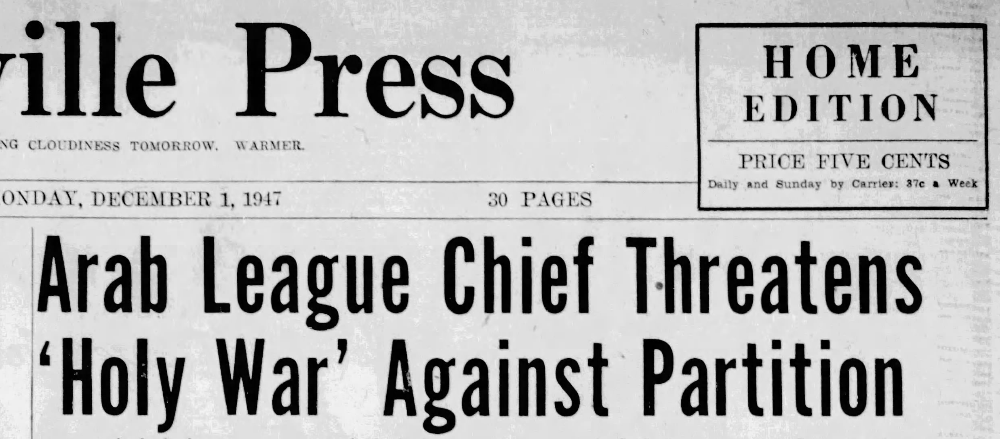
(This page doubles as Chronology B.) After World War I, Britain and the League of Nations had good reasons for seeing the inhabitants of Palestine in a much different way than many portray them today, and why they didn’t need or deserve a state.
Sections:
Summary, Arabs, not Palestinians,
Immigrants, Areas added to Palestine,
More lives and longer lives due to Zionism, Revolving populations,
Tribes and clans, Politics from a sliver,
Colonialism and settlers, Genetics.
Summary
Laying out the facts about the population does not diminish the attachment some had to the land.
Less than half the Muslims in 1948 Palestine had a genetic connection to the pre-Islamic inhabitants, who were mostly Christians and Jews, and they, in turn, had ties to the groups before them.
Going back a few centuries, the population rose from just 150,000 to 275,000 in the mid-1800s- and that was based on the larger size of the territory. In the times of Judea, it held a few million souls.
The Kurds are an actual, historical people who before WWI numbered 10-15 million and they didn’t get independence. (Newsweek article about statehood.) How could a small number of Muslims after WWI claim sovereignty over all the territory that was mostly uninhabited, that they never ruled and that was never an independent entity to them?
Arabs, not Palestinians
Most Arabs primarily identified with their tribe, clan or village (further down). Those with ties to Beirut or Damascus saw themselves first as Beirutis or Damascenes. After WWI, that broadened to Lebanese or Syrians as the modern versions of those lands were formed. At the same time, many identified as part of the Arab nation spanning the Middle East.
Azmi Bishara, former Arab Member of the Israeli Knesset (Parliament) – 1996.
The full quote: “I don’t think there is a Palestinian nation at all. I think there is an Arab nation. I always thought so… I think it’s a colonialist invention – a Palestinian nation. When were there any Palestinians?”
Walid Shoebat, former member of the PLO turned peace activist – 2019.
The pertinent part, starting at 2:02, about the time before the Six-Day War: “We considered ourselves Jordanians. There was no such thing as Palestine. I don’t remember the word ‘Palestine’ was ever taught in school.”
The video also serves as proof that hatred is taught.
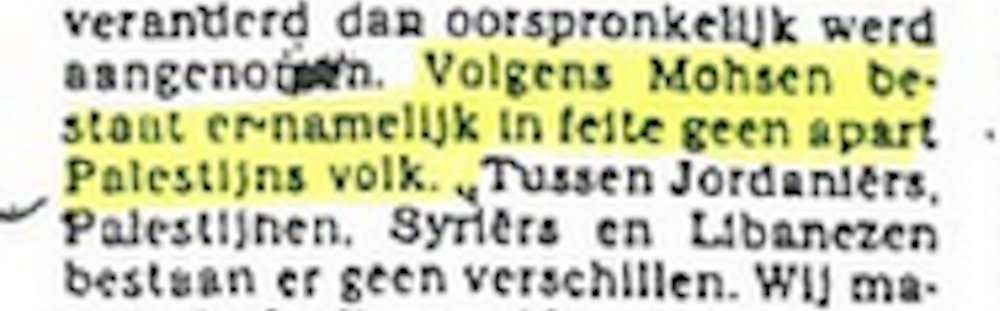
“There are no differences between Jordanians, Palestinians, Syrians and Lebanese. We are all part of one nation. Identification of a Palestinian state was merely a new tool in the continuing battle against Israel.”
Zuhir (or Zahir) Muhsein, PLO executive council member, in an interview in Amsterdam’s Trouw newspaper – May 31, 1977. Full article.
The first chairman of the PLO (Palestine Liberation Organization), Ahmad Shukeiri (or Shuqary), was from Lebanon. The second, Yasser Arafat, was from Cairo.


Meaning of the Nakba by Constantine Zurayk – August 1948.
Two of many instances: Top- p. 21, Bottom- p. 25. Archive.org.
This Syrian intellectual (also spelled Zureiq) is the one who applied the word “nakba” (disaster) to the events before and after Israel’s independence. (It’s more about the Arabs’ faults than blame against the Jews, though is still replete with falsehoods.) The 74-page translated booklet views the land and people as one part of an Arab whole. It does not contain the word “Palestinian”.


The Lesson of Palestine, a translated essay by Musa Alami , in
The Middle East Journal – October 1949 Vol. 3, Issue 4, pp. 388 and 391. Archive.
Mr. Alami was a leader who regarded Arabia and the Levant as one Arab nation. However, the reality of that time necessitated a narrower view of Syria, Israel/Palestine, Iraq and ideally Lebanon combining as one state.
(The essay also has many fabrications or references to hate-based sources.)
In September of 1947, partition of the non-sovereign territory of Palestine looked inevitable when two Jewish officials met privately with Azzam Pasha, Secretary-General of the Arab League.

Central Zionist Archives S25/9020. Reproduced in Neil Caplan’s
Futile Diplomacy V2: Arab-Zionist Negotiations and End of the Mandate- 2015.
Page 274. Full page (PDF of 3 pages).
Britain’s Mr. Ormsby-Gore:
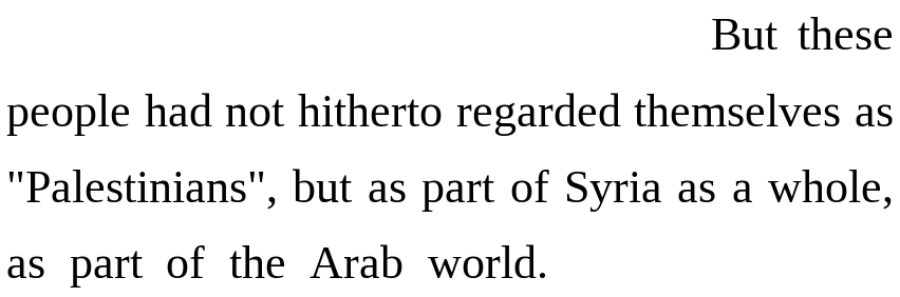
League of Nations Permanent Mandates Commission, Minutes of the 32nd (Extraordinary) Session – 22nd Meeting – August 13, 1937. UN.org.
(Find in page “comparatively”, 3rd instance.)
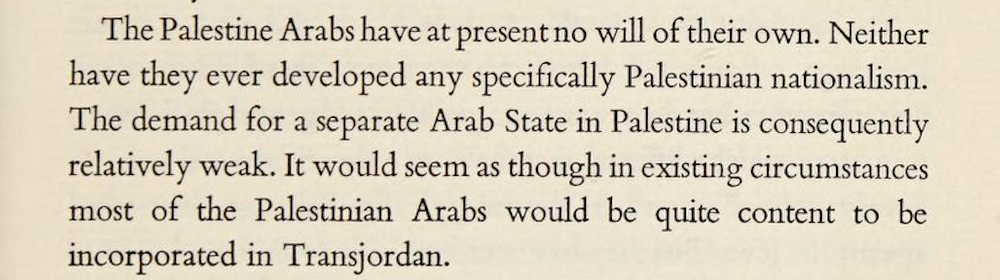
To Jerusalem by Folke Bernadotte – 1951, p. 113. Full page, Archive.org (login).
Concerning 1948. He was a UN mediator. The original book is in Swedish.
The West Bank Arabs had Jordanian citizenship from 1950 to 1988. The idea of a Palestinian people largely took shape after the War of 1967.
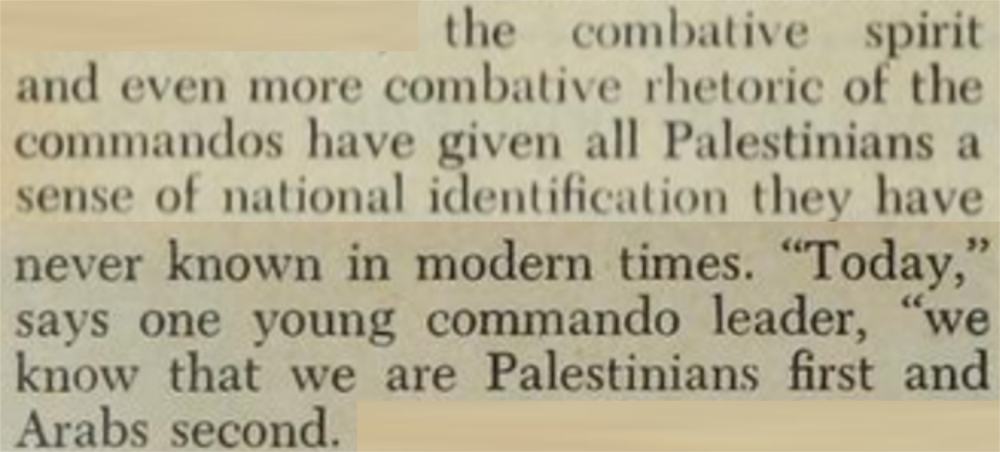
Newsweek magazine (USA) – September 21, 1970. Full page.
Look at the pre-1967 articles on this site and see how the residents were often called the “Arabs of Palestine” or “Palestine Arabs”. Less frequent was “Palestinian Arabs”. “Palestinian” alone was rare and meant anyone from that land- Arab, Jewish or Christian. (That’s why this site uses the same wording for pre-1967 eras.)
The following encyclopedia entries discuss the people of Egypt and Syria. Compare them to the entries on Palestine.
Encyclopedia Americana 1922: Palestine, Egypt, Syria.
Collier’s Encyclopedia 1921: Palestine, Egypt, Syria.
When applied to the Arabs before 1967, "Palestinian" is a form of historical revisionism. It's worse than calling the pre-1948 Jews Israelis. Many neutral-minded scholars and journalists, including Jews, make this mistake and contribute to anti-Israel sentiment because it feeds into the myth that they were a nation.

As for after 1967, the term Palestinian should have no more weight than Jordanian. Nobody thinks of the latter as a unique or historical nation.
Immigrants
One complaint against the early Zionists is that they were immigrants to the land. So were many Arabs and Muslims. The key difference is that the Jews returned home.(Sub-sections: Prior to 1917, Further back, After WWI.)
Prior to 1917
At the time of the Balfour Declaration in 1917, a third of the Arabs and Muslims in Palestine were the product of immigration over the previous 86 years.
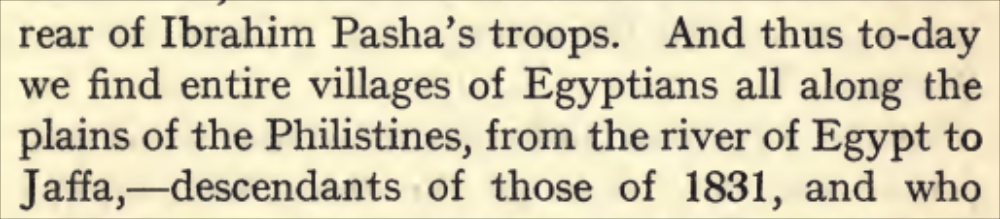
The Immovable East- Studies of the People and Customs of Palestine
by Philip J. Baldensperger – 1913. Page 201, Archive.org.

Concerning Beit She’an (aka Beisan).
The Land of Israel: A Journal of Travels in Palestine – 1865 by H.B. Tristram.
Page 503, Archive.org.

Syria and Pal. – Great Britain Foreign Office Historical Section – 1920, p. 56. Archive.
- Thousands of Algerians settled in the Galilee and Jerusalem (Mahgreb Review article; it’s behind a paywall and the title says enough about it).
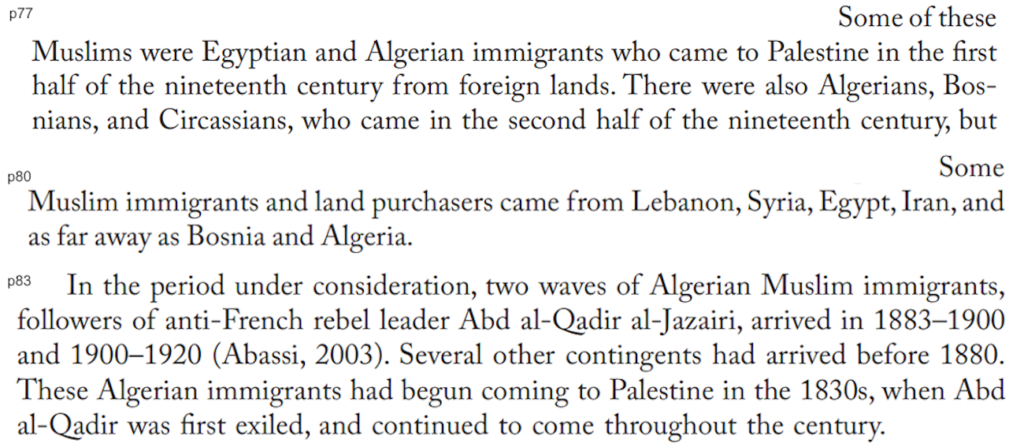
The Muslim Settlement of Late Ottoman and Mandatory Palestine.
In the Digest of Middle East Studies—Volume 22, Number 1—Pages 77–83.
Full digest of 21 pages (pdf) or on ResearchGate.
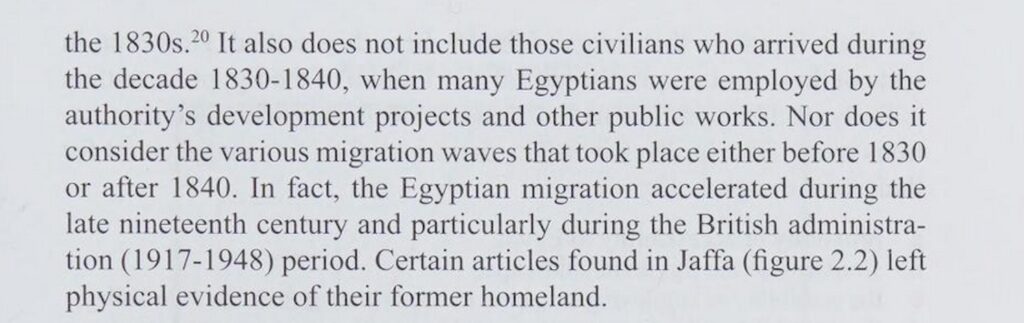
Rural Arab Demography and Early Jewish Settlement in Palestine – 2011.
By David Grossman, then a Professor of Geography at Bar-Ilan University.
Page 51, full page. The book.
Also: Pages 44-46 (pdf) are notable.

Agricultural Land in Palestine: Letters to Sir Moses Montefiore, 1839.
By Ruth Kark in 1988. Page 226 on ResearchGate.

The Palestine Problem Today; Israel and its Neighbors – 1953. P. 13, Archive.
By Carl Hermann Voss of the American Christian Palestine Committee.
- In 2014, Saeb Erekat- negotiator for the Oslo Accords- claimed to be the “son of Canaanites”. The truth is that he’s from the Huwetait tribe that hails from Saudi Arabia and Jordan, and his family settled in Palestine in the early 1900s.
The late 19th and early 20th centuries saw another wave of migration, driven by the construction of the Ottoman railway linking Southern Turkey to the Hejaz and Mecca. The Haifa branch of this railway attracted labourers from Trans-Jordan and Syria, many of whom remained in the area.
Refutation: A few people who somehow ignore the evidence say the Arab population in this period instead boomed in a natural manner. Really? See further down for all the parts about malaria, high infant mortality rates, mud hovels, and poor hygiene to understand how impossible that was.
Further back
Yes, they and their descendants became part of the territory. The point is that immigration has affected nearly the entire globe so it’s foolish to point a finger at the Jews- who were desperate to return home.

Politics in Palestine 1939-48 by Issa Khalaf – 1991. P. 12 (excerpt), SUNY Press.

Biblical Researches in Palestine by Robinson and Smith- 1838, p. 18. Archive.

Britain’s Royal Commission Report (aka Peel) – 1937, p. 44. Archive.org.
The Nashashibi clan is still prominent and has a Wikipedia page. Their presence in Jerusalem began with an Egyptian in 1469. Their longer roots are Kurdish and Circassian.
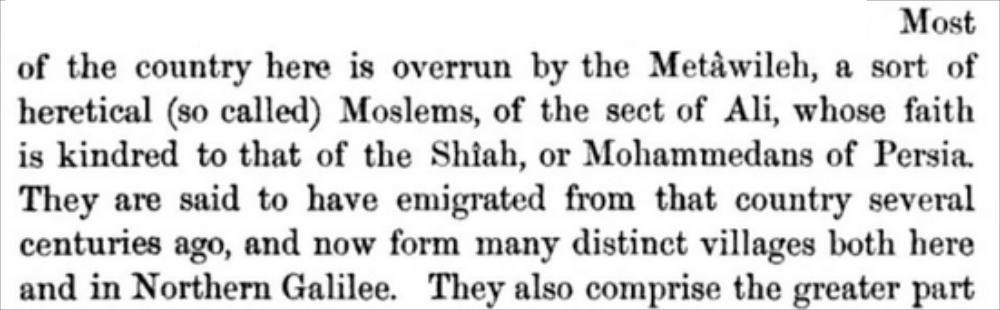
Tristram, p. 107.

Charles Clermont-Ganneau’s Archaeological Researches In Palestine During the Years 1873-74. Page 460 (495 online), Archive.org.
Family names
The website Forebears reveals common names around the world and the list of popular Arab surnames in Israel, Gaza and the West Bank include many that denote origins from elsewhere: al-Masri- the Egyptian, Mughrabi – Moroccan, Djazair- Algerian, Shami- Syrian, etc. (There are variations in spelling, as with Jazzar below being the same as Djazair.)

A prominent leader’s name denotes an origin from today’s Saudi Arabia.
Byeways in Palestine by James Finn – 1872. Page 202 on Archive.org.

Ottoman Reform in Syria and Palestine 1840-61- 1968. P. 4 on Archive (login).
Personally, half my family is Egyptian. We are all like that. More than 30 families in the Gaza Strip are called Al-Masri [“Egyptian”]. Brothers, half of the Palestinians are Egyptians and the other half are Saudis.
Hamas Minister of the Interior and of National Security, Fathi Hammad.
Al-Hekma TV – March 23, 2012.
The last line is a moderate exaggeration.
More about Egyptians in Palestine:
Egyptian Émigrés in the Levant of the 19th and 20th Centuries.
More about Arab immigration from two articles in the Middle East Forum:
The Smoking Gun: Arab Immigration into Palestine, 1922-1931 [with 1800s].
A Muslim Aliyah Paralleled the Jewish Aliyah.
Refutations: For the period before 1917, those who ignore the proofs about Arab immigration point to Ottoman registration records that tell a somewhat different story. Yes, because many arrivals did not register so as to avoid paying high taxes or being conscripted into the army. (This included some Jews, who faced other issues.)
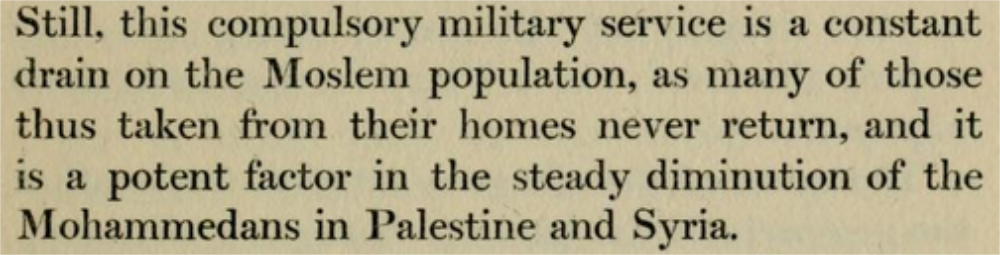
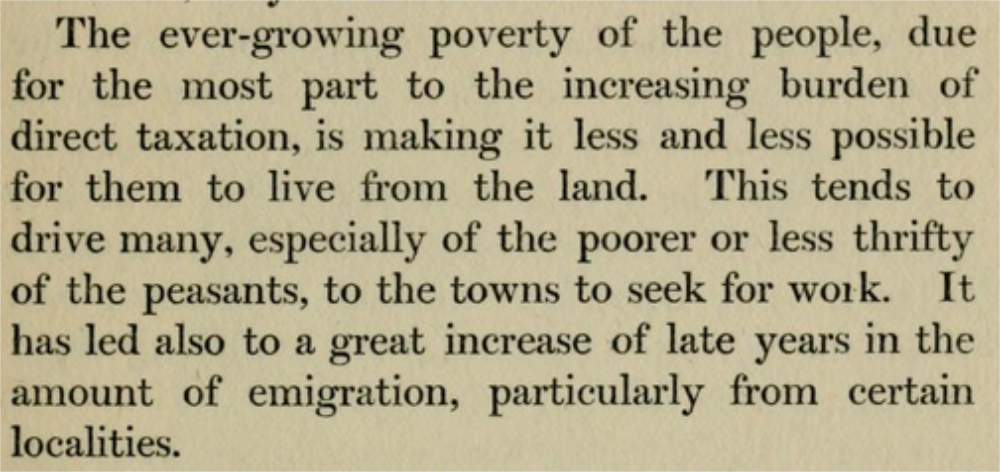
Peasant Life in The Holy Land by Rev. C.T. Wilson – 1906, p. 83 and p. 5. Archive.
For later years, pro-Palestinian voices point to A Survey of Palestine from 1945-46 that says illegal Arab immigration was insignificant. They leave out the part that says data on it prior to 1939 is unknown.

A Survey of Palestine Volume I- 1945-46, page 162. Archive.org (needs login).
(It was released in January of 1946 and data from then until ’48 is fuzzy.)
After World War I
With the Zionist movement that began in the late 1890s, Arab immigration increased due to the oasis that the Jews developed. After WWI, the British contributed in significant ways, though it’s hard to imagine all their efforts without Zionism. Seeking a better life has always been the number one factor behind migration so those who attempt to minimize it when it comes to Palestine are arguing against worldwide history.
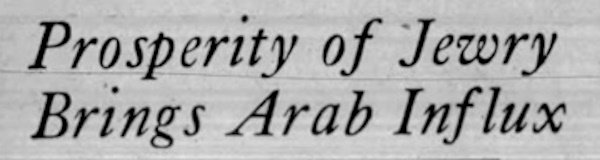
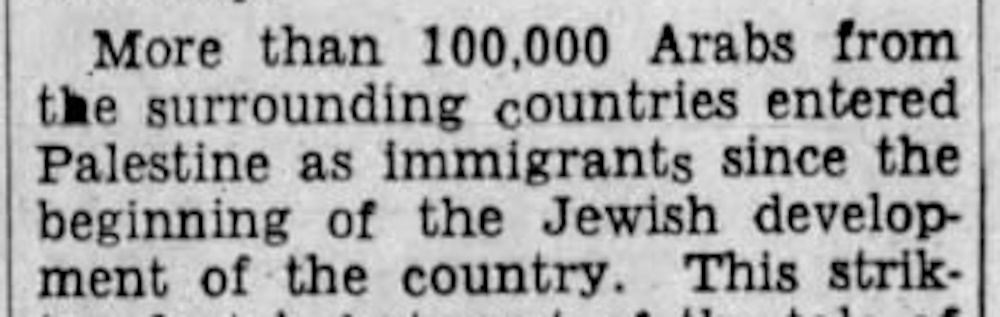
The Washington Herald – October 6, 1936. Full page.
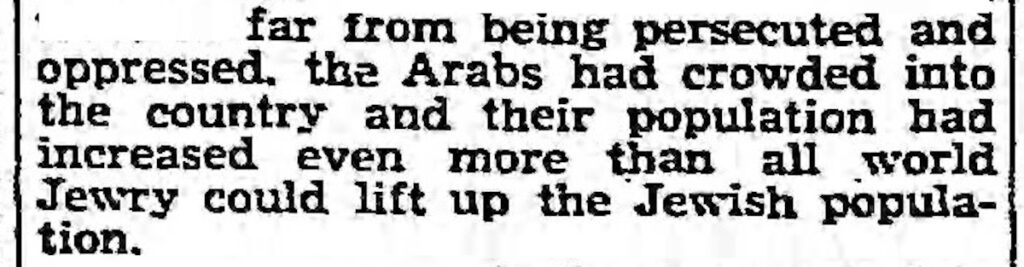
British MP Winston Churchill in the House of Commons.
The Manchester Guardian (UK) – May 24, 1939. Full page.

Peel, p. 128.

American President Franklin D. Roosevelt in memorandum to Secretary of State –
May 17, 1939. History.state.gov.

Nowhere To Lay Their Heads, p. 28. Full page, Canada’s Memorial University.
A 1945 essay by Victor Gollancz, a British socialist.

Concerning 1920 clashes in Lebanon. RealTimeHistory.net.
The British counted illegal Jewish immigrants, but not Arab illegals.
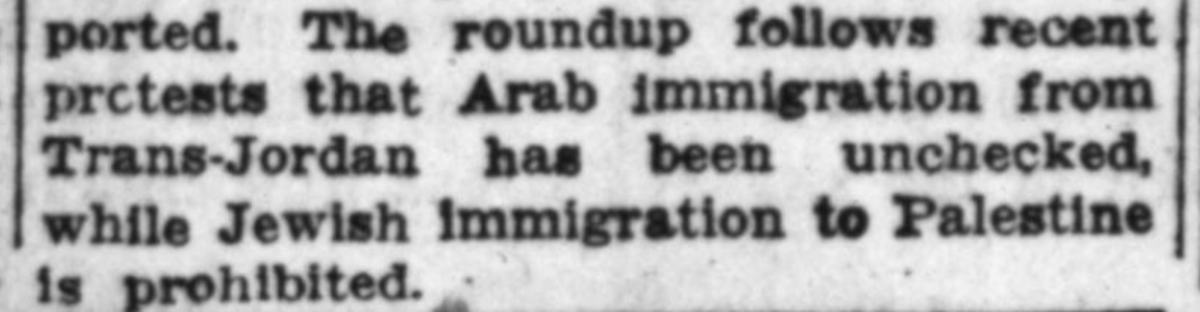
Chicago Daily Tribune – December 8, 1930. Full page.

A British MP in the House of Commons.
The Daily Telegraph (UK) – November 18, 1930. Full page.

Great Britain and Palestine 1915-1945 Information Papers No. 20, p. 64.
Refutation: Some say that illegal Arab immigrants from after WWI to 1929 were expelled. Only a small number were. The Hope Simpson Report of 1930 admitted on page 125: "Where the case is flagrant [emphasis added], recourse should certainly be had to expulsion. In cases of no special flagrancy..."

The Report continues: "Another serious feature of immigration is the number of persons who evade the frontier control and enter Palestine without formality of any kind."

The Hope Simpson Report had a number of flaws and was superseded by the more professional Palestine Royal Commission Report of 1937, aka the Peel Report. Quoting Hope Simpson over Peel is usually a sign of ignorance, bias or malintent.
Before Zionism, Palestine was a sparsely-populated and mostly barren land that was dotted with primitive villages. Organized life was found in about a dozen areas, like Jerusalem, Hebron, Nablus, etc.
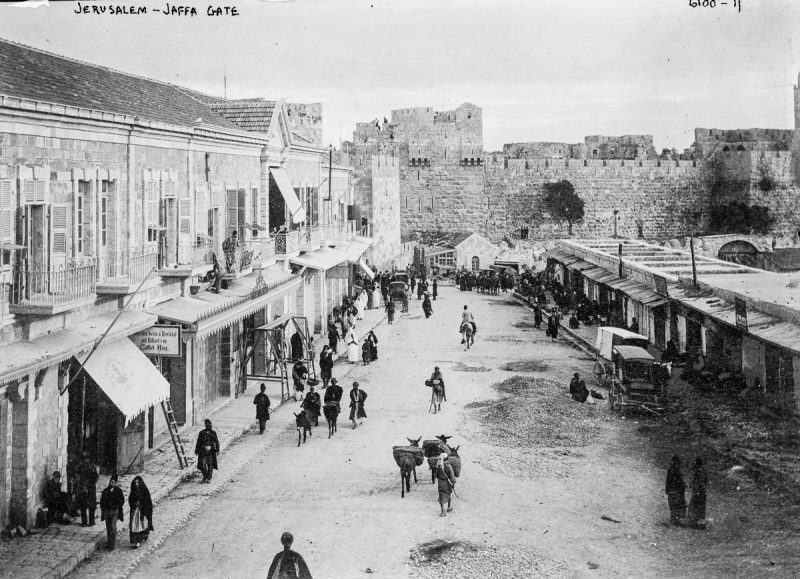
Jerusalem between 1900 and 1918. More images from VintageNews.com.
Jews were the plurality of the city in 1867 and the majority in 1910.
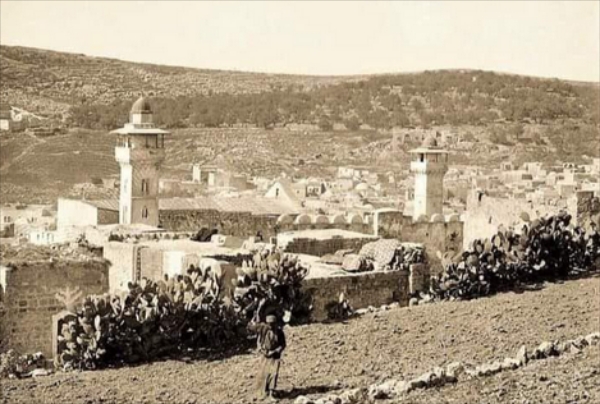
The Cave of the Patriarchs in Hebron – 1898. Link.
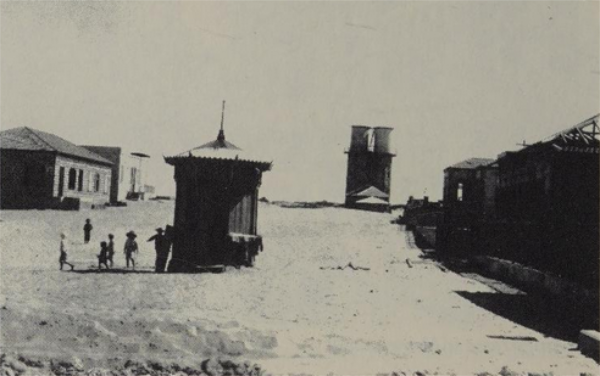
Tel Aviv in 1910.
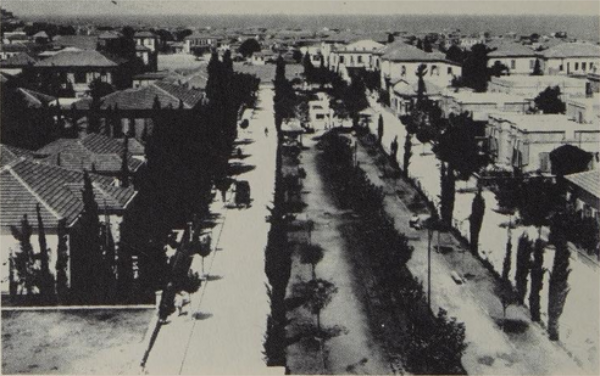
Tel Aviv in 1920.
Things were different in the villages where 70% of the Arab population lived.

Peel, p. 310.

Baldensperger, p. 2 and p. 139.
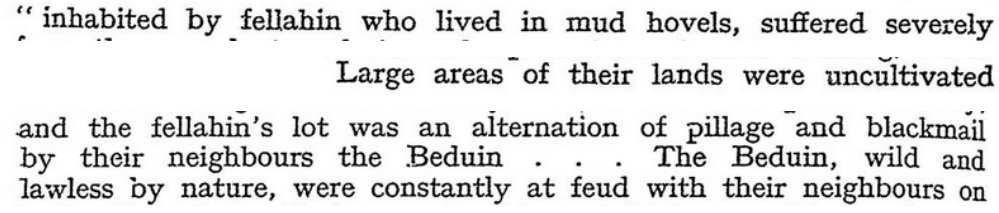
Post-WWI report on Beisan by Lewis French, Director of Pal. Development for the UK.
Peel, pp. 259-260.


A witness from 1913. Peel, pp. 233-4.
In the 1880s before the official Zionist movement began, Arabs flocked to this Jewish settlement because it meant a better life.

Turks, Arabs and Jewish Immigration… P. 40 (86), Oxford Archive.
Areas and people added to Palestine
North
Many Arabs with a long history in the land were referring to areas that were not part of historical Palestine. Until 1915, the Ottomans and Arabs only considered the Sanjak of Jerusalem to be the region of Palestine.
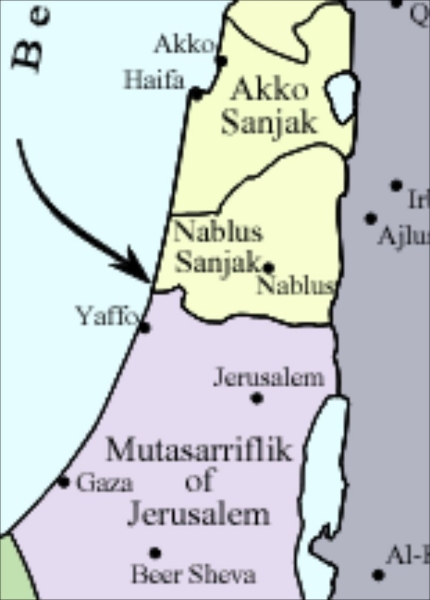
The Arab-Muslim view was roughly the same since the conquest of 640 CE.
The northern sanjaks were the region of Syria.

Tristram, p. 131.
The West Bank town of Jenin was Syrian territory in 1865.

Thomas Philipp‘s The Rise and Fall of Acre – 1990, p. 1. Full- Persée or pdf.
Acre was Syrian.
Philipp's work is also an example of historical revisionism that swept Western academia beginning in the 1990s. A lengthier version was published in 2002 and given a new title of "Acre: The Rise and Fall of a Palestinian City".

Syrians were a large part of the population and differentiated from others.
Stirring Times by James Finn – 1872. Page 200 on Archive.org.

A Survey of Palestine Volume II- 1945-46, p. 212. Archive.org (login).

The Times of London – April 12, 1837. Link.
The quake hit the Galilee- in the region of Syria.

Among Arabs and Jews: a personal experience 1936-90, p. 12. Archive.org.
By P.J. Vatikiotis, a Greek Gentile from Haifa.
South
The Negev Desert and vicinity were added to Palestine by 1922. The Bedouin tribes were counted as part of the new domain’s population even though they were nomads.

Peel, p. 44.

Robinson and Smith, p. 156.
A particular tribe’s grounds included Egypt and Gaza.
Within the division of all the tribes, the Bedouins were the most separate. From a letter in 1923 to Britain’s High Commissioner for Palestine: “We don’t meddle in politics, don’t attend rallies, and don’t send delegations. We are simple people who live in tents and deal with our own affairs only.” From the Chapter 3 paragraph on JStor about “Army of Shadows: Palestinian Collaboration with Zionism, 1917–1948” by Hillel Cohen in 2008.
More:
Many defended Israel against the Arab League invasion in ’48, and serve in the IDF.
Trans-Jordan/Eastern Palestine
The Balqaa District covered the eastern and western banks of the Jordan River and the people freely moved within it. The eastern is now part of Jordan.

Grossman, p. 44.
The addition of these areas explains the discrepancies in some of the reports on the population of Palestine between the late 1800s and after the Mandate of 1922.
More lives and longer lives due to Zionism
Zionist advancements in health care and the eradication of diseases like malaria lowered the infant mortality rate in Palestine and led to more people living longer- at rates far exceeding the rest of the Middle East.

A Survey of Palestine Vol. II – 1945-46, p. 707. Archive.

Ibid., p. 708.

The website of America’s CDC (Center for Disease Control and Prevention).
Use the Wayback Machine in case they ever try to revise history.
More:
A research paper.

Peel, p. 129.
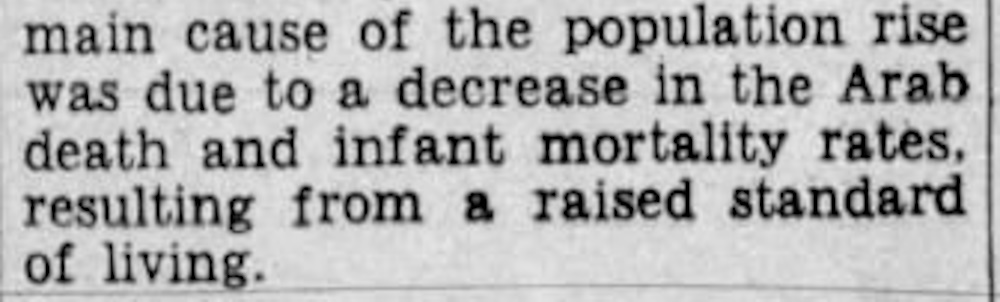
The Washington Herald – October 6, 1936. Full page.

Survey Volume II, p. 704.
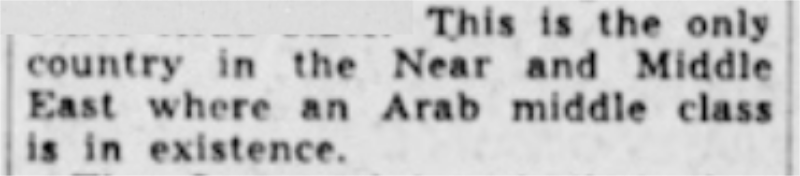
Robert Kennedy in the Boston Post – June 3, 1948. Full page.
(Like many others, he didn’t seem to realize that the Arab perspective he examined was an extremist one.)
Near the end of World War I, Americans via the Red Cross improved the welfare of Jerusalem (New York Times – April 21, 1918, full page).
Rebuttal: In the early years of the conflict, the extremist Mufti Haj Amin al-Husseini and his followers said that they didn't care for all the benefits of Zionism. Understandable, yet most Arabs felt differently.
Since we’re on the topic, just like Zionism improved life for the Arabs in Palestine, Jews assisted the early Muslims in Spain and North Africa.
The Times (London) – February 7, 1919. Full page.
Revolving populations
This is the world’s most battle-weary territory and conquests and wars meant large losses of life and migration.

Baldensperger, p. xvii.
Encyclopedia Americana 1922 Vol. 21, p. 200 (226 of file). Library of Congress.
Then there were diseases, notably malaria.

(“Country” often refers to a geographical area, not a state.)
Peel, p. 310.

Survey Volume II, p. 162.
Liverpool Mercury (UK) – September 19, 1865. Full page.
Concerning cholera. Wilson, p. 152.
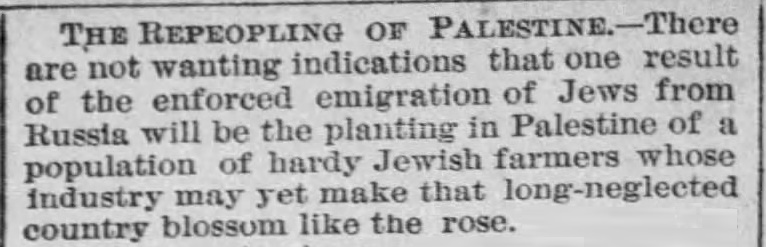
Baltimore Sun (USA) – June 19, 1891. Full page.
Tribes and clans
This section has two significant purposes.
- It adds to the evidence that the Muslims in Palestine were not a nation, why the world didn’t see them as needing or deserving a state after World War I. They were a wide array of tribes, clans and Sheikhdoms that were mini societies and not different stripes of one fabric.
- Many Arab leaders in the pre-1948 years supported compromise with the Jews and the largest group of them was from the rural areas who felt fighting would ruin their clan way of life. That was their nationalism. That was their identity.

Tristram, p. 288.
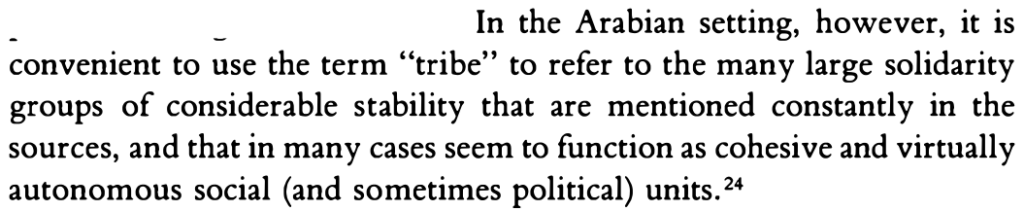
The Early Islamic Conquests by Fred Donner – 1981, p. 22. Full page, Almuslih.
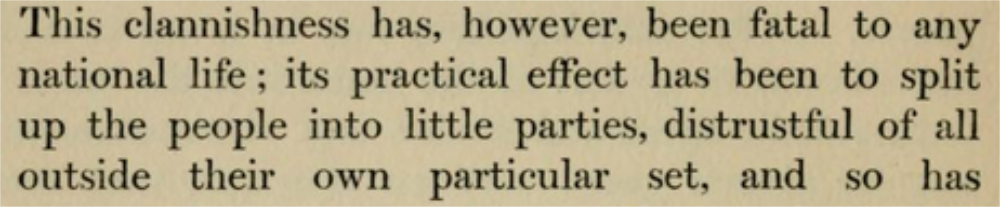
Wilson, p. 80.
Syria was the same, as was all of Arabia. (Some cities, like Damascus and Baghdad, were the closest to what became Arab states after World War I.)
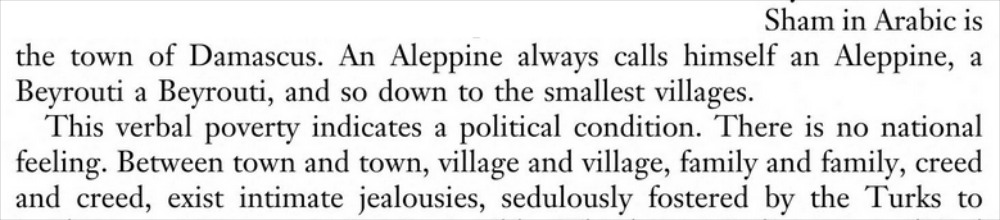
Lawrence of Arabia’s Secret Dispatches – 1915-1949, p. 27. Archive.org.
Back to Palestine-

Finn, p. 33.

Baldensperger, p. 15.
Tristram, p. 488.

Ibid., p. 568.
A reflection of the region with some areas that became part of Palestine.
Finn, p. 413.

Tristram., p. 451.
Wilson, p. 78.

Tristram., p. 155.

Ibid., p. 131.


Tristram., p. 486.
Tristram’s book mentions the following other tribes: Ghawarineh in the plain of Jericho (p. 192); Jehalin on the south-east of Hebron (192); Ta’amireh, a powerful tribe between Bethlehem and Engedi (229); S’hoor-el-Ghor around Shechem, a large tribe, but unorganized with several independent Sheiks (238); the small Rashayideh (238); Bedouin of the Kaabineh tribe, from the north of the Wady Moussa (343); Dullam (370); Agha (421); Suf (476); Ilhawarah around Nazareth (485); Beni Hassan (488); Adwan, noble but easy to war (488); Beni Obeid (487) and Beni Hamedi, ruffian (489).
For Baldensperger, see page 25 and search for more instances, though he specifies fewer names than Tristram. Stirring Times by James Finn in 1872 has details, notably page 242 on Archive.org. Also, page 156 and elsewhere in Biblical Researches in Palestine by Edward Robinson and E. Smith from 1838, on Archive.

Baldensperger, p. 156.

Tristram, p. 335.

Charles Clermont-Ganneau’s Archaeological Researches In Palestine During the Years 1873-74. Page 301 (334 online), Archive.org.
In the towns, some people also identified as Ottoman or Syrian. No one called himself a Palestinian, which is why the word does not appear in the books by Tristram, Baldensperger, Finn, Clermont-Ganneau, Wilson and others from that time.
Rebuttal: From the 1730s to 1775, a powerful local leader within the Ottoman Empire, Daher al-Umar al-Zaydani, controlled a coastal area from Jaffa to Sidon, along with part of the Galilee. The revisionists point to it as the first case of near-independence in Palestine. What they omit, aside from the Ottoman part: He was a clan leader who acted for the sake of his clan and allies. Also, nearly all of his domain was Syrian, he invited Christians and Jews to move in and there was much bloodshed during his rule.

Tristram, p. 517.
(Pro-Palestinian voices like to say that there were “400 years of peace” under Ottoman rule before World War I. The rest of the true story is on the next page.)
Later years
In the late 1800s, the Ottoman rulers imposed a centralized government that reduced some of the power of the Sheikhs and faction heads, but it didn’t fundamentally alter that way of life.

Wilson, p. 81.

Re: 1922. The Muslim Settlement, p. 84. Full digest or on ResearchGate.
1937 Peel, p. 44.
Sydney Morning Herald (Australia) – May 6, 1948. Full page.
(Concerning the leaders who fled during the Irregulars War.)

Azzam Pasha, Secretary-General of The Arab League.
British Foreign Office – Further Correspondence Respecting Middle East (General) Affairs – Part 3 January to December 1949.
Page 10 (14 of file). Full page, full doc (.pdf).
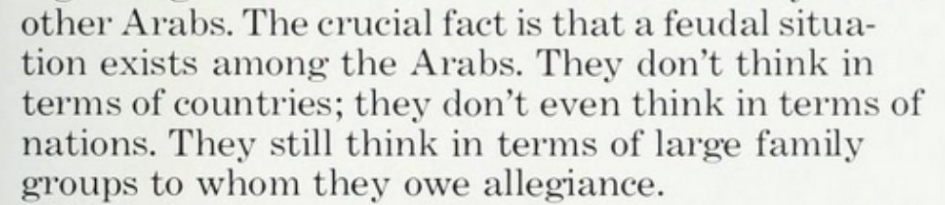
Dr. Egon Riss talks about troubled peace efforts after Israel’s independence.
In John Phillips’ A Will To Survive, page 79. Archive.org (needs login).
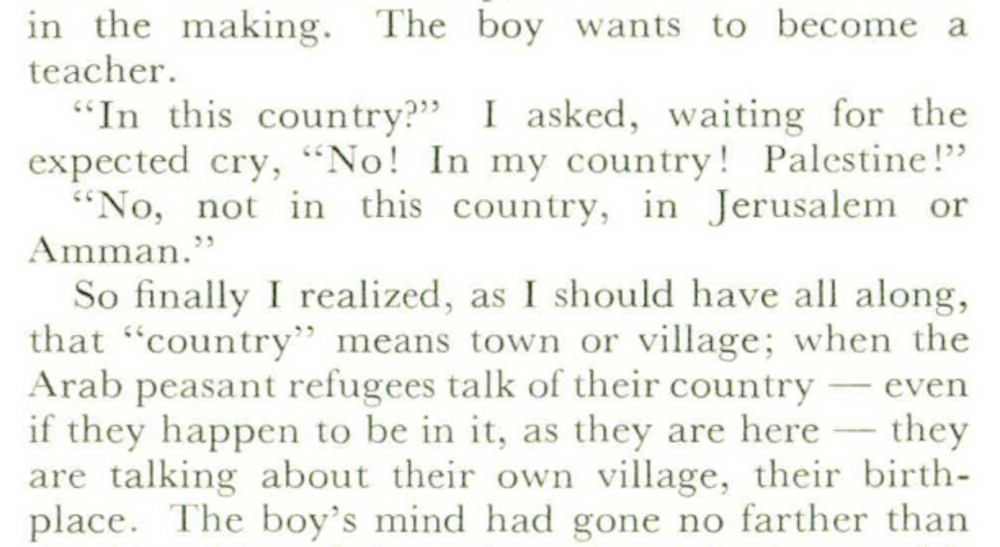
Atlantic magazine – October 1961, page 55.
More:
Khalaf, p. 18 (excerpt).
Middle East’s Tribal DNA article on the Middle East Forum.
Arab Society: Tribalism… website page.
Article from Jerusalem Center for Security and Foreign Affairs.
Tribes and clans are also the basis of “The Eight-State Solution“, or “Palestinian Emirates Plan“, that is (or was) an alternative to one state being run by the corrupt Palestinian Authority that is basically a few allied clans. (Here’s another moderate who opposed Abbas.)
Politics came from a sliver of the population
In the early decades of the conflict, the overwhelming majority of the Arab population were peasants, or fellahin.. Above them was the ruling class, or effendi. They were the wealthy Arabs- most in Syria and the area of Lebanon- and clan heads and religious leaders.



Peel, p. 337.

Turks, Arabs and Jewish Immigration Into Palestine: 1882-1914 – 1965.
Page 299 (353 of file), Oxford University Research Archive.
The peasant masses didn’t care about national affairs and they were 80% of the population, or 440,000 out of about 550,000 Muslims in 1920. (Or rather, what they did care about was the negative propaganda by their leaders.)

Syria and Pal. – Great Britain Foreign Office Historical Section – 1920, p. 57. Archive.
Out of the balance, there were moderates who wanted to negotiate some form of accommodation for the Jews. The problem was those who resorted to violence, and especially one man who made sure to influence everyone else (Chronology D).
Colonialism and settlers
One of the many topics about the conflict that gets little attention is the fact that Islam came to Palestine via conquest. The victorious soldiers from the Arabian Peninsula became settlers and many migrants followed them in the centuries afterwards.
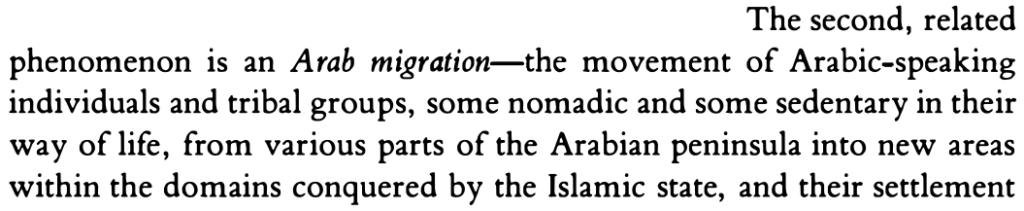
Donner, p. 7. Full page, Almuslih.

Islamic History: A New Interpretation by M.A. Shaban – 1971. P. 169, Archive.
More:
Article from The Begin-Sadat Center.
The territory gradually underwent Arabization and Islamization, with Muslims becoming the majority only in the 13th century. (It’s not even certain they were still the majority in the 1600s.) While no one can say what would have happened without Islam, the point is that much of the opposition to Zionism after WWI was driven by an extremist Islamic belief. (Chronology D.)
History has seen positive and malevolent aspects of colonialism. Only since the late 20th century has the term had an evil connotation due to a focus on the bad from Western liberals and, ironically and insincerely, jihadists.
Muhammed, Islam’s prophet, was born in Mecca and later migrated to Medina, both in today’s Western Saudi Arabia. The first iteration of Islam was designed to attract Jews, such as a call to face Jerusalem for prayers. However, nearly all Jews (and most other people at first) did not accept Muhammed as a prophet because, for one thing, the period of prophecy had ended a thousand years earlier. Those who did not convert were murdered. And so the Koran became laced with antisemitism.
Fueled by the new religion, Muhammed and his followers established the first Islamic State with a combination of battles and submissions. His successors took Syria-Palestine with a conquest that ended in 640 CE and seized nearly all of the Middle East and North Africa within the next 120 years. The early conquests rivaled only those by Alexander The Great and lasted longer.
The new Muslims saw expansion as a religious duty (Donner, p. 8 and Raymond Ibrahim article) and it had a significant similarity to European colonialism.

From the article “Were the Muslim Arab Conquerors of the Seventh-Century Middle East Colonialists?” By historian Robert G. Hoyland.

Shaban, p. 118,
There were many positive facets and times. And there were many on the dark side, especially in North Africa. The Berbers (aka Amazigh or Imazighen) lost their kingdoms. Over centuries, Arabs enslaved 10-18 million Africans and caused mass displacement. In 2026 countries still struggled with discrimination from the lighter-skinned Arabs to the darker-skinned indigenous people. Many of the atrocities and tragedies, such as the Darfur genocide that began in 2003, were a result of Arab “supremacy”.
More:
Article by historian Richard Inegbedion on Linkedin.
An article on ModernGhana.com.
Where Muslim imperialism differed was the way some conquered people helped shape early Islam. They had an easier time integrating into, and advancing in, the new society- via conversion. The lifting of discriminatory laws and practices were the main reasons behind conversion.
Note the differences between Zionism and the Arabian Muslim imperialists:
- Zionism wanted the return of their home, a small territory, and the Arabian Muslims wanted to conquer new lands. Really, the whole world.
- Zionism commenced with history, diplomacy and law, and turned to war in defense. Islam began with war, though some areas accepted the conquerors without a battle.
- Zionism didn’t alter the practices of the non-Jewish population. Conversion in the new Muslim lands was often a better option than not as non-Muslims were (and still are) viewed as less-than. This is one reason why extremism has been prevalent in Muslim societies.
- Israel has continued to fight- in defense, which includes diplomats and lobbyists in various countries. Islamic imperialism never ended. The Ottoman Empire in the 17th century nearly conquered Central Europe. In the early 20th century, Palestine’s Mufti Haj Amin al-Husseini wanted to rule a new caliphate. Saudi Arabia became a giant state mostly via conquest. Iran’s proxies in the Middle East- Hezbollah in Lebanon, the Houthis in Yemen and others in Iraq and elsewhere- are about covert conquest. Turkey under Recep Tayyip Erdoğan seeks a neo-Ottoman caliphate. The Muslim Brotherhood and similar ideologues talk about global control and worm their way into Western states; just ask Canada, France and Belgium. (More about the West misunderstanding the Middle East: The Tail Wags the Dog.)
Hatred is blind: Despite all the evidence that the jihadists are doing it, many people claim that Israel and the Jews are secretly manipulating world affairs.
Converts, the region of Palestine, before Islam
The Arabian Muslim conquest featured military campaigns, occupations, refugees and settlers. Some areas- it wasn’t ruled as one- accepted the newcomers without a fight because the rival powers at the time were degraded by decades of warfare. Through conversion, marriage and assimilation over time, the pre-Islamic groups and cultures in Palestine were largely erased, with small numbers of Christians, Jews and Samaritans remaining distinct.
The others were an array of peoples and tribes from various backgrounds. From the time of the Jewish exile in 136 CE until the 5th century, most of the small number of non-Christian Arab tribes in Palestine were Bedouins in the Negev Desert.
As for Arabs in general…
Peter Webb, a scholar specializing in Arabic literature and culture, wrote a well-reviewed book in 2006 titled Imagining the Arabs: Arab Identity and the Rise of Islam. He also wrote a follow-up article in 2016. Key parts:
It appears that Arabians in the first centuries CE were a scattered array of very diverse peoples, speaking somewhat related but distinct languages, and lacking a sense of political, communal or cultural unity.
There are no ancient indigenous myths of common origin tying Arabian populations together into an imagined ‘Arab family’…
9th-century writers in Mesopotamia (mostly Iraq) developed the idea of an Arab people as a response to the diminished role of Arabians within Islam and fading memories of its rise.
Only previews of a few chapters of the book are available online and the following is from Part 2, Chapter 4:
“The sum of their writings had the seminal result of creating the impression that pre-Islamic Arabia was inhabited by ‘Arabs’. Akin to the construction of communal identities across the world, the Muslim-era writings obscured the Arab community’s origins in early Islam and cast Arabness back into a deep, ancient pre-history, cobbling memories of tribes…“
From the publisher’s overview: “It is revealed that the time-honoured stereotypes which depict Arabs as ancient Arabian Bedouin are entirely misleading…Arab identity emerged and evolved as groups imagined new notions of community to suit the radically changing circumstances of life in the early Caliphate.”
Genetics
There have been numerous studies into the people of the Levant and the findings support history. With all the links, it’s best to read the originals and not news articles that reported the research, as they usually have a bias of some kind. (The abstracts or introductions, and the conclusions or discussion paragraphs, are written for lay people.) We avoid small or narrow studies.
According to historical records part, or perhaps the majority, of the Moslem Arabs in this country descended from local inhabitants, mainly Christians and Jews, who had converted after the Islamic conquest in the seventh century AD. These local inhabitants, in turn, were descendants of the core population that had lived in the area for several centuries, some even since prehistorical times. Thus, our findings are in good agreement with historical evidence…
The quote is from page 8 of a study in 2000 titled “High-resolution Y chromosome haplotypes of Israeli and Palestinian Arabs reveal geographic substructure and substantial overlap with haplotypes of Jews.” It references three history books, two of which have clips above (Donner and Shaban).
Based on everything on this page, “perhaps the majority” is too much. Less than half is more accurate.
- 2013 from the Author Summary: “We reconstructed the genetic structure of the Levantines and found that a pre-Islamic expansion Levant was more genetically similar to Europeans than to Middle Easterners.” European Christians were a big part of that.
- 2010 (search for “Bedouin”, first instance): “Bedouins, Jordanians, Palestinians and Saudi Arabians are located in close proximity to each other, which is consistent with a common origin in the Arabian Peninsula..”
- 2010 from the Discussion paragraph: “Besides Southern European groups, the closest genetic neighbors to most Jewish populations are the Palestinians, Bedouins, and Druze.”
- 2000: “Arabs are more closely related to Jews than they are to the Welsh, indicating a more recent common ancestry.” From the end of the Discussion’s first page. (Similar: Search for “Iraqi” in this 2023 study.)
Indigenous?
An official definition does not exist. The United Nations describes the term as “Indigenous Peoples are inheritors and practitioners of unique cultures and ways of relating to people and the environment. They have retained social, cultural, economic and political characteristics that are distinct from those of the dominant societies in which they live.“
This did not apply to the Arabs in 1948 Palestine and it didn’t somehow change decades later. Arabs as a whole are native to Arabia and the Syrian Desert. Only during the Ottoman era was the Levant considered an extension of Arabia.
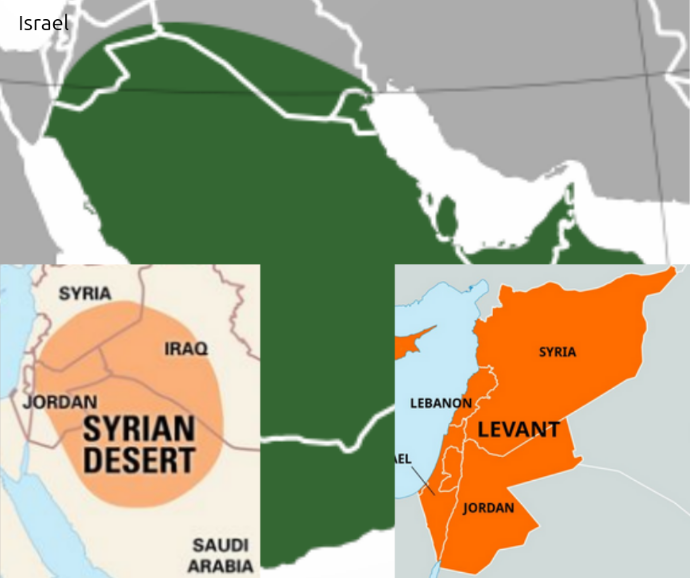
Map of the Arabian Peninsula, aka Arabia, by M.Bitton – Own work, CC BY-SA 3.0. (“Israel” added for clarity.) Full map.
Syrian Desert insert and Levant insert from Britannica.
That a small number of Arabs were able to trace their roots back centuries in the land is not part of the meaning of indigenous. Another aspect of the term is being the original inhabitants of an area and no Arab tribe was. Plus, the people changed drastically over the millennia. As for the Palestinians in 2026, they live in their own domains, not as minorities in a dominant society. Lacking sovereignty is not part of the word. Those who call them indigenous are either making a mistake or expressing bias.
What the Arab-Muslims actually claimed in 1920 for their rights to the land is covered in Chronology D. It wasn’t nationhood, indigenous or genetics.
Next: Page #3: The Zionists had global and historical support, and they didn’t steal land. (It doubles as Chronology C: Through 1914.)
Or Home for the top issues.